📚 Table of Contents
- Understanding FinTech Product Management in the Real World
- Why This Career Is Growing So Fast
- What a Remote FinTech Product Manager Actually Does
- 1. Shaping Product Direction
- 2. Coordinating Distributed Teams
- 3. Improving User Experience Continuously
- 4. Managing Compliance and Risk
- 5. Planning Product Roadmaps
- Skills That Actually Matter (Not Just on Paper)
- Understanding Systems, Not Just Tools
- Comfort With Financial Concepts
- Thinking in Data, Not Opinions
- Clear Remote Communication
- Problem Solving Under Constraints
- A Practical Roadmap to Get Started
- Learn Product Thinking First
- Add FinTech Context
- Build Something Small but Real
- Get Comfortable With Remote Tools
- Build a Portfolio That Shows Thought Process
- Opportunities You Can Explore Remotely
- The Reality: Challenges You Should Expect
- Misalignment Happens Easily
- Regulations Can Slow Things Down
- High Stakes Environment
- Constant Learning Curve
- What Actually Helps You Succeed
- A Simple Real-World Scenario
- The Future of Remote FinTech Product Management
- FAQs
- 1. Can I enter FinTech product management without a tech background?
- 2. Is remote FinTech product management a stable career choice?
- 3. What are the most important skills for this role?
- 4. Do certifications help in getting hired?
- 5. What tools should I learn first?
- Conclusion
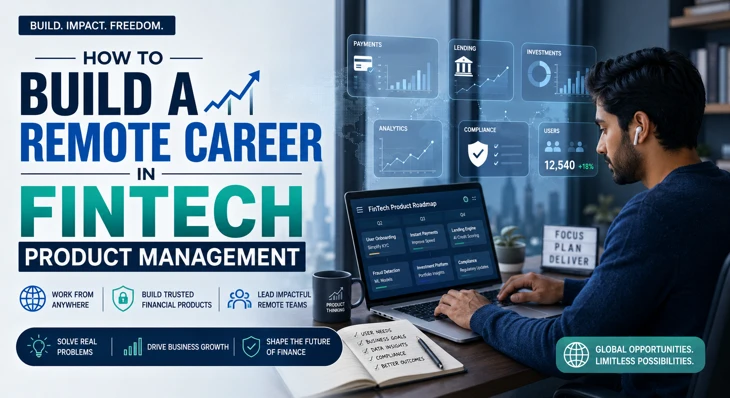
How to Build a Remote Career in FinTech Product Management
Breaking into FinTech product management today looks very different from what it did a few years ago. Remote work has completely reshaped how product teams operate, and financial technology companies are now hiring talent from across the world—not just from traditional tech hubs. If you’re aiming to build a remote career in FinTech product management, the path is absolutely achievable, but it needs clarity, consistency, and real-world understanding of both product thinking and financial systems. Let’s break it down in a practical, grounded way.Understanding FinTech Product Management in the Real World
At its core, FinTech product management is about building digital financial products that people trust and use daily—apps for payments, lending, investing, insurance, or even crypto-based platforms. But the real job goes far beyond “building apps.” A product manager in FinTech is constantly balancing three things:- Business goals (revenue, growth, retention)
- User needs (simplicity, trust, speed)
- Regulatory constraints (compliance, security, risk)
Why This Career Is Growing So Fast
FinTech isn’t just another tech niche anymore. It’s becoming the backbone of modern financial systems. A few real shifts are driving demand:- Cashless payments are now mainstream in many countries
- Banks are rapidly moving to digital-first ecosystems
- AI is being used for credit scoring, fraud detection, and personalization
- Startups are building global financial tools without physical branches
What a Remote FinTech Product Manager Actually Does
The title sounds glamorous, but the day-to-day work is very structured and detail-heavy.1. Shaping Product Direction
You decide what gets built and why. This means looking at user behavior, business metrics, and market gaps before anything enters development.2. Coordinating Distributed Teams
In a remote setup, your team might be spread across continents. Developers in one timezone, designers in another, stakeholders somewhere else entirely. Your job is to keep everyone aligned without face-to-face interaction.3. Improving User Experience Continuously
FinTech users expect speed and simplicity. Even a small friction in onboarding or payments can lead to drop-offs. So you constantly refine flows based on feedback and data.4. Managing Compliance and Risk
Unlike typical apps, FinTech products operate under strict legal frameworks. Every feature needs to be evaluated for security and regulatory impact.5. Planning Product Roadmaps
You’re always thinking ahead—what’s being built this month, next quarter, and next year.Skills That Actually Matter (Not Just on Paper)
Many people assume product management is just communication and planning. In FinTech, it goes deeper.Understanding Systems, Not Just Tools
You don’t need to code, but you should understand how APIs work, how payments flow, and how data moves between systems. This makes your decisions far more practical.Comfort With Financial Concepts
You should understand basic lending logic, banking workflows, and digital transactions. Even a rough understanding of terms like KYC, escrow, or credit scoring helps a lot.Thinking in Data, Not Opinions
Good product managers rarely say “I think.” They say “the data shows.” Tools like Mixpanel or Amplitude help validate decisions.Clear Remote Communication
This is where many people struggle. Remote FinTech teams rely heavily on written clarity—product docs, tickets, and updates need to be extremely clear and structured.Problem Solving Under Constraints
You will constantly deal with trade-offs: speed vs. security, UX vs. compliance, growth vs. risk.A Practical Roadmap to Get Started
Let’s make this very real and actionable.Learn Product Thinking First
Start with basics—how products are built, how user journeys work, and how teams ship features.Add FinTech Context
Then layer financial understanding on top. Learn how digital wallets, lending platforms, and payment gateways actually function behind the scenes.Build Something Small but Real
This is where most people skip—and shouldn’t. Try building or designing:- A simple budgeting app
- A peer-to-peer payment flow
- A basic loan approval UX concept
Get Comfortable With Remote Tools
Remote product managers live inside tools like:- Jira for execution tracking
- Notion for documentation
- Figma for design collaboration
- Slack or Teams for communication
Build a Portfolio That Shows Thought Process
Don’t just show “what you built.” Show how you thought through problems. That’s what hiring teams care about.Opportunities You Can Explore Remotely
The good news is that FinTech roles are no longer tied to location. Some common remote paths include:- Product Manager – Payments
- Product Manager – Lending Systems
- Growth-focused Product Manager
- Product Analyst in FinTech
- Strategy roles in digital banking startups
The Reality: Challenges You Should Expect
It’s not a “smooth” career path—and that’s okay.Misalignment Happens Easily
Without in-person discussions, small misunderstandings can grow into bigger delays.Regulations Can Slow Things Down
FinTech moves fast—but compliance sometimes doesn’t. You’ll often need patience.High Stakes Environment
Mistakes can have financial consequences. That pressure is part of the job.Constant Learning Curve
New tools, regulations, and technologies keep emerging. Stagnation is not an option.What Actually Helps You Succeed
Instead of generic advice, here’s what genuinely makes a difference:- Stay close to real user problems, not assumptions
- Document everything clearly (it saves you later)
- Learn to ask better questions instead of rushing for answers
- Focus on building trust inside your team
- Keep upgrading your understanding of FinTech trends
A Simple Real-World Scenario
Imagine a FinTech team working on a lending app where users currently wait 48 hours for approval. The product manager’s goal is to reduce that to under 10 minutes. Instead of jumping straight into solutions, they:- Study where delays happen in the flow
- Work with engineers to introduce automated credit scoring
- Simplify the application form with designers
- Ensure legal checks are still intact
- Test improvements using real user data