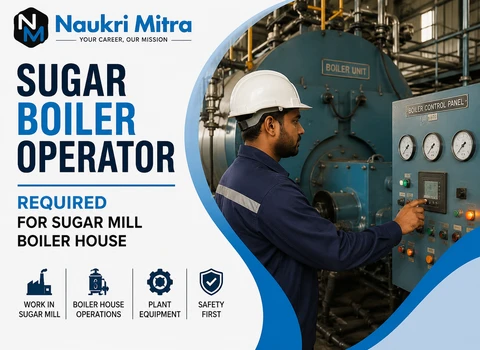
Keeping the Steam Flowing in a Sugar Mill
Walk into a sugar mill during crushing season, and the boiler house is usually the loudest, hottest corner of the whole plant. Someone has to keep that pressure steady, hour after hour — that's the Sugar Boiler Operator's job. This is a Full-time opening based in Lakhimpur Kheri, Uttar Pradesh, India. It's a region where sugarcane processing runs at real scale, so mills here need people who won't panic the moment a gauge starts climbing faster than it should.
Why Mills Can't Really Run Without This Role
Cane crushing. Juice boiling. Turbine operation. Nearly every stage in a sugar mill leans on steam somewhere. If the boiler operator gets distracted or misreads the pressure trend, output slows, and fuel is burned for nothing. That's really why mills take this position seriously — it's not a background job; it's closer to the plant's heartbeat.
A Shift, More or Less
Most shifts start with a walk-around — check the drum water level, fuel feed, whatever the last gauge readings were. After that, it's mostly about staying ahead of things. Adjusting bagasse or coal input. Watching how the pressure responds. Catching a small drift before it becomes an actual problem. There's also a fair bit of writing things down. Logs matter here — people genuinely don't skip them because maintenance and safety checks later depend on accurate data.
What Actually Falls on Your Shoulders
- Bringing boilers online and shutting them down, no shortcuts
- Holding steam pressure and temperature within a safe band
- Watching water level, feed pumps, blowdown valves
- Testing safety and pressure relief valves on schedule
- Coordinating with the power house and process teams when something changes
- Keeping shift logs accurate, since the next person relies on them
The Equipment You'll Actually Touch
Pressure gauges, water level indicators, feed pumps, economizers — these aren't occasional tools; they're the daily routine. A good number of mills now run semi-automated boiler setups, so you'll be reading digital control panels about as often as the old analog dials. Knowing both is genuinely useful. Relying on just one of them won't get you very far anymore.
What Gets Someone Hired for This
Technical know-how counts, sure. But discipline counts just as much — sticking to procedure even when a shift feels routine and nothing seems wrong. An ITI in Boiler Attendant or Steam Engineering is usually the starting point mills look for. A Diploma in Mechanical Engineering opens doors too, especially for someone eyeing a supervisory track down the line. A Boiler Attendant Certificate, wherever it applies locally, adds real weight to an application.
Honestly, what tends to matter more than any certificate is whether a person can read a steam table without hesitating, understand how fuel behaves differently under changing loads, and make sense of instrument readings on the spot.
What the Environment Is Actually Like
Hot. Loud. Long stretches on your feet, climbing platforms, wrestling with valves that don't always cooperate the first time. Physical stamina matters more than most people expect when walking in. Shifts run around the clock during crushing season — night duty and rotation aren't the exception here; they're just part of the deal.
Safety Isn't Something You Negotiate
This is one of those jobs where cutting a corner has real consequences, not theoretical ones. Heat-resistant gloves, safety goggles, ear protection, closed footwear — standard PPE, no debate. Lockout-tagout during maintenance isn't optional. Bypassing a safety valve, even for a minute, is the kind of call that ends badly more often than not. Odd sounds or vibrations get reported right away — not "at the end of shift."
The Rhythm of the Job, Challenges Included
Sugarcane supply is seasonal, and that shapes basically everything. Peak crushing season brings longer hours and constant pressure demands, no way around it. Off-season eases into maintenance and inspection work instead. Getting comfortable with that swing — rather than fighting it every year — is really what makes the job sustainable over time.
Where It Can Lead
Operators who stay with it usually move toward Senior Boiler Operator, then Shift In-Charge, and eventually Boiler House Supervisor if things go well. Staying current with newer boiler technology and fuel-efficiency practices tends to help that climb along.
Pay, and What Might Come Alongside It
The role pays ₹38,200 a month. Some employers add overtime, PF, ESI, bonus, uniforms, or transport on top of that — though none of it's guaranteed, and it's worth just asking whoever's doing the hiring directly.
If You're Getting Ready to Apply
Brush up on basic steam engineering concepts before walking into an interview. Know the common boiler faults cold — not just the names, but why they happen. Freshers especially benefit from hands-on experience through ITI training or an apprenticeship in a real working boiler house. Reading about it and standing next to a running boiler are two completely different kinds of learning.