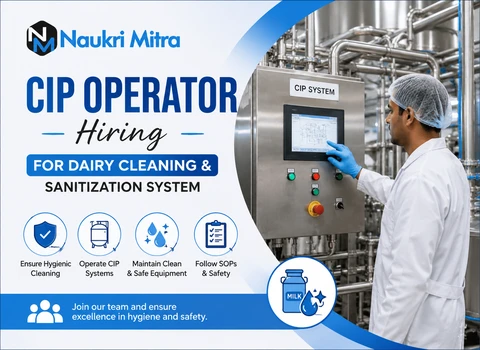
What Does a CIP Operator Actually Do?
Walk into any dairy plant, and you'll notice something most visitors never think about: the pipes, tanks, and pasteurizers have to be scrubbed clean after almost every single production run. That job falls to the CIP Operator. CIP stands for Clean-in-Place, a method in which cleaning solutions are automatically pumped through the equipment rather than workers dismantling the machinery by hand. The position advertised here — CIP Operator Hiring for Dairy Cleaning & Sanitization System, based in Sangli, Maharashtra — is a full-time role centered entirely on this cleaning process.
Why Milk Processing Can't Skip This Step
Milk turns bad fast. Leave a trace of residue inside a pipeline overnight, and bacteria will multiply before the next shift even starts. That's the risk dairy plants are trying to avoid. A poorly cleaned tank doesn't just create a hygiene problem — it can spoil an entire batch and cost the company real money. So plants keep dedicated staff whose only job is to make sure every surface that touches milk is properly sanitized, on schedule, every time.
A Shift From Start to Finish
Most days start with a walk around the CIP panel, checking that the previous cycle was logged correctly and that the tanks are ready to receive the cleaning solution. From there, the operator mixes caustic and acid solutions to the correct strength, sets the cycle on the control panel, and monitors the readings as the pre-rinse moves into the main wash and then the final rinse. It sounds repetitive on paper, but no two shifts run exactly the same — a blocked nozzle or a slow drain can throw off timing and needs to be sorted out on the spot.
Tasks You'll Handle Regularly
- Running CIP skids and automated cleaning panels
- Measuring and preparing caustic and acid cleaning solutions
- Watching temperature, flow rate and cycle duration on the panel
- Cleaning pasteurizers, storage tanks, pipelines and valves
- Filling out cleaning logs for quality checks
- Flagging leaks or panel faults to the maintenance crew
Where People in This Role End Up Working
This kind of job is found mostly in dairy processing units and milk chilling centers, as well as in some food and beverage plants that handle liquid products. Since this particular opening is a full-time position in Sangli, Maharashtra, the person hired will be stepping into a production facility where hygiene checks aren't occasional — they're part of the daily routine.
The Equipment on the Floor
The CIP skid itself is the centerpiece — a set of tanks, pumps, and valves that mix and circulate cleaning solution through the system. Around it you'll find dosing pumps for chemicals, flow meters, temperature probes, and a control panel that runs the whole sequence. A conductivity meter is used to check whether the chemical strength is correct before a cycle starts, and pressure gauges indicate whether the solution is actually circulating or if something downstream is blocked. None of this is exotic machinery, but knowing how each piece connects to the next is what separates a confident operator from someone still learning the ropes.
Skills That Actually Matter Here
Chemical handling knowledge helps, and so does a basic mechanical sense — understanding how valves, pumps and pipelines fit together. But the operators who last in this line of work are usually the ones who notice small things: a slightly slower drain, a panel reading that's a touch off, a smell that shouldn't be there. That kind of attention doesn't come from a textbook. It comes from paying attention shift after shift and asking questions when something looks unusual.
Who Gets Hired for This Kind of Work
Freshers are considered, particularly if they've completed an ITI in a mechanical or food-processing trade or hold a diploma in the same field. Some plants prefer candidates who've already worked around industrial cleaning systems, but plenty are willing to train someone from scratch as long as they show up ready to learn the specific CIP setup used at that facility.
On Your Feet, On the Move
Expect to be standing and walking for most of the shift, moving between the CIP panel and the tanks it's cleaning. The area around cleaning stations tends to stay damp, sometimes warm from steam or hot rinse water. In a full-time role, shift work is likely, since cleaning cycles must align with milk collection and processing times rather than a fixed nine-to-five schedule.
Handling Chemicals Without Cutting Corners
Caustic soda and acid-based cleaning agents are not something to get casual about. Gloves, safety goggles, an apron, and gumboots are the basics most plants expect operators to wear near dosing stations. Before touching any equipment for maintenance, the line has to be locked out properly — skipping that step, even once, is how accidents happen. It's a habit worth building in the first week rather than learning the hard way later.
What Trips Up New Operators
The cleaning sequence has several stages, and remembering the order, along with the correct chemical concentration for each, takes a bit of repetition before it sticks. Dosing errors are another common mistake — too little chemical and the cycle doesn't clean properly; too much and it wastes solution or damages seals over time. Staying sharp through repetitive cycles, shift after shift, is honestly the hardest part for most beginners, and it only gets easier with time on the job.
Where This Can Lead
Operators who stick with it and build a solid track record often move into senior operator or shift-in-charge positions, eventually taking charge of troubleshooting and training newer staff on the CIP system. Because sanitization is non-negotiable in every dairy plant, the demand for people who genuinely understand this process tends to remain steady, which gives long-term operators a reasonable amount of job security within the industry.
Pay and What Else to Expect
This full-time position in Sangli, Maharashtra, India pays ₹29,200 a month. Beyond the base salary, some employers offer overtime pay, PF and ESI coverage, an annual bonus, uniforms, or transport and canteen facilities — though these differ from one company to another, so it's worth confirming the specifics directly with the employer before accepting an offer.