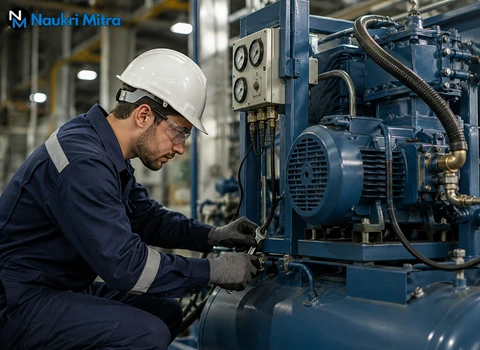
Understanding Life as a Compressor Technician in Industrial Maintenance
Industrial plants across India run on machines that never really stop, and one of the most important pieces of equipment keeping factories alive is the air or gas compressor. A Compressor Technician Required for Industrial Plant Maintenance is the person responsible for keeping these machines running safely and efficiently. This is a hands-on, technical role suited for people who enjoy working with mechanical systems, solving practical problems, and being part of a plant's day-to-day operations. This full-time opening is based in Vadodara, Gujarat, India, and offers a monthly salary of ₹34,000.
Why Factories and Plants Need This Role
Compressors power pneumatic tools, control systems, packaging lines, and countless production processes. If a compressor fails without warning, an entire production line can come to a halt. That is why industrial units, chemical plants, engineering workshops, and manufacturing facilities recruit dedicated maintenance technicians rather than relying on general workers. Companies want someone who understands compressor behavior well enough to spot early warning signs before a small issue becomes an expensive breakdown.
Where This Kind of Work Happens
People in this profession usually work in industrial plants, process manufacturing units, engineering workshops, and utility sections of larger factories. Gujarat, and Vadodara in particular, has a strong base of chemical, engineering, and manufacturing industries, which makes this kind of maintenance work fairly common in the region.
What a Typical Working Day Looks Like
The daily routine of a compressor technician revolves around inspection, monitoring, and repair work. A regular day may include:
- Checking compressor pressure, temperature, and oil levels
- Listening for unusual vibration or noise during operation
- Cleaning or replacing air filters and separators
- Attending breakdown calls and diagnosing the fault quickly
- Recording maintenance readings in daily logs
- Coordinating with the shift supervisor about pending repairs
No two days are identical, since maintenance work depends heavily on which machine needs attention.
Core Responsibilities on the Job
Beyond daily checks, a technician is expected to carry out preventive maintenance schedules, replace worn-out parts such as belts, valves, gaskets, and bearings, and support overhauls during planned shutdowns. Understanding compressor types, such as reciprocating and screw compressors, helps diagnose problems more accurately, since each design has distinct common failure points.
Tools, Instruments, and Equipment Commonly Used
This role involves working with hand tools such as spanners, wrenches, and screwdrivers, along with pressure gauges, multimeters, vibration meters, and lubrication equipment. Technicians also use torque wrenches for precision tightening and basic measuring instruments to check clearances and wear.
Skills That Make a Technician Successful
Good technicians combine formal training with practical understanding. Employers often prefer candidates who have completed an ITI in a relevant mechanical or electrical trade, or a Diploma in Mechanical Engineering. Reading engineering drawings, understanding pressure systems, and using precision measuring tools are valuable skills. Equally important are workplace habits like discipline, patience during troubleshooting, and clear communication with the maintenance team.
Physical Demands and Working Conditions
The work involves standing for long periods, climbing near equipment, and occasionally lifting moderately heavy parts. Plant environments can be noisy and warm near compressor rooms, so physical stamina matters. Depending on the plant's operating schedule, shift work may be required to ensure machines are monitored around the clock.
Safety Practices and Protective Equipment
Safety is central to this profession because compressors operate under high pressure. Technicians are trained to follow lock-out tag-out procedures before servicing, use ear protection in high-noise areas, and wear safety shoes, gloves, and helmets as standard PPE. Carefully following safety checklists significantly reduces the risk of accidents.
Common Challenges in This Line of Work
Sudden breakdowns during peak production hours, working in confined compressor rooms, and diagnosing intermittent faults are some real challenges technicians face. Staying calm under pressure and methodically checking each component usually leads to faster solutions.
Growing Within the Profession
With experience, a compressor technician can move into senior maintenance roles, take charge of preventive maintenance planning, or specialize in handling larger industrial compressor systems. Consistent learning about newer compressor technologies adds long-term value to a technician's career.
Salary and Common Workplace Benefits
This position offers a monthly salary of ₹34,000 for a full-time role in Vadodara, Gujarat, India. Depending on the employer, additional benefits may include overtime pay, PF, ESI, bonuses, uniforms, transport facilities, or canteen access, though these vary by company and are not guaranteed.