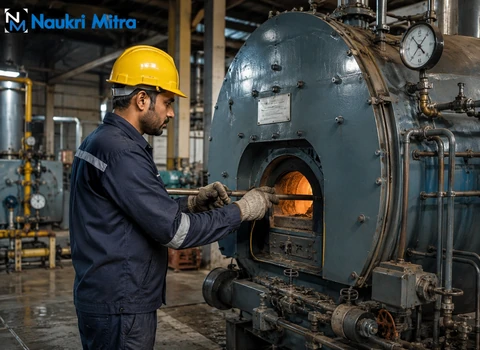
What a Steam Boiler Operator Actually Does All Day
Steam doesn't just appear. Someone has to make sure the boiler feeding it stays within safe limits, hour after hour, shift after shift. That's the job of a Boiler Operator, and right now there's an opening for one in Ankleshwar, Gujarat, India. It's a Full-time position, paying ₹32,000 a month. If you've never thought about what happens behind the scenes to keep a factory's heat and pressure systems running, this is a good place to start.
Put simply, a boiler operator keeps an industrial boiler running the way it's supposed to — not too hot, not under-pressured, not leaking water it shouldn't be losing. Sounds straightforward. In practice, it takes attention, some technical know-how, and the ability to notice when something's slightly off before it becomes a real problem.
Where This Job Actually Exists
Boilers show up wherever a process needs steam or consistent heat. Chemical manufacturing units use them constantly. So do textile mills, dyeing houses, pharmaceutical plants, and food processing facilities. Ankleshwar has a fairly dense cluster of chemical and process industries, which is part of why demand for trained boiler operators in the area tends to stay steady rather than seasonal.
Without someone actively monitoring the boiler, a plant risks fuel waste at best and equipment damage — or worse, safety incidents — at worst. That's really the whole reason this role exists.
A Shift on the Job
Before startup, the operator walks the unit. Water levels get checked. So does fuel supply, the pressure gauges, and the safety valves. Nothing gets fired up until these basics are confirmed.
Once the boiler is running, the work becomes more about watching than doing. Temperature and pressure readings need constant attention. Fuel-air ratios are adjusted to maintain efficient combustion. Everything observed gets written down in a logbook, partly for operational tracking and partly because it's a statutory requirement for boiler operations in India.
A typical shift also includes:
- Following the correct startup and shutdown sequence, every time, without shortcuts
- Blowing down the boiler periodically to keep water chemistry within range
- Catching odd sounds or small leaks before they turn into bigger failures
- Working alongside maintenance staff when servicing is due
- Keeping fuel stock — coal, biomass, or furnace oil depending on the setup — properly stored and available
The Equipment You'll Be Working Around
Pressure gauges and water level indicators are the operator's constant companions. Safety relief valves, feed water pumps, and the combustion control panel all need to be understood, not just glanced at. Depending on which fuel a particular plant uses — coal, oil, or biomass — the setup can look a bit different, though the underlying principles stay the same.
Operators are also expected to know their way around steam traps, economizers, and soot blowers. None of this needs to be intimidating. Most of it is learned on the job, though having some background in it beforehand definitely helps.
What Employers Are Actually Looking For
A valid Boiler Operation Engineer certificate is usually the strongest credential to have. Short of that, an ITI qualification in a related trade — fitter, mechanic, boiler attendant — covers most employers' base requirements. Practical exposure to steam systems, even informal experience, often counts for as much as the paper qualification itself.
Beyond the technical side, what actually separates a good operator from an average one is temperament. Staying alert during a quiet stretch of a night shift, keeping calm when a reading looks unusual, following procedure even when nobody's watching — these matter more than they get credit for.
Physical Reality of the Role
This isn't a desk job. Expect to be on your feet for long stretches, working near equipment that runs hot, and occasionally handling fuel materials that need lifting or moving. Round-the-clock monitoring means shift work is common, including rotating night shifts in most plants.
The environment is typically warm and noisy near the boiler house. Combine that with Gujarat's own summer heat, and it's worth knowing upfront that comfort isn't really part of the job description.
Safety Isn't Optional Here
Boilers run under real pressure, and that changes how seriously safety gets treated on the floor. Lockout procedures are followed strictly. Safety valves get checked on schedule, not just when something feels wrong. Abnormal readings are addressed immediately rather than monitored "for a while longer."
PPE is standard — heat-resistant gloves, safety goggles, a helmet, and proper industrial footwear. Most employers provide these, but wearing them consistently is on the operator.
What Trips Up New Operators
Reading pressure fluctuations correctly takes time to get comfortable with. It's common for newer operators to either overreact to a normal variation or underreact to something that actually needs attention — both come from inexperience rather than carelessness. Diagnosing a minor issue before it snowballs is a skill that mostly comes with repetition, not a manual.
The heat itself, especially during Gujarat's summer months, is its own kind of adjustment. Operators who stay in this field tend to develop patience early and a habit of double-checking readings rather than trusting a single glance.
Where the Role Can Lead
Experience opens doors here. A boiler operator who's put in the years can move up to senior boiler attendant, shift in-charge, or eventually boiler house supervisor. Gaining additional knowledge about energy efficiency and newer steam system technology tends to speed that progression along.
Pay and What Might Come With It
This particular role in Ankleshwar, Gujarat pays ₹32,000 per month on a Full-time basis. Beyond the base salary, some employers offer extras like overtime pay, PF, ESI coverage, bonuses, uniforms, transport, or canteen access — though none of this is guaranteed and it varies quite a bit from one company to the next.
For anyone drawn to hands-on mechanical work with a real technical learning curve, boiler operation is a solid entry point into India's industrial and manufacturing workforce, with room to grow if you stick with it.