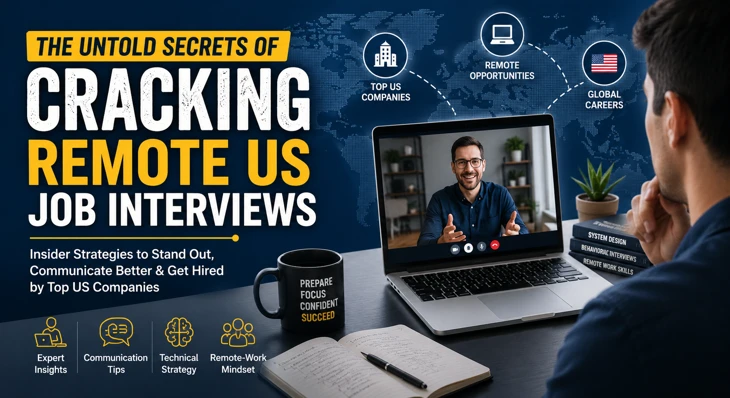
The Untold Secrets of Cracking Remote US Job Interviews
Remote work has quietly changed the way people build careers. A few years ago, landing a role in a US-based company from another country felt rare. Today, it is normal—but also far more competitive than most candidates expect. The real challenge is no longer access to opportunities; it is standing out in a process where you may never meet your interviewer in person, yet still need to convince them you are the right fit.
Cracking remote US job interviews is not just about technical ability. Many candidates with strong skills still get filtered out. What makes the difference is how you communicate your thinking, how you behave under pressure, and how naturally you fit into a distributed team environment.
This guide takes a grounded look at what actually happens in these interviews and how candidates can prepare in a way that feels practical, not overwhelming or scripted.
What Remote US Hiring Really Feels Like From the Inside
Most people imagine the process as a simple funnel: apply, interview, get selected. In reality, it feels more like a series of small trust-building steps.
Recruiters and hiring managers are trying to answer a simple question at every stage:
Can this person work independently, communicate clearly, and stay reliable without constant supervision?
A typical process might include a recruiter call, a short assignment, one or two technical discussions, and a behavioral conversation toward the end. But each stage is less about checking boxes and more about observing how you think when no one is guiding you.
One candidate might solve problems quickly but struggle to explain their approach. Another might take slightly longer but communicate their reasoning in a calm, structured way. In remote hiring, the second candidate often feels safer to hire.
That subtle difference is where most decisions are made.
Why These Interviews Feel More Competitive Than Ever
If remote interviews feel tougher now, it is because the talent pool has expanded globally. A single job posting can attract candidates from multiple continents within hours.
This changes expectations in a quiet but important way. Companies stop focusing only on raw skill level and start prioritizing how easily someone can integrate into a distributed team.
They tend to notice things like:
- Whether your answers are clear or scattered
- Whether you explain your thinking or jump straight to conclusions
- Whether you sound like someone who can work independently
Interestingly, many candidates underestimate this shift. They prepare heavily for technical questions but don’t spend enough time practicing explaining their thoughts out loud. That gap alone can decide outcomes.
Building a Strong Base Before You Even Apply
There is a quiet advantage that strong candidates use long before the interview begins: they understand the company properly.
Not just what the company does, but how it thinks.
Instead of only scanning the homepage, it helps to look at their product updates, engineering blogs, or even small changes in how they communicate publicly. These small details often reveal how decisions are made inside the company.
When you reflect that understanding in your answers, your responses feel more natural and less rehearsed.
Communication Is the Real Differentiator
In remote US job interviews, communication is not an extra skill—it is part of the job itself.
Many candidates assume they need perfect English or a polished accent. That is not true. What matters far more is clarity.
Clear candidates usually share a few habits without realizing it. They pause before answering instead of rushing. They structure their thoughts in small, logical steps. And they avoid over-explaining when a simple answer works better.
A helpful way to think about it is this: the interviewer should never have to guess what you mean.
One technique that helps many candidates is the STAR method, but it should not feel mechanical. When used naturally, it simply helps you explain real situations without losing direction.
The best answers feel like conversations, not rehearsed speeches.
Why Your Resume Needs to Feel “Remote-Ready”
A resume for remote US roles works differently than a traditional one. It is not just about listing experience; it is about signaling that you are comfortable working without physical supervision.
Hiring teams usually notice whether you have worked with tools like Slack, Zoom, Jira, or GitHub. But more importantly, they look for signs of ownership—whether you have handled tasks independently or relied heavily on constant direction.
Even if you have not worked remotely before, you can still shape your resume to reflect independence by highlighting project ownership and cross-team collaboration.
Most recruiters spend only a few seconds scanning each profile, so clarity matters more than decoration or lengthy descriptions.
Technical Interviews: What They Are Really Testing
Technical rounds often feel intimidating, but they are not designed to trick you. They are designed to observe how you approach problems when there is no fixed path.
A common mistake is focusing only on getting the correct answer quickly. In reality, interviewers care just as much about how you get there.
They want to see whether you break problems into smaller parts, question assumptions, and explore more than one approach rather than rushing.
One thing that consistently helps strong candidates stand out is talking through their thinking. Even if the solution is not perfect, a clear thought process builds confidence in the interviewer’s mind.
Silence, on the other hand, often creates uncertainty—even when the final answer is correct.
Practicing under time limits also helps because remote interviews usually come with pressure. The more familiar you are with that pressure, the less it affects your performance.
The Part Most Candidates Underestimate: Behavioral Rounds
Behavioral interviews often decide final outcomes, yet many candidates prepare for them last—or not at all.
These conversations are not about perfect stories. They are about understanding how you react in real situations.
Questions usually revolve around teamwork, challenges, deadlines, and disagreements. But the interviewer is not just listening to what happened; they are listening to how you describe it.
Do you take responsibility? Do you explain situations clearly? Do you reflect on outcomes honestly?
Strong answers are simple. They don’t try to sound impressive. They sound real, structured, and thoughtful.
A common mistake is overloading answers with unnecessary detail. The better approach is to keep the story focused: what happened, what you did, and what changed because of it.
Time Zones: A Challenge That Is Easier Than It Seems
For candidates outside the US, time zones often feel like a major obstacle. In reality, most companies are already used to distributed teams.
What they care about is predictability.
They want to know when you will be available, how you handle overlap hours, and whether you can stay responsive when needed.
Candidates who approach this topic with clarity and flexibility usually put interviewers at ease quickly. It is less about matching US hours perfectly and more about being dependable within agreed working windows.
A Simple Preparation Routine That Actually Works
Most candidates overcomplicate preparation. The people who perform well usually follow a very simple routine before interviews.
They ensure their setup works properly. They revisit key projects they have worked on. They mentally rehearse explaining their experience without memorizing lines. And they make sure they are in a calm, distraction-free environment.
That is often enough.
Confidence in remote interviews does not come from over-preparation. It comes from familiarity.
A Small Reality That Changes Everything
Two candidates can have similar technical skills but very different outcomes.
One might be fast but difficult to follow. The other might be slightly slower but easy to understand and comfortable to talk to.
In remote hiring, the second candidate is often preferred because teams are not just hiring skills—they are hiring someone they will communicate with daily across screens and time zones.
That sense of ease plays a bigger role than most people realize.
Mistakes That Quietly Cost Opportunities
A few patterns show up repeatedly among rejected candidates:
Speaking too quickly without structure. Avoiding clarification questions. Trying to memorize answers instead of understanding concepts. Ignoring behavioral preparation. Or simply not checking technical setup before the call.
None of these is a major flaw on its own, but together they can weaken an otherwise strong profile.
Standing Out in a Global Talent Pool
In a competitive remote market, visibility matters more than people think.
A strong LinkedIn profile, meaningful project work, and a visible portfolio can sometimes get attention even before the interview stage.
But beyond visibility, what truly stands out is ownership. Candidates who naturally show that they improve systems, not just execute tasks, tend to leave a stronger impression.
Remote companies want people who can think independently and collaborate smoothly without constant supervision.
FAQs
What matters most in remote US job interviews?
Clear communication and structured thinking often matter just as much as technical ability.
Do US companies really hire global remote talent?
Yes, many companies actively hire internationally, especially in technology and creative roles.
How can I improve communication for interviews?
Practice speaking your thoughts out loud in a structured way instead of memorizing answers.
Common tools include Slack, Zoom, GitHub, Jira, and Notion.
How should I handle time zone differences?
Be transparent about availability and show willingness to overlap during key working hours.
Are behavioral interviews important?
Yes, they are key to evaluating teamwork, communication style, and adaptability.
Conclusion
Remote US job interviews are not about saying the perfect thing. They are about thinking clearly, communicating naturally, and showing that you can work well in a distributed environment.
Candidates who succeed are not always the most technically advanced. They are the ones who explain themselves clearly, stay calm under pressure, and make collaboration feel easy.
With steady practice and a focus on real communication rather than memorized answers, remote opportunities become far more accessible than they initially seem.