Remote Nursing Support: How to Work With International Hospitals From Anywhere
Introduction: When Nursing Starts Moving Beyond Hospital Walls
A few years ago, most people would have found it hard to imagine a nurse working for an international hospital without ever stepping inside it. Today, that idea is becoming normal.
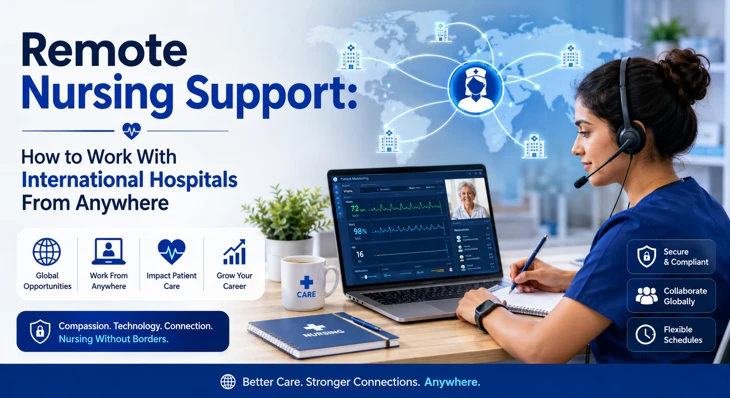
Remote nursing support is quietly reshaping global healthcare. It allows trained nurses to contribute to patient care, hospital coordination, and medical monitoring from their own locations—sometimes even from small towns far from major cities.
What’s driving this change is not just technology, but necessity. Hospitals are busier, patients need continuous care, and healthcare systems are under pressure. At the same time, digital tools have enabled skilled professionals to support care teams without being physically present.
For many nurses, this has opened a different kind of career path—one that offers flexibility, international exposure, and a chance to stay in the profession without the physical exhaustion of traditional shifts.
This article takes a grounded look at how remote nursing support works in practice, what international hospitals expect, and what this kind of work feels like day to day.
Understanding Remote Nursing Support in a Practical Way
Remote nursing support simply means providing nursing care and assistance through digital systems rather than working at the bedside in a hospital ward.
It doesn’t replace traditional nursing. It extends it.
A nurse working remotely still helps with patient monitoring, communication with doctors, follow-ups, and care coordination. The difference is that everything happens through secure platforms, video calls, and electronic health systems rather than physical presence.
In many international hospitals, remote nurses act as an extra layer of support—especially during night hours, peak patient loads, or when patients are being managed across different countries.
What the Work Usually Involves
Instead of a rigid checklist, the work often flows around patient needs and hospital priorities. A typical day may include things like:
- Checking in on patients through telehealth systems
- Reviewing updated medical records and reports
- Supporting doctors during virtual consultations
- Tracking long-term conditions using digital health data
- Helping patients after discharge through follow-up calls
- Assisting in triage decisions when cases come in online
What stands out most in this role is responsibility without physical presence. You are still part of critical decisions, just from a different environment.
Why International Hospitals Are Turning Toward Remote Nursing Support
Hospitals across countries such as the United States, the United Kingdom, Canada, and Australia are facing similar challenges—more patients, limited staff, and rising healthcare demands.
Remote nursing support has become a practical solution.
Instead of relying solely on on-site teams, hospitals now build hybrid systems in which remote nurses help fill coverage gaps, especially for continuous monitoring and patient communication.
There’s also another factor: telemedicine is no longer experimental. It is now part of mainstream healthcare delivery. Once that shift happened, remote nursing naturally became more relevant.
Skills That Actually Matter in Remote Nursing Roles
What surprises many nurses moving into remote roles is that clinical knowledge alone is not enough. The work blends healthcare with communication and digital confidence.
A strong clinical foundation still matters. You need to understand patient conditions, interpret symptoms, and respond quickly when something doesn’t look right.
But beyond that, communication becomes central. You are often explaining medical situations to patients who are not in front of you, which requires clarity and patience.
Then there’s the digital side. Most international hospitals use electronic health records and telehealth platforms, so being comfortable with these systems makes the transition much smoother.
Soft skills quietly carry a lot of weight here, too. Time zone differences, cultural sensitivity, and calm decision-making often matter as much as technical knowledge.
How Nurses Typically Enter International Remote Roles
Most nurses don’t jump directly into remote international roles. It usually builds on existing hospital experience.
A valid nursing license is always the starting point. From there, additional exposure in critical care, emergency units, or outpatient departments often helps build the confidence needed for remote decision-making.
Many professionals also get comfortable with telehealth platforms over time, especially as hospitals increasingly integrate digital systems into everyday workflows.
Opportunities are usually found through international hospital hiring portals, telehealth staffing agencies, and remote healthcare job platforms that connect nurses with overseas teams.
When interviews happen, they tend to focus less on theory and more on real-world thinking—how you would respond if a patient’s condition changes, or how you would coordinate with a doctor in a different time zone during an urgent situation.
The Technology Behind Remote Nursing Support
At the core of remote nursing is a simple idea: better information leads to better decisions.
That’s why hospitals rely heavily on digital systems to connect nurses, doctors, and patients.
Telemedicine platforms allow real-time consultations. Electronic health records keep patient history accessible across teams. Remote monitoring devices track vital signs like heart rate, oxygen levels, and blood pressure.
In more advanced setups, wearable devices send continuous updates to hospital systems, and AI tools help flag early warning signs so nurses can respond faster.
None of this replaces human judgment—it supports it. The nurse still decides what matters, but with more data available than ever before.
What Makes Remote Nursing Support Attractive to Many Professionals
For many nurses, the shift toward remote work is not just about convenience—it’s about sustainability.
Long hospital shifts can be physically demanding over time. Remote roles often reduce that strain while still keeping professionals active in healthcare.
There’s also the global exposure factor. Working with international hospitals means seeing different healthcare systems, patient behaviors, and treatment approaches.
Career growth is another advantage. Some nurses move into telehealth coordination, healthcare consulting, or even clinical operations roles after gaining remote experience.
Financially, international remote roles can also be competitive, especially when working with hospitals in higher-paying healthcare systems.
Challenges That Come With the Role
Of course, remote nursing isn’t without its difficulties.
One of the biggest challenges is the lack of physical assessment. You rely heavily on what patients describe and what digital tools show, which requires careful judgment.
Time zones can also be tricky. Working with international hospitals often means adjusting your schedule to match theirs.
Technology plays a big role, too. If systems slow down or internet connectivity drops, it can directly affect workflow.
And then there’s the human side. Virtual communication can sometimes feel less connected than in-person care, and it takes time to adjust.
Salary Trends in Remote Nursing Work
Earnings in remote nursing vary widely depending on experience, specialization, and the hiring hospital's country.
Early-career professionals usually start with moderate pay while they learn the systems and workflows. With experience, salaries become more competitive, especially when working with international healthcare providers.
Specialized roles—such as ICU support or telehealth coordination—often receive higher compensation due to the complexity of the work involved.
Some hospitals also offer performance-based incentives and long-term remote contracts, which add stability to the role.
A Realistic Look at a Remote Nursing Day
To understand how this job feels in practice, imagine a nurse based in India working with a hospital in the United Kingdom.
The day begins with a review of patient updates that came in overnight. Later, there might be video consultations with patients recovering at home after treatment.
Midday often involves coordinating with doctors about treatment adjustments or checking patient progress reports.
By evening, the focus shifts to updating records and preparing summaries for the next shift.
The structure is clear, but not rigid. There is space for flexibility, yet responsibility remains constant.
The Future of Remote Nursing Support in Global Healthcare
Healthcare is gradually moving toward hybrid systems where physical and digital care work together.
Remote nursing is expected to become a permanent part of this structure.
As AI tools improve, wearable devices become more common, and telehealth continues to expand, the role of remote nurses will likely grow even further.
International collaboration between hospitals is also increasing, which means healthcare professionals will continue working across borders more frequently.
Frequently Asked Questions
Is remote nursing support a real career option or just temporary work?
It is very much a real and growing career path, especially in hospitals that use telehealth systems.
Do I need special training for international remote nursing roles?
A nursing license is essential, and familiarity with telehealth tools and hospital systems is highly beneficial.
Can fresh nurses apply for remote nursing jobs?
Most roles prefer some clinical experience, but entry-level opportunities do exist in certain support functions.
Is the workload in remote nursing easier than hospital work?
It is different, not necessarily easier. The pressure comes from decision-making and communication rather than physical tasks.
What is the biggest advantage of remote nursing support?
Flexibility combined with international exposure while staying active in clinical healthcare.
Conclusion: A Shift in How Nursing Careers Are Built
Remote nursing support is changing the direction of healthcare work. It allows nurses to stay connected to patient care while stepping outside traditional hospital environments.
It is not a replacement for bedside nursing—it is an extension of it. And as healthcare continues to evolve digitally, this role is likely to become even more important.
For many professionals, it represents a balanced middle path: meaningful clinical work, international exposure, and a lifestyle that is more flexible than ever before.