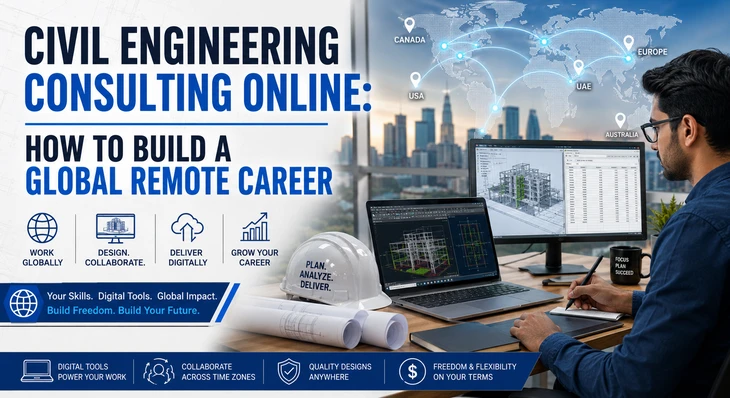
Civil Engineering Consulting Online: How to Build a Global Remote Career
Civil engineering is no longer limited to dusty construction sites, site visits, or long office hours at a local firm. A growing number of engineers are quietly shifting their careers online, working with clients across continents from their homes. What once felt unusual is now becoming a practical, stable, and often more rewarding way to work.
Online civil engineering consulting is not just a trend—it is a shift in how the industry functions. Projects are planned digitally, designs are reviewed on screens, and collaboration happens across time zones without anyone stepping into the same room.
For many engineers, this shift has opened a door they did not even know existed a few years ago.
What working as an online civil engineering consultant really looks like
At its core, online civil engineering consulting means offering professional engineering services remotely. Instead of physically being present at a construction site or office, engineers deliver their expertise through digital tools and communication platforms.
A typical day might involve reviewing structural drawings in AutoCAD, preparing a BOQ in Excel, checking BIM models in Revit, or discussing design changes over a video call with a client in another country.
There is no fixed “office environment” anymore. Your workspace becomes your laptop, your software tools, and a stable internet connection.
What makes this model powerful is its flexibility. You are not limited to local projects or employers. A residential project in Canada, a commercial layout in the Middle East, or a BIM coordination task from Europe can all be part of the same portfolio.
Why remote civil engineering careers are growing so fast
This shift did not happen overnight. It is the result of several changes in the construction and design industry.
First, companies are under pressure to reduce costs while still maintaining quality. Hiring remote specialists allows them to access skilled engineers without maintaining large in-house teams.
Second, the industry has become more digital than ever. Tools like BIM, cloud-based storage, and real-time collaboration software have removed the need for physical presence.
Third, there is a global shortage of specialized engineering talent in many regions. Outsourcing work to skilled freelancers has become a practical solution.
And finally, engineers themselves are seeking more control over their time, income, and work style. The traditional 9-to-5 setup no longer appeals to everyone.
Skills that actually matter in this field
Success in civil engineering consulting online is not just about knowing engineering theory. It is about combining technical ability with digital fluency and communication.
Most successful remote engineers usually develop a strong mix of these skills:
They understand structural design principles well enough to analyze real-world projects without supervision. They are comfortable working with tools like AutoCAD, Revit, STAAD Pro, or ETABS. They can prepare clean reports, drawings, and calculations that clients can directly use.
But beyond technical knowledge, communication becomes equally important. You may be explaining design decisions to someone in another time zone who has never met you in person. Clear writing and structured thinking make a big difference here.
Time management also plays a huge role. Working with international clients often means handling overlapping deadlines and different working hours.
Services you can offer as a remote civil engineer
One of the most interesting parts of this career path is how many directions it can take.
Some engineers focus on structural design, helping architects and developers finalize safe, efficient building structures. Others specialize in drafting, creating precise CAD drawings that serve as the foundation for construction projects.
BIM modeling has also become one of the most in-demand services. Many firms outsource BIM coordination because it requires both technical understanding and software expertise.
Quantity surveying is another strong area. Engineers prepare cost estimates, material take-offs, and BOQs that help clients plan budgets accurately before construction begins.
There are also engineers who work on site planning and layout design, especially for residential and commercial developments.
The key is not to try everything at once. Most successful consultants start with one skill and gradually expand as they gain experience.
A practical path to building your remote career
Starting out in this field can feel confusing at first, but the process becomes clearer when broken into steps.
It usually begins with strengthening your core engineering knowledge. This does not mean going back to theory books, but rather practicing real-world problems and improving your software skills.
After that, building a portfolio becomes essential. Clients do not just hire based on degrees—they want to see what you can actually deliver. Even simple sample projects can make a big difference.
Choosing a niche is another turning point. Engineers who focus on a specific area, such as BIM modeling or structural analysis, often find it easier to attract consistent work.
Once you are ready, platforms like Upwork or Fiverr can help you find your first clients. At the beginning, the projects may be small, but they are important for building credibility.
LinkedIn also plays a powerful role. Many engineers underestimate it, but it often leads to direct client conversations and long-term contracts.
Behind every remote engineering project is a set of tools that make everything possible.
AutoCAD is still the backbone for drafting work. Revit is widely used for BIM modeling and collaboration. STAAD Pro and ETABS handle structural analysis tasks. Excel remains essential for calculations, BOQs, and cost estimates.
On the communication side, tools like Zoom and Microsoft Teams replace face-to-face meetings. Google Drive and Dropbox handle file sharing and version control.
The interesting part is that mastering tools is not about knowing every feature. It is about becoming fast, accurate, and reliable with the features you actually use daily.
How engineers actually find international clients
Finding clients is often the biggest concern for beginners, but there are more paths than people expect.
Freelance platforms are the most common starting point. They provide access to global clients who are actively seeking engineering support.
However, long-term success usually comes from networking. A strong LinkedIn profile that clearly shows your skills and past work can attract direct inquiries.
Online engineering communities also help. Many professionals share project requirements in groups and forums, and opportunities often come through conversations rather than formal job postings.
Some engineers also create simple portfolio websites. This builds credibility and makes it easier for clients to trust their services.
Over time, referrals become one of the strongest sources of work. A satisfied client often leads to the next opportunity without any marketing effort.
Challenges you will face along the way
This career path is rewarding, but it is not without difficulty.
Working across time zones can be tiring, especially when meetings are scheduled late at night or early in the morning. Communication gaps can also lead to misunderstandings when instructions are unclear.
Another challenge is competition. Since this is a global market, you are not just competing locally—you are competing with engineers worldwide.
Software tools can also be expensive, which can be a barrier when starting out.
And finally, every country has its own building codes and standards. Adapting to different requirements takes time and patience.
The good news is that all of these challenges become easier with experience.
A simple real-world scenario
Imagine a civil engineer working in a small city in India. They start by offering basic CAD drafting services online. The first few months are slow, with small projects and limited income.
Gradually, they improve their skills, build a strong portfolio, and start receiving more complex work from international clients.
A few years later, they are handling BIM coordination projects for a construction company in Dubai and structural detailing for a firm in the UK.
Their income grows, but more importantly, their work is no longer limited by geography. That shift alone changes the entire career trajectory.
Where this industry is heading
The future of civil engineering consulting online is closely tied to digital transformation in construction.
Cloud-based design tools, AI-assisted modeling, and virtual project management systems are becoming standard practice. Companies are increasingly open to remote collaboration, even for large-scale infrastructure projects.
This means more opportunities for engineers who are comfortable working digitally.
Those who adapt early will likely have a significant advantage in the coming years, not because they work harder, but because they work in a more connected system.
Conclusion
Online civil engineering consulting is quietly reshaping how engineering careers are built. It gives professionals the freedom to work globally, choose their projects, and build careers that are not limited by location.
Success in this field comes from steady skill-building, patience, and the ability to communicate clearly in a digital environment. It is not an overnight shift, but a gradual transformation.
For engineers willing to learn and adapt, this path offers something traditional roles often cannot—freedom, flexibility, and global reach.
FAQs
Can civil engineers really work remotely full-time?
Yes, many engineers now work fully remotely in areas such as BIM, drafting, structural design, and estimation.
What is the easiest way to start freelancing as a civil engineer?
Start with small CAD or drafting projects on freelance platforms and gradually build your portfolio.
Do I need advanced software knowledge before starting?
Basic proficiency is enough to begin, but advanced skills help you land higher-paying projects.
Is remote civil engineering financially stable?
It can be very stable once you build a consistent client base and gain experience in a niche.
How long does it take to build a strong freelance career?
Most engineers see steady growth within 1–3 years, depending on skills and consistency.