
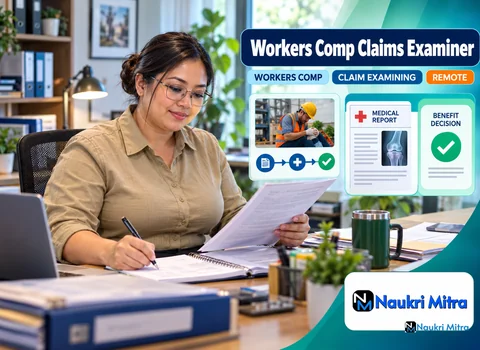
Walk through a sample file, invented for this page. Monday, 8:40 a.m., a first report of injury lands in the queue: Marcus, a warehouse worker, felt his right shoulder give while lifting a stack of boxes onto a pallet late on Friday's shift. He saw an urgent care doctor on Saturday and was told to rest it. By Wednesday the examiner handling the file has made three calls. The first goes to Marcus, to hear what happened in his own words and explain what comes next. The second goes to his supervisor, to confirm the shift, the task and whether light work exists. The third goes to the clinic, to get the visit notes and the work status slip. That first week is a fair picture of remote workers comp claims examiner jobs: one person in the middle, keeping an injured worker, an employer and a set of medical providers moving in the same direction. The opening is full-time and fully remote, welcomes applicants worldwide and pays USD 4,350 per month.
Boiled down, the workers comp claims examiner job description is this: you own a file from the first report until it closes. You gather facts, decide (within your authority) whether the injury is covered, pay what is owed, and keep the person on track toward getting back to work. You are not a nurse, a doctor or a lawyer. You do not tell anyone what treatment to get, and you do not give legal advice to the worker or the employer. When a medical or legal question comes up, you route it to the right professional and document that you did.
For Marcus, the questions are ordinary ones. Was he on shift? Does the reported task match his job? Did anyone see it? You collect a recorded or written statement, the employer's account and the first medical note, then make a call within the guidelines and authority your team gives you. The standards behind that decision vary by jurisdiction.
Bills from the clinic and later a physical therapist arrive within weeks. Most claim teams pair the examiner with bill-review software or an outside vendor that reprices charges against the applicable fee schedule. Your part is checking that the bill relates to the accepted body part, that the treatment was authorised where authorisation is needed, and that nothing is a duplicate. If the review tool flags a CPT code for a knee on a shoulder claim, you are the one who catches it and asks why.
If Marcus is off work, he may be owed wage replacement. You pull payroll, work out an average weekly wage and apply the rate that fits. Formulas and waiting periods vary by jurisdiction, so you follow the procedure that applies to the claim.
For many injured workers, this part of the file matters most. A doctor's note might say "no lifting over 10 lbs, no overhead reaching." You take that to the employer and ask whether there is a desk task, a scanning role or inventory counting that fits. If there is, you put the offer in writing, confirm the start date with Marcus, and update the provider.
Every open file carries a reserve, your best estimate of what the claim will cost. You set it early and revise it when facts change, such as a referral to an orthopaedic surgeon. You also run a diary: a dated reminder on each file, maybe 14 days for a simple medical-only claim and 7 days for a lost-time claim with surgery pending. A missed diary date is a common reason files stall.
When treatment ends and the worker is back at full duty, you close the file per procedure. Some claims settle instead. Settlement authority depends on your role and the jurisdiction.
Marcus does not know what "TTD" or "MMI" means and should not have to. Good examiners explain the next payment date, what a modified-duty offer means for his pay, and who to call if a pharmacy refuses a prescription. Calls get tense sometimes, and calling back when you said you would usually settles nerves better than a script.
Readers hunting for entry level remote workers comp claims examiner jobs should know this one wants two years. People new to claims usually start as claims assistants or trainees in medical-only units, then move up. That trainee-first route is the common way to become a workers comp claims examiner.
Like most workers comp claims examiner work from home jobs, the role runs on the phone and in the claims system: inbound calls from workers and providers, plus outbound calls from your diary. A steady caseload means mixing new claims with older files that need a reserve update or a payment.
Workers comp claims examiner skills you will lean on daily:
A quiet room, a reliable connection and a headset are the basics.
A liability adjuster decides whether an insured is at fault for someone else's loss and negotiates with claimants or attorneys. Workers comp is often described as a no-fault system, though the details vary by jurisdiction; the main question is whether the injury arose from work, and the file runs for months of treatment and benefits. Comp examiners also spend far more time on medical bills and return-to-work talks than liability adjusters do. Many people move between the two.
The workers comp claims examiner salary per month here is USD 4,350, full-time. No bonus, overtime or benefits package is stated, so raise anything beyond base pay with the hiring team. Figures elsewhere for the title vary with region and licence status.
Yes, the work can be stressful. Deadlines are real, some claimants are frustrated, and a few files turn into disputes. A clean diary and honest notes help. Growth paths include senior examiner on litigated files, team lead or quality review.
Third-party administrators such as Sedgwick and Gallagher Bassett are well-known employers of claims staff in general, alongside insurers, self-insured employers and smaller TPAs. That is background only; the employer here is not named.
If you hold a licence, confirm it is active. For a workers comp claims examiner course or a workers comp claims examiner certification, the AIC outline from its issuing body, insurer training programs and your licensing study cover most of what is needed. You won't need any one paid course.
On your workers comp claims examiner resume, lead with the claim types you worked (indemnity, medical-only), the systems you used and any return-to-work wins. For workers comp claims examiner interview questions, prepare a story about a modified-duty placement you arranged.
Among workers comp claims examiner jobs remote worldwide, this one takes responses straight from this page. Naukri Mitra charges applicants nothing, and anyone posing as an employer who wants money from you to be considered is not one to trust. Include your years in claims, whether you hold an adjuster licence and where, and whether you have the AIC or are working toward it. If your experience is in liability or property, say how it carries over to comp.