
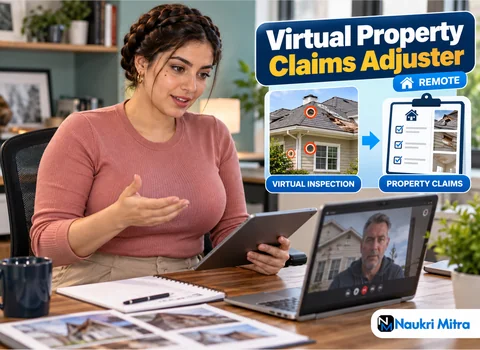
"Okay, Rosa, can you tip the phone up toward that brown ring on the ceiling? Good. Now take two steps back toward the fridge so I can see the whole kitchen in one frame. Last thing: lay the tape measure along the bottom of that wall, zero end in the corner, and keep it still for me." That exchange is invented, yet it fairly pictures a weekday in remote virtual property claims adjuster jobs, where you guide the homeowner's camera from your own desk. The opening here calls for a full-time adjuster who runs those live video inspections personally, from first call to written estimate.
Here is the virtual property claims adjuster job description in brief: you do what a field adjuster does, minus the drive. You meet the policyholder on a video inspection app, walk them through the damaged areas, capture the photos and measurements the file needs, sketch the rooms, write the repair estimate in Xactimate, confirm coverage and move the claim toward settlement. The position is full-time, accepts applicants in every country and carries USD 4,350 per month.
One thing to be clear about: this is not a desk review job where you check reports that someone else gathered on site. Here the inspection is yours. If the photo of the subfloor is blurry, that is your shot to retake, and you retake it while the homeowner is still standing in the room.
Most claims follow a similar rhythm, though every house has its quirks.
Before anyone opens a camera, you phone or message the policyholder to agree a time and tell them what to prepare. A good pre-call note: charge the phone, clear a path to the affected rooms, have a tape measure handy, and plan on about 30 to 45 minutes.
Start wide, then go tight. Ask for the doorway view of each room first so you can place the damage in context, then move in on staining, warped boards, lifted vinyl or cracked drywall. Narrate as you go ("pan slowly left, stop at the window") because most homeowners have never been asked to film anything like this.
Grab still captures inside the app as you go, labelled by room. For dimensions, get the tape in frame along each wall at a height the homeowner can reach while standing on the floor. A kitchen that is 12 feet 4 inches by 10 feet 9 inches matters to the sketch; "about twelve by ten" does not. If the homeowner reads the tape aloud, repeat the number back so you both hear it and the recording catches it.
You never ask anyone to climb onto a roof, go up a ladder, crawl into an attic with weak joists, step into standing water near outlets, or enter a room with a sagging ceiling. If the only way to see something is to put someone at risk, the shot is not worth it. Note what could not be viewed and why. A file that says "attic not inspected, access hatch above stairwell, homeowner unable to reach safely" is far more useful than a guessed scope.
After the call, you build the floor plan in Xactimate, drop in the line items for removal, drying, drywall, paint, flooring or cabinets, and check the scope against what the photos actually show. Coverage questions are checked against the policy wording and the insurer's own guidelines, which vary by insurer and by jurisdiction.
Close every call with the next steps: when the estimate will be ready, what the homeowner may receive, and who to contact with questions. Describe the process honestly and never promise a payment amount or a coverage decision before the file has been reviewed.
Wi-Fi in a basement is often terrible. Ask the homeowner to switch to mobile data, turn off video for a moment while you talk, or record short clips offline and upload them afterwards.
Some losses do not suit a camera: suspected structural movement, large fire losses, roof damage nobody can safely show you, or a homeowner who cannot handle the phone. Part of the job is recognising those early and requesting a field inspection instead of forcing a video estimate.
Here is the background the listing calls for:
The virtual property claims adjuster skills that matter most day to day are clear verbal direction, patience, an eye for damage that the homeowner may not notice, and careful note-taking. Someone who has worked as a restoration estimator or a contractor's project lead often picks up the video side quickly.
If you are hunting for entry level video adjusting roles that need no experience, note that this post wants at least 12 months of claims or estimating work plus a licence. The route in is well trodden, though. To become a virtual property claims adjuster, get licensed where required, learn Xactimate through the vendor's own training, take an inside or catastrophe claims role or an estimating job with a restoration firm, then move into video work once you can write a clean scope.
There is no single required virtual property claims adjuster course or virtual property claims adjuster certification for this post beyond the licence and Xactimate training. Regular practice sketching rooms will help you more than extra certificates.
A field adjuster drives to the property, climbs where it is safe for a trained professional to climb, and measures everything personally. A virtual adjuster sees the same house through someone else's phone. The estimating knowledge is the same. What changes is communication, because you need clear footage from someone who may be nervous and has never filmed a room for an insurer.
Virtual property claims adjuster work from home jobs call for a proper workspace. Expect to provide:
The virtual property claims adjuster salary attached to this position is USD 4,350 per month, on a full-time basis. That figure is the virtual property claims adjuster salary per month stated in the listing; nothing more is promised about bonuses or extras. Working hours and time zone coverage are details to confirm during hiring.
Openings like these come from property and casualty insurers, independent adjusting firms, third-party administrators and claims outsourcing companies that handle overflow after storms. Video inspection lets one adjuster cover a wide area, which is how virtual property claims adjuster jobs remote worldwide became workable. Openings rise and fall with claim volumes and weather.
Run a mock inspection with a friend in their own kitchen. Direct them through it, take stills, then write the estimate. For your virtual property claims adjuster resume, list the licence number and jurisdiction, the losses you have worked, and your Xactimate experience in plain terms.
Expect virtual property claims adjuster interview questions that test the video side: how you would guide an elderly homeowner, what you do when the call keeps dropping, and when you would escalate to a field visit.
Send your resume, licence details and a short note on the property claims or estimating work you have done via this listing. Applications are free here, and any request for payment means the offer is not real.