
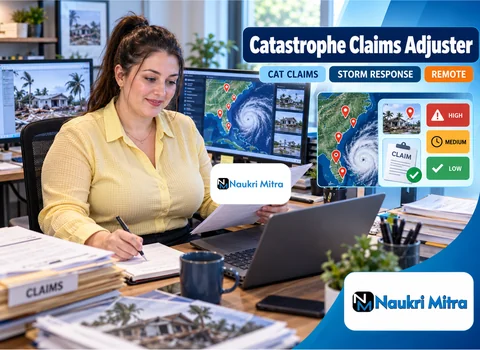
A big hailstorm crosses a metro area in minutes and leaves the paperwork for weeks. By morning, homeowners everywhere are on hold, photographing dented gutters and stained ceilings, and the insurer's regular team cannot open files as fast as they arrive. That is the moment remote catastrophe adjusters are called in to take the overflow. This listing covers remote catastrophe claims adjuster jobs of exactly that kind: full-time, paid $4,350 per month (USD), home-based, and open in any country to people who hold the right licence and know Xactimate.
Because the files are US claims under US state licensing law, check every posting for licence and location conditions before you apply. What follows is the catastrophe claims adjuster job description as it really runs, hours included.
Most people you phone have never filed a property claim. Some have a tarp on the roof and a bucket in the hallway; some are angry after days of silence. Your first job is to listen, confirm they are safe, and make sure any temporary repairs that stop further damage are being handled.
Then you set expectations, plainly. Tell them what happens next, how photos or an inspection will be arranged, and when they will hear from you again. Keep promises small and keep every one of them. A homeowner who knows you will call back on Thursday, and gets that call on Thursday, will forgive a great deal of waiting.
As a desk adjuster you rarely stand on the roof. The evidence comes to you: policyholder photos, field inspection reports and often drone imagery of the roof planes. Read it critically.
When the photos are not enough, ask for more. Guessing from a blurry image helps nobody.
Scoping means turning what you see into measurable line items. On the roof that covers squares of shingle, starter, ridge cap, drip edge, flashing, vents and the labour to tear off and dispose of the old layer. Siding brings its own puzzle, because a few cracked panels on one elevation can raise the question of matching with the rest of the house.
Inside, you follow the water. A stain on a bedroom ceiling may mean drywall, insulation, paint across the whole room and perhaps flooring. Good scopes are specific: which room, which surfaces, what quantity, and why.
Xactimate is where the scope becomes a number. You sketch the structure, apply the correct regional price list, select line items and add notes that explain your choices to the reviewer who reads the file after you. Speed matters during a surge, but an estimate missing ridge cap or using the wrong pitch costs more time later as a supplement or reopened claim.
Among the core catastrophe claims adjuster skills, Xactimate fluency comes first: sketch, roof diagrams, macros and price list updates without hunting for menus.
Homeowners deserve to understand their own policy. Your part is to explain it clearly, never to give legal advice. The conversations usually cover three ideas:
When a homeowner asks something you cannot answer from the policy wording, escalate it. Saying you will check is better than being confidently wrong.
Settlement conversations go best when the homeowner has already heard the main points earlier. Walk through the estimate line by line if they want it, explain the deductible and any depreciation held back, and tell them how to send a contractor's supplement if the roofer finds hidden damage. When you disagree, stay calm, ask for the contractor's figures and compare like with like.
XactAnalysis is where assignments arrive and where status, notes and documents are tracked for the carrier. Closing a file promptly there means uploading the final estimate, photos and report, setting the right status and leaving notes clear enough for anyone to follow.
Be honest with yourself about the hours. During a major storm response, desk adjusters often work long days, six or seven days a week, for weeks at a time, because the claims keep coming and homeowners keep waiting. Catastrophe claims adjuster work from home jobs remove the hotel and the drive, but the queue never quite empties.
Adjusters who last several seasons block a real break in the day, set a hard stop for phone calls, keep a running list of promised callbacks, and sleep enough to keep their estimates accurate. Burnout shows first as sloppy files and short tempers. Notice it early.
An active adjuster licence is required. In the US, many adjusters hold a licence from their resident state or, where they live in a state without its own adjuster licence or outside the country, a designated home state licence from a state that issues one to non-residents. Additional reciprocal licences from other states widen the range of claims you can legally handle, and this role values them. Each state writes and revises its own rules, and its insurance department is the place to confirm what currently applies.
Xactimate certification is preferred rather than mandatory here, though proficiency itself is essential. A catastrophe claims adjuster certification in Xactimate gives a reviewer quick proof that you can produce clean estimates unsupervised.
A daily claims adjuster handles the steady flow: a burst pipe, a kitchen fire, a single tree on a garage, usually for one carrier and at a predictable pace. A catastrophe adjuster is brought in for the spikes, working claims from one event in large volumes, often through an independent adjusting firm on behalf of the insurer.
Independent adjusting and claims-management companies such as Crawford, Sedgwick and Pilot are examples of the kinds of organisations that run catastrophe programmes. Many adjusters join rosters with several firms. Desk roles like this one sit alongside field roles that travel to the affected area.
This role asks for one to two years of property claims or catastrophe experience. If the question is how to become a catastrophe claims adjuster from outside claims entirely, the honest answer is a stepping stone or two. Earn a licence first, then look for property work as a daily desk adjuster, a claims assistant, a field inspector or a roofing estimator.
A catastrophe claims adjuster course can teach roof measurement, policy basics and estimating, but no course replaces a season of real files. On a catastrophe claims adjuster resume, list claim types, volumes, software and licensed states. Common catastrophe claims adjuster interview questions cover a difficult policyholder, a disputed roof and how you organise a heavy queue.
When people search catastrophe claims adjuster salary figures, they find wide swings. This role lists $4,350 per month for full-time remote work, which is easier to plan around than uneven deployment income. Still, catastrophe adjusting is cyclical. Busy periods tend to follow hail, hurricane and wildfire seasons, and quieter months follow. Nothing in this field guarantees a level of income or a set number of deployments.
The life suits people who like intense stretches of useful work and can rest properly afterwards. The reward is moving a family from a leaking roof to a signed repair contract. If the hours suit you, check this posting's licence conditions against your own before applying.