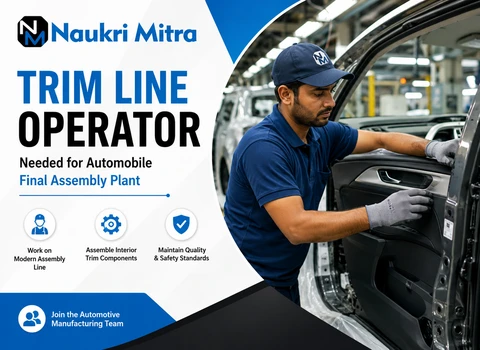
What a Trim Line Operator Actually Does on the Shop Floor
A trim line operator works at one of the busiest sections of an automobile final assembly plant, where a bare vehicle body slowly turns into a finished car. This is the stage where seats, dashboards, wiring harnesses, door panels, glass, carpets, and small fittings are added to the vehicle in a fixed sequence. Every part has to go in at the right station, in the right order, without damaging the vehicle body or the component itself. This role is a full-time position in Halol, Gujarat, India, and suits people who enjoy hands-on, repetitive precision work rather than sitting at a desk.
Why Automobile Plants Depend on This Position
Car manufacturing runs on a moving assembly line, and the trim section is one of the longest and most detail-heavy parts of that line. If one station falls behind, the whole line slows down. That is why companies recruit dedicated operators for this stage rather than relying on general helpers. Consistency matters more than speed here, because a single missed clip or loose connector can lead to a quality complaint much later, sometimes after the car has already reached a customer.
A Typical Shift on the Line
Work usually occurs within a fixed cycle time, meaning each operator completes the same set of tasks in a set number of seconds before the next vehicle arrives at the station. A regular day may include:
- Fitting interior trims such as door panels, pillars, and dashboards
- Connecting wiring harnesses and electrical connectors
- Installing seats, seat belts, and carpets using powered and hand tools
- Checking fitment gaps and alignment before the vehicle moves ahead
- Reporting any defective part or mismatch to the line supervisor immediately
Where This Work Happens
Trim line operators are employed inside automobile final assembly plants, which are large industrial facilities with multiple production lines running in parallel. These plants are common in India's automotive manufacturing belts, and Halol in Gujarat is home to established vehicle assembly operations of this kind. The environment is indoor, well-lit, and organized into stations, with overhead conveyors moving vehicle bodies from one operator to the next.
Tools and Instruments Used at the Station
The job involves regular use of pneumatic torque guns, hand screwdrivers, trim clip tools, and sometimes small lifting devices for heavier components like seats. Quality checks are performed using go/no-go gauges, feeler gauges, and torque-verification tools to confirm that fasteners are tightened to the correct specification. Digital scan guns are often used to log part numbers and confirm the correct variant is fitted to each vehicle.
Skills That Help an Operator Succeed
Good hand-eye coordination, attention to detail, and the ability to work at a steady pace are essential. Basic understanding of vehicle components, wiring diagrams, and torque specifications is valuable. Employers generally prefer candidates who have completed an ITI in a relevant trade such as Automobile, Mechanical, Electrician or Fitter, or a Diploma in a related engineering stream. Familiarity with reading simple engineering drawings and using precision measuring instruments is often seen as a strong advantage, even for entry-level applicants.
Physical Effort and Shift Pattern
This is a physically active job that involves standing for long periods, bending, reaching overhead, and repetitive hand movements. Plants typically run rotational shifts to keep production continuous, so operators should be prepared for morning, evening or night shifts on a rotating basis.
Safety Practices on the Trim Line
Safety shoes, hand gloves, and safety glasses are standard PPE at most trim stations. Operators are trained to follow lockout procedures near powered tools, keep walkways clear, and report any unsafe fixture or tool immediately rather than working around it.
Common Challenges Operators Face
Meeting cycle time consistently while maintaining accuracy is the biggest daily challenge, especially during the first few weeks. New operators sometimes struggle with fitment on tight components until muscle memory develops. Regular practice, asking senior operators for tips, and closely following the standard work sequence usually resolve this within a short period.
Building a Career from This Starting Point
Many operators grow into line leader, quality checker, or shift supervisor roles after gaining experience across different trim stations. Learning multiple stations instead of staying fixed at one increases both value on the line and chances of future promotion within the same plant.
Salary and Common Benefits
This full-time position in Halol, Gujarat offers a monthly salary of ₹33,200. Depending on the employer's policy, operators may also be eligible for benefits such as overtime pay, Provident Fund (PF), ESI coverage, annual bonus, uniforms, and transport or canteen facilities, though these should be confirmed directly with the employer.