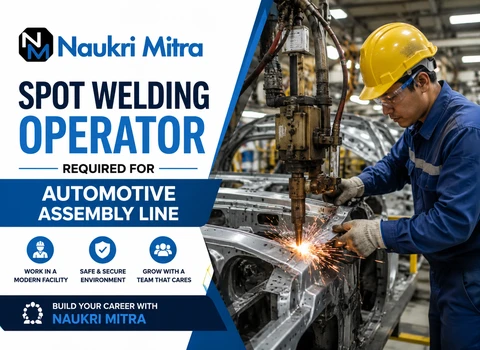
Joining Metal, One Weld at a Time
Walk onto any car body shop floor, and you'll hear it before you see it — a sharp hiss followed by a quick spark as two sheet-metal panels are fused together. That's spot welding, and the person running that gun is doing far more than pulling a trigger. A Spot Welding Operator presses metal panels between copper electrodes, sends a short burst of current through them, and melts the metal at that single point until it fuses. Do this correctly a few hundred times a shift, and you've helped build a car body that can survive years on Indian roads.
Why This Job Exists on Every Assembly Line
A car body isn't one piece of metal. It's dozens of panels — doors, pillars, roof sections, floor pans — that all need to be stitched together with precision. Nobody welds these by hand with a torch; it would take too long, and the joints wouldn't be consistent enough. So plants use spot welding guns, either handheld or robot-mounted, and they need operators who understand the machine, the material, and what a good weld actually looks like. That's the gap this role fills.
What the Shift Actually Looks Like
Most days start the same way — check the gun, check the electrode tips, check the cooling lines. Water-cooled equipment that isn't circulating properly will overheat and ruin a weld, so this isn't a step operators skip. Once the fixture jig is loaded with a panel, the real work begins: align it, trigger the weld, move to the next spot. Somewhere in between, there's time spent inspecting completed welds for spatter, checking for burn-through, and flagging anything that looks off to a supervisor.
Over a full shift, an operator might handle:
- Loading and positioning body panels on jigs before welding
- Running spot welding guns, sometimes handheld, often robot-assisted
- Checking weld spots for strength, spacing, and consistency
- Swapping or dressing electrode tips once they wear down
- Logging basic production numbers and quality notes
The Equipment You'll Get Hands-On With
Expect to work with pneumatic or servo-controlled welding guns, transformer units that supply the current, and fixture jigs built specifically for the panel being welded. Tip dressers keep the copper electrodes properly shaped, and gauges are used to check the weld nugget size against spec. A lot of plants now use robotic arms for repetitive, high-volume welds, which shifts the operator's job toward loading, monitoring, and stepping in to make adjustments rather than manually welding every joint.
Where You'll Find This Kind of Work
This trade is mostly found in automotive body shops, component manufacturing units, and sheet metal fabrication workshops. Pithampur, Madhya Pradesh, has grown into a serious automotive manufacturing hub, and much of this work happens in body-in-white sections — the part of the plant where the raw metal frame comes together before it moves on to paint.
What Gets You Hired for This Role
An ITI certificate in Welder, Fitter, or a related mechanical trade is usually what employers ask for first. A Diploma in Mechanical Engineering also opens doors here. But paperwork only gets you the interview — what actually matters on the floor is whether you can read a basic engineering drawing, handle sheet metal without hesitation, and use a measuring instrument without being told twice. Operators who've spent time around machines before, even informally, tend to pick this up faster than someone learning everything from scratch.
Beyond the technical side, the job rewards a specific kind of temperament. You need patience for repetition — the 400th weld of the day still needs the same care as the first. Standing for hours doesn't bother everyone, but it will bother some people, so physical stamina matters here too. Following the standard procedure exactly, even when you think you know a shortcut, keeps both the product and the operator safe.
Shift Life in Pithampur
This is a Full-time position, and like most manufacturing roles tied to production targets, it usually runs on rotational shifts. The floor itself runs warm — welding throws off heat, and with multiple stations running at once, it adds up. Noise is a constant too. None of this is unusual for the industry, but it's worth knowing before you sign up.
Staying Safe Around Live Current and Hot Metal
Spot welding combines electrical current, heat, and moving fixtures, which means safety habits aren't optional. Safety goggles or a face shield protect against spatter, heat-resistant gloves handle the hot electrodes, and safety shoes are standard on any shop floor with this kind of equipment. Before touching a machine for maintenance, lockout procedures need to be followed properly. Loose cables and hoses left lying around cause more accidents than people expect, so keeping the station tidy is part of the job, not an afterthought.
The Parts of the Job Nobody Warns You About
New operators often struggle with keeping weld quality steady once electrode tips start wearing — a slightly worn tip changes the weld even if everything else looks the same. The other challenge is more physical than technical: repetitive hand movements and standing for a full shift can take a toll on the body over months, which is why posture and short breaks actually matter more than they seem at first.
Where This Can Lead
Operators who stick with this trade and get good at it often move into senior welding technician roles, quality inspection on the line, or team lead positions overseeing a section of the body shop. Learning to work with robotic welding systems, rather than just manual guns, tends to open up more of these opportunities down the line.
Pay and What Might Come With It
This role pays ₹34,800 a month for a Full-time position based in Pithampur, Madhya Pradesh, India. Depending on the employer, additional benefits sometimes offered alongside this kind of role include overtime pay, PF, ESI, performance bonuses, uniforms, transport, or canteen facilities — though none of these are guaranteed and they vary from one company to another.