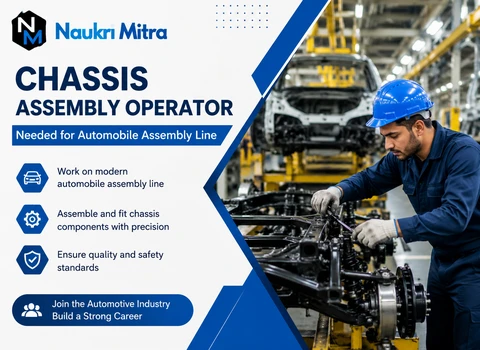
Getting Under the Skin of Chassis Assembly Work
Walk onto any automobile assembly line, and you'll notice one section where everything else in the vehicle eventually rests: the chassis station. This is where the Chassis Assembly Operator role lives. The job involves fitting axles, suspension components, and mounting brackets onto the vehicle's frame, laying the groundwork for everything that gets built on top later. It's a full-time position based in Chakan, Maharashtra, a part of India where automobile manufacturing has grown into a major employment hub over the past two decades.
The Chassis Isn't Just Another Part
Think of the chassis as the skeleton of a car. Get it wrong, and the steering pulls, the brakes wear unevenly, the ride feels off — problems that surface weeks or months after a vehicle leaves the plant. Manufacturers don't take chances here. Rather than shuffling random line staff through this station, they keep operators who know the sequence cold, who can spot a misaligned bracket before it becomes a warranty claim.
What a Shift Actually Looks Like
Before the line even starts moving, there's a quick equipment check — torque guns tested, jigs inspected, tools counted. Once production kicks off, components arrive at the station on a fixed rhythm. The operator positions each piece in its fixture, fastens it to spec, and moves to the next unit. No pauses to think it over; the line keeps moving whether you're ready or not. Speed matters, but so does getting the torque value right every single time.
Where the Hours Actually Go
- Fitting suspension arms, axle assemblies, and mounting brackets onto the frame
- Running torque wrenches and pneumatic guns to bring fasteners to spec
- Checking fitment with jigs, feeler gauges, or calipers before signing off
- Flagging anything that doesn't align to the line supervisor right away
- Keeping the station's tools clean, calibrated, and ready for the next shift
Tools You'll Actually Touch
Pneumatic and electric torque guns dominate the toolkit here, alongside hydraulic lifts and conveyor-mounted jigs that hold parts steady during fitting. Basic hand tools — spanners, Allen keys — still come out for smaller adjustments. For checking work, operators lean on vernier calipers, feeler gauges, and torque testers. Reading a work-instruction chart or a simple engineering drawing posted at the station is part of the job too; most stations display these visually so there's no guesswork.
What Separates a Good Operator from an Average One
Mechanical sense helps, but discipline matters just as much. The strongest operators tend to share a few things in common:
- They're comfortable around hand and power tools without needing constant supervision
- They can follow a technical drawing or work instruction without hand-holding
- They catch small errors — a loose bolt, a torque reading slightly off — before they snowball
- They've built up the stamina to stand, bend, and lift through a full shift
- They work well with the two or three people stationed alongside them, since this isn't solo work
Training and Qualifications That Help
Employers may prefer candidates with relevant machining or tool room training. Depending on the complexity of the work, an ITI in a machining-related trade, a Diploma in Mechanical or Tool and Die Engineering, or equivalent vocational training may be considered suitable. That said, practical experience often counts for just as much as the certificate — someone who's spent time around EDM machines, engineering drawings, and precision measuring instruments usually adapts faster than someone with only classroom exposure.
On Your Feet, Literally
There's no sitting down on this job. Operators lift components, bend into awkward angles to reach fasteners, and hold fixed postures for stretches at a time — all while keeping pace with the conveyor. Plants running this kind of production typically operate rotational shifts to keep output continuous, so flexibility around shift timing comes with the territory for this full-time role.
Noise, Heat, and the Gear That Protects You
Assembly halls aren't quiet places. Pneumatic tools hiss, conveyors hum, overhead cranes move parts overhead — all at once, most of the time. Safety shoes, gloves, ear protection, and safety glasses are standard issue on most lines. Beyond wearing the gear, operators are expected to follow lockout procedures near moving machinery, keep walkways clear, and report a faulty tool the moment it's noticed rather than working around it.
What Trips Up New Operators
The cycle time is usually the first hurdle. It takes a few weeks for the body to adjust to repetitive movements before fatigue sets in. Holding torque accuracy while racing the clock, adjusting to rotational shifts, staying sharp during long standing hours — these are common early struggles, not signs that someone isn't cut out for the work. Most people find their rhythm once the station's sequence becomes second nature.
Where This Can Lead
Operators who hit their quality and output numbers consistently often get looked at for line lead or shift supervisor roles down the road. Some move sideways into quality inspection within the same plant — the eye for detail built on the chassis line translates well there. Cross-training on other stations also makes an operator harder to replace and easier to promote.
What the Pay Looks Like
This role, based in Chakan, Maharashtra, India, pays ₹33,800 a month. Beyond the base salary, employers in this sector sometimes offer overtime pay, Provident Fund (PF), ESI coverage, an annual bonus, uniforms, or transport and canteen facilities. None of these extras are guaranteed across every employer, so it's worth confirming what applies during the hiring conversation.