What Does a Transmission Assembly Operator Actually Do
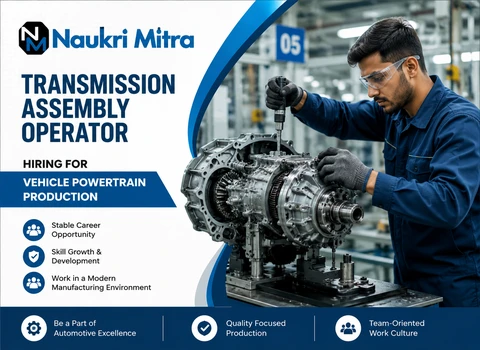
Every vehicle that leaves a factory in India passes through a transmission line at some point, and someone has to build that transmission by hand — or with hand-guided machines. That's the job. A Transmission Assembly Operator fits gears, shafts, clutch packs, and housings together in a set order, checks the work, and sends it forward. This particular opening is a Full-time position in Hosur, Tamil Nadu, paying ₹36,600 a month. If you're weighing whether powertrain assembly work is for you, it helps to know what the job actually involves, not just what the title sounds like.
Why This Role Exists on the Factory Floor
Transmissions don't tolerate sloppy work. A gearbox has dozens of moving parts, and if a shaft is misaligned by even a fraction of a millimeter, or a bolt is under-torqued, the whole unit can fail once it's in a vehicle. That's why plant staff dedicated assembly operators instead of leaving the work to chance or automation alone — someone needs to catch problems before they leave the line. Component manufacturers and OEM supplier units treat this as a skilled position precisely because the margin for error is so thin.
The Kind of Facilities That Hire for This Work
You'll mostly find this role at:
- Powertrain manufacturing plants
- Component assembly units supplying automakers
- Vehicle production facilities running dedicated gearbox lines
- Tier-1 supplier factories building sub-assemblies for OEMs
Hosur sits in Tamil Nadu's automotive corridor, so there's a reasonable concentration of this kind of production work in the area — one reason it's a location worth watching for candidates in this trade.
A Shift, Start to Finish
Nobody walks straight to a workstation and starts assembling. A shift usually opens with a briefing — targets for the day, any changes from the previous shift, known issues on the line. Then comes a tool-and-fixture check. After that, it's mostly repetition: fit a part, torque it to spec, check it, move on. It sounds simple written out like this, but doing it correctly a few hundred times in a row, without the quality slipping toward the end of the shift, is where the actual skill shows up.
Day-to-Day Responsibilities
- Assembling gears, shafts, clutch plates, and housings in the correct build sequence
- Running pneumatic or electric torque tools to exact fastening specifications
- Checking dimensions and visual quality at each stage
- Logging production numbers and flagging anything off-spec to the supervisor
- Sticking to the standard operating procedure for each station, even under time pressure
- Keeping the workstation clean enough that tools and parts don't get mixed up
Tools You End Up Knowing Well
Give this job six months, and you'll know your torque wrench better than most people know their own phone. Beyond that, the tools include pneumatic screwdrivers, pick-and-place fixtures for heavier components, and — for checking your own work — vernier calipers, micrometers, and dial gauges. Some lines also run conveyors or automated guided vehicles moving parts between stations, so you pick up a working sense of machine indicators and safety interlocks even if that's not officially "your" machine.
What Actually Makes Someone Good at This
Speed matters less than people assume. What separates a strong operator from an average one is usually attention to detail and consistency — can you read a basic engineering drawing, understand what a torque spec means and why it matters, and still be doing careful work in hour seven of an eight-hour shift? That combination is harder to find than raw speed, and it's what supervisors actually notice.
There's also a softer side to it: noticing when something's slightly off before it becomes a real problem, and being able to flag it clearly to a team lead without holding up the whole line.
What Training Employers Look For
Employers may prefer candidates with relevant machining or tool room training. Depending on the complexity of the work, an ITI in a machining-related trade, a Diploma in Mechanical or Tool and Die Engineering, or equivalent vocational training may be considered suitable. Practical experience with EDM machines, engineering drawings, and precision measuring instruments is often valued as much as formal education — many experienced operators started with shop-floor training rather than in a classroom.
The Physical Side of the Job
This isn't a desk job, and it's worth being honest about that. Expect to be on your feet for most of the shift, doing repetitive hand movements, and occasionally lifting small or mid-sized parts. Hand-eye coordination matters more here than most people expect going in. Plants running transmission lines typically operate in rotational shifts — general, morning, night — because production doesn't stop just because the sun goes down. Shift work should be treated as a normal part of this role rather than an exception.
What the Shop Floor Feels Like
Picture a factory floor with machinery noise in the background, moderate heat near the assembly stations, and the smell of lubricants or cutting fluid in the air. Most modern transmission plants keep things organized — marked walkways, decent lighting — but it's still an industrial environment, and staying alert matters more here than in a typical office setting.
Safety Isn't Optional
Safety rules exist because the consequences of ignoring them are real. Lockout-tagout procedures, proper machine guarding — these aren't formalities, they're how operators avoid getting hurt. The standard protective gear includes:
- Safety shoes with toe protection
- Gloves suited for handling metal components
- Safety glasses or goggles
- Ear protection near louder machinery
- Uniforms cut to avoid loose fabric catching on equipment
Where New Operators Tend to Struggle
Honestly, the repetition trips people up more than the technical side. Hitting cycle times without letting quality slide, staying synced with the stations before and after yours so the line doesn't stall, adjusting to a rotating shift schedule — none of it is complicated, but it takes a few months to stop feeling exhausting. It gets easier once the movements become automatic.
A Few Things That Actually Help
- Recheck torque settings before starting a new batch — five seconds now saves an hour of rework later
- Keep your station organized; hunting for a tool mid-shift costs more time than it seems
- If something sounds or feels wrong with the equipment, say so immediately instead of waiting to see if it gets worse
- Learn the specific transmission models on your line rather than treating every unit the same
- Actually read updates to the SOP instead of assuming nothing's changed
Where This Can Lead
Operators who stay consistent and keep building technical knowledge often move up to line lead, quality checker, or senior assembly technician roles over time. The experience gained assembling transmissions also positions people to train newer hires or move into stages of the process that demand tighter precision. It's not a fast track, but it is a real one.
Pay and What Else Might Come With It
This Full-time role in Hosur, Tamil Nadu, pays ₹36,600 per month. On top of that, manufacturing jobs of this type sometimes include overtime pay, PF and ESI contributions, performance bonuses, company-issued uniforms, and transport or canteen access — though these vary by employer and shouldn't be assumed without confirming during hiring.
Should You Consider This Line of Work
If you like hands-on work with a clear, structured rhythm, and you don't mind that most of the reward comes from getting things exactly right rather than getting them done fast, this kind of role fits well. Freshers coming out of an ITI or diploma program can treat transmission assembly as a solid first step into vehicle powertrain manufacturing. Experienced technicians bring shop-floor instincts that make the transition even smoother. Either way, it's steady, skill-based work in one of Tamil Nadu's more established manufacturing sectors.