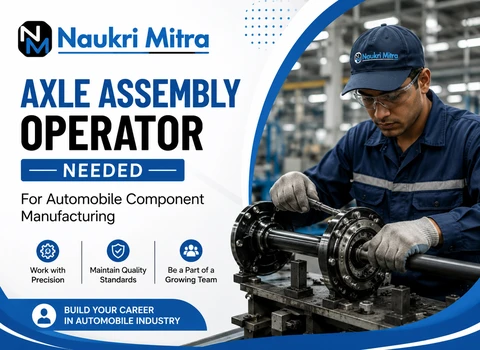
The Part of a Vehicle Nobody Notices Until It Fails
Ask most people what makes a truck or tractor run smoothly, and they'll talk about the engine. Almost nobody mentions the axle. Yet it's the axle assembly that carries the vehicle's weight, transfers power to the wheels, and takes the shock of every pothole. Getting it right takes a steady hand and a trained eye — which is exactly what an Axle Assembly Operator brings to a production line. If you're looking at this as a job in Jamshedpur, Jharkhand, here's a realistic picture of what it involves.
Why Manufacturers Won't Cut Corners Here
An axle isn't a cosmetic part. If it's assembled loosely or out of alignment, the vehicle vibrates, wears unevenly, or in the worst case, fails on the road. So component manufacturers don't leave this to chance labor — they hire people specifically for the job and train them to follow the same sequence, the same torque values, every single time.
What the Shift Actually Looks Like
No two days feel identical, but the core routine stays consistent. On a given shift, you might:
- Pick up axle housings, gears, bearings, and shafts from the previous stage
- Inspect each part quickly for scratches, cracks, or missing components
- Mount the housing on a jig built for that particular axle design
- Press in bearings and seals using a hydraulic press or pneumatic tool
- Tighten bolts to the exact torque spec with a calibrated torque wrench
- Run a quick alignment check using a dial gauge before the unit moves on
Some shifts move fast with tight targets. Others slow down for quality checks or when a new variant is introduced on the line. Either way, the sequence has to be followed — skipping a step to save time is where most defects start.
Tools That Become Second Nature
You won't be handed a single machine and told to master it. The job involves a mix — hydraulic presses for bearing fitment, pneumatic torque guns for speed, overhead cranes when housings get heavy, and hand tools like micrometers and dial indicators for the final check. Knowing why each tool exists, not just how to operate it, is what makes someone reliable on this line rather than just present on it.
The Kind of Places That Hire for This
This work is found in automobile component manufacturing units and the ancillary plants that supply parts to larger vehicle assemblers. Jharkhand has a fair number of these operations, and Jamshedpur specifically has grown as an industrial base where such manufacturing work is available on a full-time basis.
What Actually Gets You Hired
Reading an assembly drawing correctly matters more than people expect — a misinterpreted tolerance can let a defective part pass straight through. Employers generally look for candidates with an ITI in Fitter or Machinist, or a Diploma in Mechanical Engineering, since that background usually means someone already knows how to handle drawings and gauges without hand-holding. That said, hands-on exposure during an apprenticeship often counts for just as much as the paper qualification.
Practical habits matter too. Keeping the fixture area clean, flagging an odd sound or vibration instead of ignoring it, and sticking to the written procedure even under pressure — these separate an operator who lasts on the job from one who doesn't.
On Your Feet, Not at a Desk
This is physical work. Expect long hours standing, some lifting, and repetitive hand movement through the shift. Plants typically run rotating shifts to keep production going round the clock, so flexibility on timing is part of the deal.
Staying Safe Around Heavy Equipment
Safety gear isn't optional here. Safety shoes, gloves, goggles, and ear protection near the presses are standard. Before touching a fixture for adjustment, operators are expected to follow lockout-tagout steps, and keeping the floor clear of oil or loose tools prevents most of the avoidable accidents on an assembly line.
Where People Struggle — and How They Manage
The toughest part usually isn't the physical effort; it's holding quality steady when the line speeds up to meet a daily target. Operators who handle this well tend to prep their tools before the shift starts, double-check torque readings rather than assuming the gun did its job, and speak up the moment a part looks off instead of letting it pass.
Moving Up From Here
Stick with it long enough, and the usual path leads to becoming a line-in-charge or taking on quality-check responsibility across a few stations. From there, a supervisory role overseeing the assembly section is realistic for someone with a clean safety record and consistent output.
What the Pay Looks Like
This is a full-time position based in Jamshedpur, Jharkhand, with a monthly salary of ₹33,600. Beyond the base pay, some employers offer extras like overtime, PF, ESI, a festival bonus, uniforms, transport, or canteen access — though these vary from one company to another and aren't guaranteed.
For someone with mechanical aptitude who'd rather work with their hands than sit at a desk, an axle assembly role is a solid way into India's automobile component manufacturing sector — steady, structured, and with room to grow if you stay consistent.