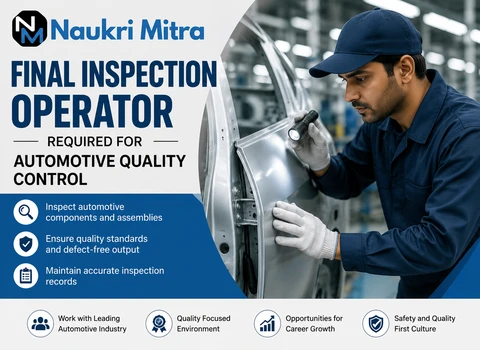
What Does a Final Inspection Operator Actually Do?
Before any automotive part leaves the factory, someone has to check it. That someone is the Final Inspection Operator. It's a Full-time role based in Manesar, Haryana, and the job comes down to one question, asked hundreds of times per shift: does this part meet spec or not?
People sometimes assume machines catch every flaw on their own. They don't. A press or a CNC machine can drift out of tolerance without anyone noticing until a human checks the output. That's where this job fits in — the last set of eyes and hands before a component gets a pass or a rejection tag.
Why This Position Exists in the First Place
Automotive parts run on tight tolerances. A bracket that's off by half a millimeter might still look fine to the naked eye, but it can cause fitment problems down the line, or worse, a functional failure once the vehicle is on the road. Manufacturers in industrial hubs like Manesar hire inspection staff specifically to prevent that — not to slow production down, but to protect it from costly recalls and rework later.
A Shift, Start to Finish
Most days begin with picking up the inspection checklist for whatever batch is running. Then it's a cycle: pull a sample (or check every piece, depending on the process), measure it against the drawing, log the result, move on. Toward the end of the shift, there's usually paperwork — updating registers, tagging rejects, handing over notes to the next shift if one is coming.
It sounds repetitive on paper. In practice, no two hours are quite the same, because different batches bring different problems.
What the Job Involves Day to Day
- Checking dimensions with vernier calipers, micrometers, height gauges, and dial indicators
- Matching parts against engineering drawings and approved master samples
- Logging measurements by hand or into a digital quality system
- Spotting surface defects — burrs, dents, scratches, incomplete machining
- Pulling rejected or reworked pieces out of the batch
- Flagging repeat problems to the supervisor or tool room before they snowball
Where This Work Actually Happens
Think assembly lines, press shops, and quality control bays inside automotive component plants. Some factories also keep a separate metrology room, away from the noise and vibration of the shop floor, for the more sensitive checks. Not every part gets measured on the line itself.
The Tools You'll Be Handling
Vernier calipers and micrometers cover the basics. Beyond that, go/no-go gauges, surface plates, and occasionally a CMM (coordinate measuring machine) come into play for tighter tolerances. Experience with EDM — Electrical Discharge Machining — is a genuine plus here, since parts produced this way often need close dimensional checking. If you've worked around EDM before, mention it; employers notice.
Being able to actually read a drawing matters more than people expect. Knowing what a tolerance symbol means, or having a basic grasp of GD&T, separates someone who can just use a gauge from someone who understands why the measurement matters.
Who Employers Tend to Hire
An ITI certificate in a machining trade opens the door for this kind of role. So does a Diploma in Mechanical or Tool and Die Engineering. Equivalent vocational training counts too. But formal paper only goes so far — plenty of hiring managers care just as much about whether you've actually held a micrometer and read a drawing under real production pressure, not just in a classroom.
On Your Feet, Under the Lights
This isn't a desk job. Expect to be standing for most of the shift, doing repetitive hand movements, and staring closely at small parts for extended periods. Decent eyesight and a steady hand go a long way. Automotive plants commonly run rotating shifts, so flexibility around timing is part of the deal. The environment is indoors, but it's rarely quiet — nearby machines keep running while inspection continues.
Staying Safe Around the Line
Inspection stations sit close to active machinery, so basic shop-floor discipline isn't optional. Safety shoes, gloves, and safety glasses are standard PPE for this kind of work. Beyond wearing the gear, it helps to keep the inspection table clear and speak up early if something looks unsafe — a loose guard, a slippery patch, anything out of place.
What Makes This Job Harder Than It Looks
Production doesn't wait. There's pressure to move through batches quickly while still catching every real defect, and those two goals pull against each other. Long stretches of similar checks can dull concentration too — which is exactly when a bad part slips through. Operators who stay in this field tend to develop a steady checking rhythm and re-verify anything that looks borderline rather than guessing.
Where the Role Can Lead
Time on the floor adds up to something. Operators who stick with quality work often move into senior inspector roles, or into a quality control supervisor position, or toward metrology-focused work if they get comfortable with advanced measuring equipment. Getting familiar with digital quality documentation systems tends to accelerate this progression, as more plants are shifting away from paper logs.
Pay and What Might Come With It
The salary for this Full-time position in Manesar, Haryana, India, is ₹34,200 a month. Beyond the base pay, some employers offer overtime, PF, ESI, a bonus, uniforms, or transport and canteen facilities — though this varies by company, and none of it should be assumed as guaranteed.