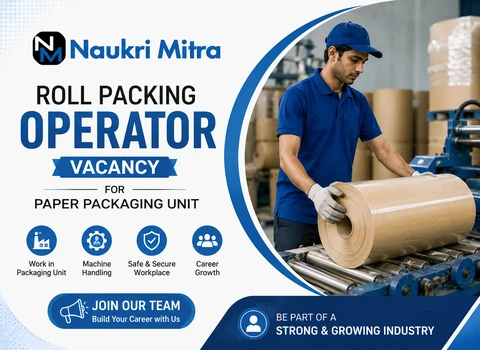
What It Means to Work as a Roll Packing Operator
Before a paper roll ever reaches a printer, a shop, or a factory customer, someone has to ensure it survives the journey. That's the job of a Roll Packing Operator. The rolls come off the production line, and it's the operator's task to wrap, seal, label, and prepare them to travel without tearing, crushing, or picking up moisture along the way. It's not glamorous work, but it's necessary, and in Sivakasi, Tamil Nadu, where printing and packaging businesses form a big part of the local economy, there's steady demand for people who can do it well. This particular opening is full-time and pays ₹28,200 per month.
Why This Job Exists in the First Place
Paper is fragile in ways people don't always think about. A roll that looks fine sitting in a factory can arrive damaged at its destination if it wasn't wrapped tightly enough, or if moisture got in through a weak seal. That's expensive for a company - damaged stock means returns, complaints, and wasted material. So factories keep dedicated packing staff on hand rather than leaving this to whoever's free. A good operator catches problems before they leave the building, not after a customer calls to complain.
A Day on the Packing Line
Most shifts start the same way: checking the line, laying out wrapping material, and confirming the rolls coming from production actually match what was ordered - right size, right weight. From there it's a steady rhythm. Feed the roll in, wrap it, seal the edges, slap on a label. Repeat. By the end of the shift, there's usually stacking and staging work too, getting finished rolls positioned for storage or for loading onto a truck.
What the Job Actually Involves
- Wrapping rolls by hand or machine using packing paper, stretch film, or corrugated sheets
- Running semi-automatic or fully automatic packing equipment
- Sealing and strapping each unit so it holds up during transport
- Checking rolls for damage or size mismatch before they get packed at all
- Logging what got packed and dispatched each day
- Keeping the work area clear of paper scraps and packing waste
Where People in This Role Actually Work
This isn't limited to one type of factory. Printing presses need it, tissue paper units need it, corrugated box manufacturers need it - basically anywhere paper rolls are the finished product. Sivakasi has built a name for itself in printing and packaging over the years, and that means there's usually more than one unit in the area looking to fill this kind of position.
The Equipment You'll Get Familiar With
Expect to work with roll wrapping machines, strapping machines, heat sealers, and weighing scales. A lot of smaller units still do some of this by hand at manual wrapping tables, especially for odd-sized rolls that don't fit standard machine settings. Once you know how to set a heat sealer's temperature correctly or load a strapping machine without jamming it, you become the person supervisors trust with the trickier batches.
Who Tends to Do Well Here
You don't need a fancy resume for this. What matters more is whether you pay attention - can you tell a properly wound roll from a defective one just by looking? Can you keep your hands steady doing the same motion for hours without it turning sloppy? Freshers get trained on the job, and that's normal. That said, candidates who've done an ITI course or spent time on any factory floor before tend to pick things up a bit faster than someone walking in cold.
The Physical Side of the Job
Be honest with yourself about this part: it's a standing job, a lifting job, and a repetitive-motion job. Rolls aren't always light, and doing the same wrapping movement shift after shift takes a toll if your technique is off. Since this is a Full-time position, expect a fixed shift structure, though some units adjust shift timing when order volumes spike.
Staying Safe Around the Machines
Strapping bands can cut if you're careless with them, and packing machines have moving parts that don't care whether your sleeve is loose. Gloves and safety shoes are standard here, and a dust mask often helps too, since paper dust builds up faster than people expect in a packing area. Machines get switched off properly during maintenance - never worked on live - and that rule exists for a reason.
Where Things Tend to Go Wrong for Beginners
New operators usually stumble in one of two places: either they pack too slowly trying to be careful, or they rush and start missing size mismatches between batches. Both settle with time. The other issue people underestimate is physical strain - sore shoulders, aching wrists - which is really just a sign that lifting technique needs fixing, not that the job itself is too hard.
Building a Career Out of This
Stick with it, and there's room to grow. Reliable operators often get pulled into quality-checking duties or eventually into supervising an entire packing line. Some specialize further, becoming the go-to person for running the more advanced automated equipment. None of this happens overnight, but consistency on the floor tends to get noticed.
Pay and What Else Might Come With the Job
The salary for this Full-time position in Sivakasi, Tamil Nadu is ₹28,200 per month. Beyond the base pay, some employers offer extras like overtime, PF, ESI, an annual bonus, uniforms, or canteen access - though these depend entirely on the specific company and shouldn't be assumed as guaranteed.