What Does a Pouch Making Machine Operator Actually Do?
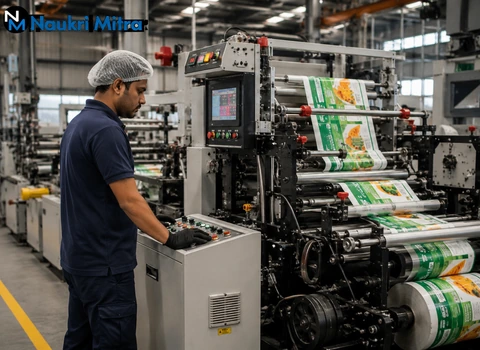
Walk into any flexible packaging plant, and you'll notice the pouch section almost immediately — rolls of film feeding into machines, the hiss of sealing bars, finished pouches stacking up at the end of the line. That's where a Pouch Making Machine Operator spends the day. The job is about converting rolls of plastic or laminate film into finished pouches, the kind used for packing snacks, spices, food products, personal care items, and a long list of industrial goods. In Silvassa, Dadra and Nagar Haveli, and Daman and Diu, this full-time role sits at the center of that production process.
Why This Role Keeps Coming Up in Hiring Lists
Pouches have quietly replaced a lot of rigid packaging over the last decade. They're lighter, cheaper to ship, and take up less warehouse space — reasons enough for FMCG and food companies to keep ordering more of them. But machines don't run themselves. Someone has to load the film, set the parameters, and catch problems before a whole batch turns into scrap. That's exactly why plants keep this position on their hiring lists. A good operator is the difference between a smooth shift and a costly one.
How a Shift Usually Unfolds
Most days start with a walk-around: checking the film roll, confirming sealing temperatures, making sure the last shift didn't leave anything unfinished. Once the machine starts running, attention shifts to watching — seal strength, pouch size, print alignment, film tension. Small things. But a pouch that's off by a couple of millimeters, or a seal that's slightly weak, can mean rejected stock further down the line. So the eyes stay on the machine, not the clock.
What the Job Actually Involves
- Loading and threading film rolls through the machine correctly
- Adjusting sealing temperature, speed, and tension for each pouch type
- Inspecting finished pouches for seal quality, size, and print accuracy
- Logging production figures and flagging rejections or downtime
- Handling routine cleaning and basic preventive maintenance
- Looping in supervisors whenever material or tooling changes are due
The Machines and Instruments You'll Get Familiar With
Operators generally work on form-fill-seal machines, side-seal or center-seal pouch units, and in some plants, rotary pouching machines. Alongside the machine itself, there's a set of instruments that become part of the daily routine — tension meters, thickness gauges, seal-strength testers, and the usual hand tools for quick adjustments. Understanding why heat sealing works the way it does, how temperature and dwell time affect the bond between film layers, isn't something you learn from a manual. It comes from watching the machine long enough to know when something's off.
Skills That Actually Matter on the Floor
Technical knowledge helps, but attentiveness is what separates a decent operator from a good one. Many employers prefer candidates with an ITI qualification in a relevant trade, or a diploma in mechanical, plastics, or packaging technology. That said, hands-on experience running machines, reading basic engineering drawings, and using measuring instruments often counts for just as much as a certificate on paper. Add to that some troubleshooting instinct, patience through changeovers, and a comfort level around moving parts — and you've got someone plants want to keep around.
Where You're Likely to Find This Kind of Work
This role turns up across flexible packaging units, film converting plants, and manufacturing facilities tied to FMCG supply chains. Industrial belts like Silvassa host a fair number of plastic processing and packaging setups, many of them supplying pouches to food, pharma, and consumer goods companies. It's the kind of work that stays in demand as long as packaged products keep moving off shelves.
What the Work Demands Physically
Expect to be on your feet for long stretches. There's lifting involved when handling film rolls, and staying alert matters — you're working near moving parts and heated sealing bars for most of the shift. Depending on how the plant is run, this may include rotating shifts or night duty. Near the sealing stations, it can get warm, and noise levels in most production halls sit somewhere between moderate and fairly loud.
Safety Isn't Optional Here
Around sealing bars, cutting blades, and rotating rollers, there's no room for shortcuts. Safety shoes and hand gloves are standard PPE, with ear protection added depending on how loud a particular machine runs. Operators are trained to power down before clearing any jam, keep loose clothing well away from moving parts, and report anything unusual — a strange vibration, an odd smell — right away rather than waiting to see if it resolves itself.
The Everyday Challenges Nobody Mentions Upfront
Changeovers are probably the trickiest part of the job. Switching pouch sizes or film types requires fresh calibration almost every time. Material is often wasted during setup, seals occasionally leak, and print misalignment shows up when least expected. None of this is unusual — it's the nature of running a machine that has to adapt constantly. What matters is staying steady through it and communicating clearly with maintenance when something needs a second pair of hands.
Where This Can Lead Over Time
Operators usually start on one machine type and, with time, pick up others — handling multiple pouch formats and more advanced converting equipment along the way. Consistent performance tends to open doors toward senior operator roles, shift-in-charge positions, or machine setter responsibilities within the same plant. Some go on to train newer staff or take a more active role in improving line efficiency, which is often how experienced operators end up shaping how a shift runs.
Pay and What Might Come With It
This position is offered as full-time work, with a monthly salary of ₹23,500. Beyond the base pay, employers may offer overtime, Provident Fund (PF), Employees' State Insurance (ESI), an annual bonus, uniforms, and in some cases transport or canteen facilities. None of these are guaranteed across every employer — they vary, so it's worth confirming directly during the hiring process.
If You're Just Starting Out
Freshers, ITI candidates, and diploma holders looking for a way into the flexible packaging sector will find this a reasonably practical entry point. It doesn't demand years of prior experience, just a willingness to learn machine behavior and stay sharp during a shift. For anyone considering this Pouch Making Machine Operator role in Silvassa, the path forward is fairly straightforward: show up, pay attention to the details, and the skills build from there.