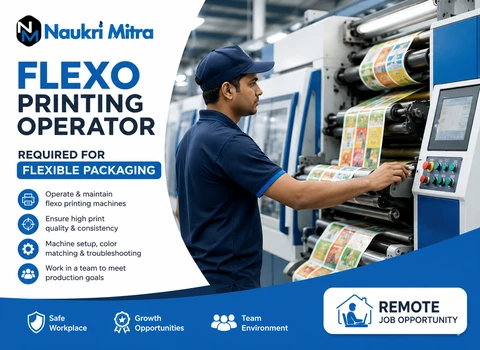
Flexo Printing Operator Required for Flexible Packaging
Flexo printing is one of those trades where the work looks simple from outside a factory window and turns out to be anything but. The operator sets the plates, gets ink flowing at the right thickness through the anilox roller, and keeps watching the film as it runs - because a press that's printing perfectly at 9 am can start drifting by 10. This opening is in Ahmedabad, Gujarat, a Full-time role in flexible packaging production, paying ₹28,000 a month.
People who've never stood next to a running flexo press underestimate how much attention it takes. Ink viscosity shifts a little, temperature in the shed changes, and suddenly the color on meter 400 doesn't quite match meter 4. Spotting that gap early is most of the job, honestly.
Why Packaging Companies Hire For This Specifically
Think about how much printed flexible packaging surrounds us - spice pouches, shampoo sachets, snack wrappers, pharma strips. All of it has to look identical from the first roll to the last, or the whole batch gets scrapped, and that material cost is gone. Companies don't want to keep training new people every few months, so a machine operator who can hold quality steady across a long shift tends to stick around.
A Shift Doesn't Really Follow a Script
There's a general shape to the day, though it rarely goes exactly the same way twice. Before the press starts, rollers and plates get checked. Plates are mounted and aligned. Ink gets matched to the job card - sometimes just by eye, sometimes with a spectrophotometer if the client is picky about the shade. A trial run follows, checking registration before the machine goes full speed. Then it's watching, adjusting, watching some more, and logging wastage and output once the run ends.
Orders change week to week. Different film, different ink combination, different level of design complexity - so the routine bends around whatever's on the schedule.
It's Not Just Pushing Buttons
A technician here fixes minor problems mid-run instead of shutting down the whole line every time something looks slightly off. That means keeping an eye on anilox roller wear, catching ink viscosity issues before they turn into streaking, and talking to quality control the moment print quality starts to slip - not waiting for someone else to notice first.
Where People In This Trade End Up Working
Flexible packaging plants, laminating units, and film converting factories are the usual places. Ahmedabad has a decent cluster of packaging and printing manufacturers, a lot of them supplying food processing and FMCG companies that need large volumes of consistently printed film.
What's Actually On The Machine
Central impression (CI) flexo presses and in-line flexo units form the core equipment. Around them: anilox rollers and doctor blades, viscosity cups for checking ink thickness, plate mounting tape and mounting machines, color reference charts, sometimes a spectrophotometer, and a set of basic hand tools for adjustments during setup. Knowing what each piece does - and why - is what separates someone who just runs the machine from someone employers actually trust with the tricky jobs.
What Makes Someone Good At This
Technical know-how about ink behavior and film types gets a candidate hired. What keeps them employed is patience during setup, plus an eye sharp enough to catch a registration mismatch before it wastes a hundred meters of expensive film. A bit of comfort with computers helps too, since job cards and logs are digital in most plants now.
Education That Actually Helps Here
An ITI in printing technology or a mechanical trade is usually the starting point most employers look for. A Diploma in Printing Technology or Mechanical Engineering helps for those aiming at senior positions later. But plenty of skilled operators picked most of it up on the machine itself - hands-on time with plates, presses, and film often matters just as much as the paper certificate.
What The Body Goes Through
Standing for most of a shift is normal. Film rolls are heavy, machine parts move close by, and staying alert matters more than it might seem. The floor gets loud, there's usually an ink smell in the air, and that's exactly why ventilation and basic safety habits aren't optional extras. Shift work is common - packaging plants tend to run multiple shifts to keep up with delivery deadlines.
Safety Isn't Something To Skip
Moving rollers, ink chemicals, sharp blades - none of it forgives carelessness. Safety shoes and gloves are standard. Ear protection near the faster machines is common too. Before cleaning or adjusting a roller, proper lockout steps matter - this is not a place to rush through a shortcut.
What Trips Up New Operators
Color matching is the thing almost everyone struggles with early on. Holding registration steady through a long run is another. Film tension problems and ink drying unevenly under certain shop conditions round out the usual list. Most of this improves with repetition - the more runs someone watches closely, the faster they start noticing trouble before it wastes material.
Growing Into Something Bigger
Stick with it, build a reputation for consistent quality, and the path usually runs through senior operator, then shift in-charge, then press supervisor. What gets someone trusted with the higher-value jobs is usually troubleshooting ability and a genuinely sharp eye for quality - not just years on the job.
What This Pays, And What Might Come With It
For this Ahmedabad, Gujarat position, the salary is ₹28,000 per month, Full-time. Some employers also offer overtime pay, PF, ESI, a festival bonus, uniforms, or transport and canteen facilities - though none of that should be assumed before actually joining, since it varies by company.
A Bit Of Honest Advice
Freshers: spend a little time before the interview learning about ink types and film substrates; it makes on-the-job training much easier to follow. If you've already got experience, be ready to walk through a real situation where you caught a color-matching problem or fixed something mid-run. That's usually worth more in an interview than anything written on the resume.