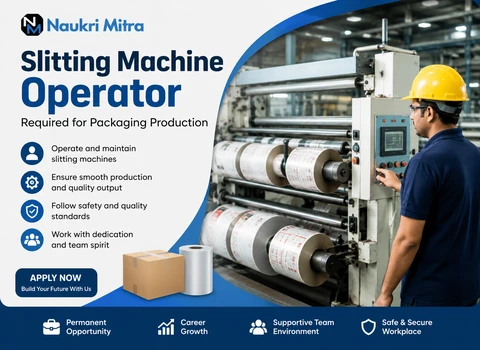
So You're Looking Into Slitting Machine Work
Here's the thing about packaging plants — the film, paper, or foil never shows up in the size anyone actually needs. It comes in wide, heavy rolls, and somebody has to cut it down before printing or pouch-making can even start. That somebody is the Slitting Machine Operator. There's an opening right now for this, Full-time, in Daman, Dadra and Nagar Haveli, and Daman and Diu, India, and it pays ₹28,000 a month. It's not a role people usually grow up wanting, but once you're in a packaging unit for a while, you realize how much rides on this one machine working right.
Why This Even Needs a Dedicated Person
You'd think cutting a roll of film into strips would be automatic and mostly hands-off. It isn't, not really. Tension shifts, blades dull, rolls drift off-center — small things that ruin a batch if nobody's watching. A plant loses money every time a roll comes out wrinkled, or the width is off by a couple millimeters, and multiply that across a full shift, and it adds up. So companies keep someone at the machine full-time, adjusting, watching, catching problems before they become expensive ones.
A Rough Idea of How the Day Goes
First thing, you'd check what's on the schedule — which order, what width, what material. Then the parent roll goes up on the unwind stand, gets threaded through the blades, and the rewind side gets set up to take the finished narrow rolls. After that it's mostly watching. Tension gauge here, roll edge there, occasional check with a width gauge to make sure nothing's drifted off spec. Some shifts this is boring, honestly; everything runs clean for hours. Other times, a new batch of material behaves differently than the last one, and you're readjusting every 20 minutes to get it stable again.
What You'd Actually Be Doing, Broken Down
The daily list isn't complicated but it does add up: loading rolls and setting blade widths to match the order, keeping tabs on speed and tension while the machine's running, catching problems early — uneven edges, wrinkling, rolls that telescope instead of sitting flat — logging output and flagging any wastage or downtime, handling small fixes yourself instead of waiting on maintenance for every little thing, and staying in touch with whoever's running the floor about which orders need to go first.
The Kind of Place You'd Be Working In
This kind of job is found in flexible packaging plants, paper conversion units, film manufacturing setups, and label workshops — that general category. Across India, a decent number of these are clustered in industrial estates that feed into FMCG, food packaging, pharma packaging, or textile supply chains. It's not office work. Expect noise, machines running one after another down the line, material constantly moving past you.
Equipment You'd Get Familiar With
The slitter is the main thing, obviously — razor blades, shear knives, or score-cutting setups depending on what's being cut. Then there's the unwind and rewind stands, tension controllers, width gauges, and hand tools for blade changes. The control panel feels unfamiliar the first week or two — speed settings, tension dials, stop points — and then one day it just clicks, and you stop thinking about it.
What Separates Someone Who's Good at This From Someone Who's Just Getting By
Understanding how tension and blade pressure affect the cut is more important than people expect before they start. Film doesn't behave like paper, paper doesn't behave like foil, even under identical settings — you learn that by watching it happen, not from reading about it beforehand. Mechanical sense helps too, especially for small jams or a quick blade swap you don't want to sit around waiting on maintenance for. But a lot of it comes down to patience. Staying alert through the slow, repetitive stretches and actually following the safety steps even when there's nobody around checking.
Employers generally like seeing some formal background behind a candidate — an ITI in a machining trade, or a Diploma in Mechanical Engineering, gives you an edge on paper. Real hands-on time with production machinery often counts just as much, though, sometimes more, once you're being judged by what you can do rather than what's written down. Being comfortable reading a basic spec sheet and using measuring tools properly rounds out what most units want to see.
What It Does to Your Body
Long hours standing, guiding or lifting rolls, staying alert around machinery running at speed — that's the physical reality of it. Shift work comes with the territory, rotational shifts especially, since these lines don't stop the way an office does at 6 pm. You need stamina for it, and the ability to stay switched on through the slower stretches when it's tempting to zone out a little.
Safety Isn't Something to Get Casual About
Exposed blades, rolls that keep turning even when the machine looks still — that's what you're working around. Gloves, cut-resistant sleeves, safety goggles, closed shoes- that's the standard PPE most operators wear on this job. Guards stay on the machine, no exceptions, and lockout steps come before touching a blade or doing any cleanup. If something sounds off or a roll starts jamming, you flag it right away. Waiting to see if it fixes itself is how accidents happen.
The Stuff That Trips People Up
Material isn't always consistent batch to batch, so a setup that worked fine yesterday might act differently today. Blades wear down slowly enough that you don't always notice until the cut quality's already off. Then there's the pressure to hit output targets, which can make some shifts feel like you're constantly choosing between speed and getting it exactly right. That balance gets easier the longer you're doing it — nobody nails it in the first month.
Where People Usually Go From Here
Stay consistent, and you'll probably start handling more complex setups or end up showing new people how things work. Quality-check responsibility tends to follow. Some operators eventually move into maintenance oversight or shift supervision — still packaging production, just with more on your plate. None of it happens quickly. It's built on the floor over time, not through a single training course.
What the Pay Looks Like
This Full-time position in Daman, Dadra and Nagar Haveli, and Daman and Diu comes with a monthly salary of ₹28,000. On top of that, depending on the employer, there might be overtime, PF, ESI, bonuses, uniforms, transport, or canteen access — none of that guaranteed across the board, so it's worth checking directly with whoever's hiring.
If you're weighing this kind of work as a starting point in manufacturing, it's a reasonably solid one — steady hours, a clear way to build skill over time, and enough room to grow without having to jump ship into a completely different trade later on.