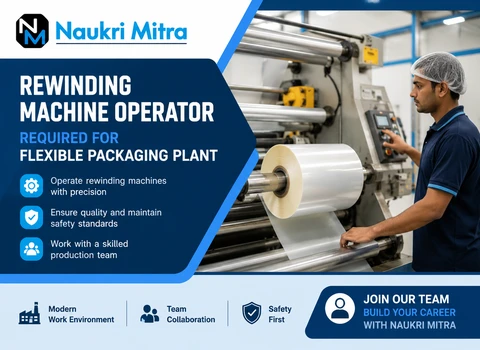
What Happens on the Rewinding Line in a Packaging Plant
Walk into any flexible packaging unit, and you'll notice large rolls of film moving through several machines before they're ready to leave the factory. One of the last stages in that journey is rewinding, where a big master roll gets converted into smaller, properly wound rolls that a customer or the next machine can actually use. The person who runs that machine is called a Rewinding Machine Operator, and the job is more technical than it sounds from the outside.
Why This Job Exists in the First Place
Master rolls coming off a printing or laminating line are often too wide or too long for practical use. Customers order rolls in specific widths, and downstream machines are built for particular roll sizes. If nobody manages the rewinding stage properly, the film can come out wrinkled, loosely wound, or cut at the wrong width, resulting in wasted material and rework. So plants keep dedicated operators on this machine rather than treating it as an afterthought.
A Shift Doesn't Look the Same Every Day
Some days involve running the same film type for hours; other days bring frequent changeovers between different orders, each with its own width and core size. A shift typically starts with checking the job card, loading the master roll onto the unwind stand, and threading the film through the machine before winding begins. Once the machine is running, the operator isn't just standing and watching — tension needs adjusting, edges need to stay aligned, and any bubbles, creases, or scratches on the film have to be caught before too much material passes through.
Toward the end of a roll, the operator checks the finished output, trims it if required, labels it, and logs details like roll length and any wastage. That data usually goes into a production register or a digital system, depending on how the plant tracks output.
What the Job Actually Involves
- Setting machine parameters — width, tension, winding speed — based on the production order
- Watching the film closely for wrinkles, air pockets, misalignment, or thickness issues
- Handling roll changeovers without losing production time
- Keeping basic production records, including downtime and material rejected
- Doing routine cleaning and small preventive checks so the machine doesn't break down mid-shift
- Flagging quality issues to supervisors instead of letting bad material move forward
The Machine, and What Sits Around It
The rewinding machine itself can be manual, semi-automatic, or fully automatic — smaller units may still run manual setups, while larger plants tend to invest in automated lines with sensors for tension and edge control. Around the main machine, you'll usually find slitting attachments for cutting film into narrower widths, core cutters, and tools like micrometers or thickness gauges to check the film meets spec. A measuring tape and a sharp cutting knife are still used daily, even in more automated setups.
Skills Worth Having Before You Apply
You don't need to be an engineer, but you do need a working understanding of how tension affects a roll — too tight and the film can stretch or telescope off the core, too loose and it slips. Reading a job card correctly matters just as much as running the machine. Beyond that, the practical stuff counts for a lot: staying alert during repetitive work, noticing a small defect before it becomes a big rejection, and being comfortable troubleshooting a minor jam without waiting for someone else to fix it.
Who Plants Usually Hire For This
Freshers do get hired, especially when the plant is willing to train them on its specific machines. That said, candidates with an ITI in a mechanical or electrical trade, or a diploma in mechanical or plastics engineering, often have an easier time picking up the role. Anyone who's already worked around film-converting or packaging machinery — even in a different department — usually adjusts faster than someone coming in with no factory exposure at all.
On Your Feet, and On the Clock
This is a full-time position, and you are expected to be standing for most of the shift. Rolls aren't always light, so there's some physical handling involved too. Flexible packaging plants commonly run round-the-clock production, which means shift work is part of the deal — something worth confirming before you accept an offer.
Inside the Factory: Noise, Safety, and Daily Habits
The floor is a working factory environment — machine noise, film moving at speed, rolls being shifted around. Safety shoes and gloves are standard, and ear protection is used near loud machines. Before touching any moving part for adjustment or cleaning, operators are expected to follow lockout procedures rather than reaching in while the machine is running. Keeping the area around the machine clear of loose trim and scrap film also matters, both for safety and to avoid accidental jams.
What Trips People Up
Thin, delicate films are unforgiving — pull too hard or misalign the winding and you'll tear the material. Frequent changeovers between different orders can eat into productive time if you're not quick with setup. And keeping speed consistent over a long run, without letting quality slip, takes more practice than anything else. Most of this gets easier once you've handled enough film types to recognize how each one behaves.
Where the Role Can Lead
Operators who stick with it and perform consistently often move into senior operator roles or shift-in-charge positions. Some transition into handling slitting or lamination lines within the same plant, since the underlying skill set — tension control, film handling, quality checking — carries over. It's a trade where on-the-floor experience tends to matter more than paperwork.
Pay and Location Details
This particular opening is based in Silvassa, in the Union Territory of Dadra and Nagar Haveli and Daman and Diu, India, and it's a full-time role. The salary on offer is ₹28,500 per month. Actual pay across the trade varies with experience and the complexity of the machinery, but this figure reflects what's being offered for this specific position.
Other Things That May Come With the Job
Depending on the employer, you might also see overtime pay, PF and ESI coverage, an annual bonus, uniforms, or transport and canteen facilities. None of these are guaranteed across every plant, so it's worth asking directly during the hiring process rather than assuming they're included.