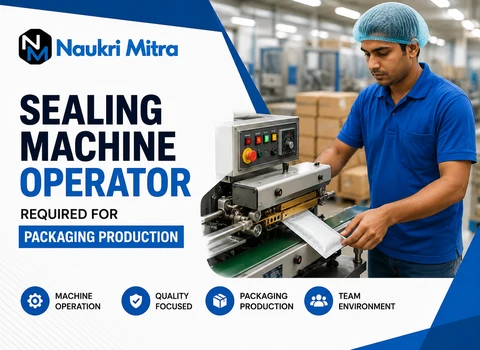
What Sits Behind Every Sealed Pouch on a Shelf
Pick up almost any packaged food item or consumer good, and somewhere on it there's a seal holding the product in. Someone ran the machine that made that seal. In Daman, part of the union territory of Dadra and Nagar Haveli and Daman and Diu, this job is titled Sealing Machine Operator and is offered as a full-time position. The work itself is straightforward to describe but harder to do well: take loose or bulk product, run it through a sealing machine, and hand over a finished, properly closed package that won't leak, tear, or fail on the way to a customer.
The Reason This Job Exists on a Production Line
A weak seal doesn't always show up right away. Sometimes it's fine off the line and fails a week later in a warehouse or on a truck. That's the risk manufacturers are trying to avoid, and it's why the sealing stage isn't left unattended or handled casually. An operator who notices a slightly uneven seal, or catches that the machine is running a touch too hot, saves the company from a returned batch. Small adjustments, made early, prevent expensive mistakes later.
The Kinds of Places That Need This Role
Food processing units, pharmaceutical packing lines, FMCG plants, and contract packaging facilities all use sealing operators in some form. Daman and its surrounding industrial belt have a fair number of small and mid-sized manufacturing setups, and wherever goods are being pouched, boxed, or bottled for dispatch, this kind of role tends to show up.
Walking Through an Actual Shift
The first twenty minutes or so usually go into machine setup rather than production. Temperature is checked, the film or pouch roll is loaded and aligned, and settings from the previous shift are cleared out or verified. Once the line starts moving, most of the shift is a rhythm of feeding material, watching the seal come out, pulling a sample every so often to check it by hand, and nudging the heat or pressure dial if something looks off. Near the end, jaws are cleaned, output numbers are logged, and any rejects from the shift are counted and reported.
A few things fill out the rest of the daily list:
- Aligning film or pouches so they feed straight into the machine
- Watching dwell time along with heat and pressure settings
- Testing seal strength on random samples rather than every single unit
- Keeping a record of production counts and rejection numbers
- Flagging jams, torn film, or odd machine noises before they become bigger problems
Equipment an Operator Gets Familiar With
Depending on what's being packed, this could mean working with a band sealer, an induction sealer, a vacuum sealer, or a conveyor-based heat sealing unit. Alongside the main machine, there's usually a seal strength tester, a thermometer or gauge to check the sealing head's temperature, and a small kit of hand tools for minor repairs. Reading the control panel and knowing what the numbers on it actually mean in practice — not just in theory — is most of the learning curve here.
Where Formal Training Helps, and Where Experience Takes Over
An ITI qualification in a relevant trade, or a diploma in mechanical or a related production stream, is something employers tend to look at favorably. It's not always a strict requirement, though. Plenty of people build a solid track record in this line of work through hands-on exposure alone, learning the machine by running it every day rather than through a classroom. What ends up mattering more day-to-day is whether someone can read a seal, spot when something's off, and understand packaging materials well enough to troubleshoot without waiting for someone else to step in.
On the more practical side, the traits that tend to separate a dependable operator from an average one aren't complicated: noticing small defects before they pile up, staying calm when a machine jams mid-run, sticking to standard procedures even when the shift is busy, and simply being comfortable working near heat-generating equipment for hours at a stretch.
What the Job Asks of the Body
Most of the shift is spent standing, with a fair amount of repetitive hand movement — loading rolls, adjusting alignment, checking output by feel as much as by sight. Some units rotate this position across shifts to keep the line active throughout the day, so anyone taking up full-time work here should expect shift-based scheduling as part of the arrangement.
Inside the Packaging Floor
These areas are indoor and generally climate-controlled, since many packaged products are sensitive to temperature and humidity. Near the sealing stations themselves, it tends to run warmer, simply because of the heating elements involved. Conveyor noise is a constant, and during peak production periods the pace on the floor picks up noticeably.
Handling Heat and Moving Parts Without Getting Careless
Heated sealing jaws and moving conveyor parts don't leave much room for shortcuts on safety. Heat-resistant gloves, safety shoes, and, depending on the product, aprons or hairnets are typical PPE for this role. Keeping hands well clear of the sealing jaws while the machine is running matters more than it might seem, and reporting anything like exposed wiring or a machine that's running hotter than it should isn't optional — it's a basic part of the job.
What Tends to Go Wrong on a Given Day
Film tearing mid-run is common enough that most operators develop a quick fix for it without thinking twice. Temperature drift is another common headache, since even a small shift can degrade seal quality without any obvious warning signs. Keeping up during a high-volume run while still checking seals properly is its own balancing act. Over time, most operators get reasonably good at telling whether a bad seal is a machine problem or a material problem — that instinct doesn't come from a manual, it comes from doing the job long enough.
Building Something Longer-Term Out of This Role
People who stick with this work and perform consistently often move into supervising a section of the line, overseeing quality checks across several machines instead of just one, or specializing in more advanced sealing systems that newer operators haven't been trained on yet. None of this happens quickly, but a steady track record on the floor is usually what opens these doors.
What the Pay Looks Like and What Else Might Come With It
This particular full-time position, based in Daman, Dadra and Nagar Haveli and Daman and Diu, carries a monthly salary of ₹23,500. Beyond the base pay, some employers add overtime, PF and ESI coverage, a festival bonus, uniforms, or transport and canteen facilities — though none of these are standard across every packaging unit, and it's worth checking with a specific employer rather than assuming.
For someone weighing up a hands-on entry into manufacturing, this is a fairly practical starting point — the kind of role where the learning happens mostly on the floor, and where a few years of consistent work can genuinely open up more senior positions within the same packaging line.