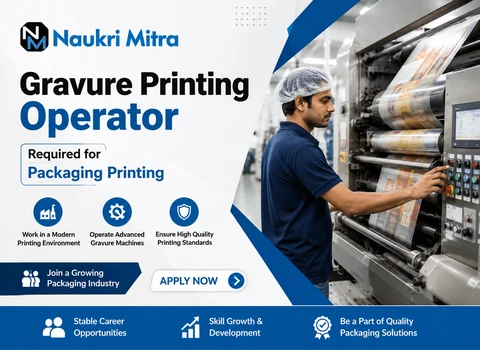
What Does a Gravure Printing Operator Actually Do?
Pick up any packaged snack or shampoo pouch and look closely at the print. Someone had to run the machine that put those colors down, layer by layer, without a smudge out of place. That's the job of a Gravure Printing Operator — handling the press that transfers ink onto film or paper for packaging material. It's less glamorous than it sounds, but it's a role that keeps many packaging factories running, and it demands genuine skill, not just button-pressing.
Why Packaging Units Keep Hiring for This Role
Gravure printing survives in this industry for one simple reason — speed with sharpness. A rotogravure press can churn out thousands of meters of printed film in a shift, and the print quality holds up even at that pace. But the machine is only as good as the person running it. Get the ink viscosity wrong, or miss a misaligned cylinder, and you end up with a roll of wasted film. That's why factories keep this a dedicated, Full-time position rather than something handled on the side.
Walking Through a Regular Shift
Most days start before the press even turns on. The operator checks the cylinders, tests ink viscosity with a cup, loads the film roll, and lines everything up. Once printing begins, it's a lot of watching — color registration, web tension, and whether the drying unit is doing its job. Every so often, a sample gets pulled off the line and held against the approved artwork. If something's off, you stop and fix it before more material gets wasted.
What the Job Involves, Day to Day
The core responsibilities don't change much from unit to unit, though the pace and pressure can vary a lot depending on order volumes:
- Setting and aligning printing cylinders before each job starts
- Mixing ink and adjusting viscosity so it prints cleanly
- Keeping an eye on web tension, running speed, and drying temperature
- Spotting print defects early — ghosting, streaks, color drift — and fixing the cause
- Cleaning doctor blades, ink chambers, and cylinders once the run is over
- Jotting down basic production numbers and wastage for the shift report
Where This Work Actually Happens
You'll find this role mostly in flexible packaging plants, printing and laminating units, and film manufacturing setups. These are places with large rotogravure presses running across multiple shifts, printing packaging for food, FMCG, and sometimes pharmaceutical products. Hyderabad and the wider Telangana belt now have a decent number of such packaging units, so it's a career path that makes more sense to pursue locally rather than chasing openings elsewhere.
The Machines and Tools You'll Work With
Expect to spend most of your time around rotogravure presses, engraved cylinders, viscosity cups, and color-matching charts. Web guiding systems help keep the film tracking straight, and many newer units have digital panels that let you monitor speed and tension without guessing. Basic hand tools also come into play, mostly for handling and cleaning cylinders between jobs. Knowing your way around all of this means less time standing around when something goes wrong.
The Skills That Actually Separate a Good Operator From an Average One
Understanding ink chemistry and color theory helps, sure. But honestly, a lot of it comes down to patience and a trained eye — noticing a slight color shift before it ruins a whole batch, staying alert around rotating machinery, knowing when to slow the press down instead of pushing through a problem. Freshers pick this up gradually on the job. Experienced hands often develop a kind of intuition for how ink behaves when humidity changes or when the press runs faster than usual.
What Employers Usually Look For on Paper
Employers may prefer candidates with relevant machining or tool room training. Depending on the complexity of the work, an ITI in a machining-related trade, a Diploma in Mechanical or Tool and Die Engineering, or equivalent vocational training may be considered suitable. Practical experience with EDM machines, engineering drawings, and precision measuring instruments is often valued as much as formal education.
Physical Side of the Job and What the Floor Feels Like
This isn't a desk job — you're on your feet for long stretches, sometimes lifting heavy cylinder rolls, always working close to moving parts. Print halls tend to be noisy, and there's usually a faint solvent smell in the air from the inks, so ventilation matters more than people expect. Since this is a Full-time role, shift rotations are common, and that can include night shifts when order volumes pick up.
Staying Safe Around the Press
Moving rollers, ink chemicals, electrical panels — none of it forgives carelessness. Safety shoes and gloves are standard, and ear protection often gets added in the louder sections of the floor. Lock-out procedures before cleaning or adjusting any part of the machine aren't optional extras; they're what keeps accidents from happening in the first place.
The Problems You'll Run Into (And How People Deal With Them)
Color mismatches show up more often than you'd like, especially on longer runs. Cylinders wear down. Ink dries faster or slower depending on the weather that day. Operators who handle this well tend to keep close notes on every job, clean their equipment properly rather than rushing, and flag quality concerns to a supervisor early, rather than waiting for a full batch to go wrong. It's a habit worth building early — it saves both material and reputation.
Where the Role Can Lead
Stick with it, and there's room to grow — senior operator roles, shift supervision, or moving into print quality checking within the same unit. None of this happens overnight, but operators who consistently deliver clean, low-wastage runs tend to get handed the more complex and higher-value jobs first.
Pay and What Else Might Come With It
For this position in Hyderabad, Telangana, India, the monthly salary is ₹27,000. Beyond that, some employers offer extras like overtime pay, PF, ESI, bonuses, uniforms, transport, or canteen access — though this varies by company, so it's worth confirming directly rather than assuming any of it applies.
If you're weighing up a career in packaging and printing, this role is a solid place to start — steady work, real skills to build, and enough room to grow if you stick with it.