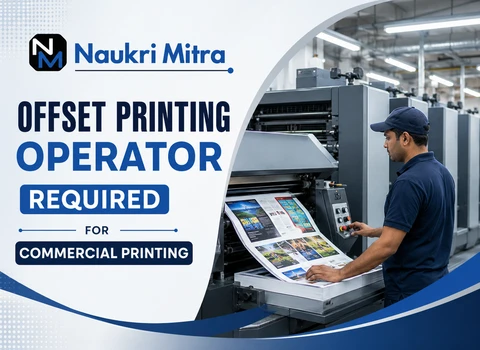
What It Actually Means to Run an Offset Press
Walk into any commercial printing unit in Sivakasi, and you'll usually find the same thing happening near the entrance of the shop floor — an operator hunched over a press, checking a sheet against a color proof under the light. That's the core of the Offset Printing Operator job. You're not just pressing a start button; you're setting plates, balancing ink and water, and catching problems before they turn into a wasted print run. It's a full-time position, and one that suits both someone just starting out and someone who's already spent years around printing machines.
Why Printing Units Keep This Role Filled
Offset is still the go-to method when a factory needs thousands of identical prints — packaging boxes, product labels, notebooks, calendars — done with sharp, consistent color every time. The catch is that offset printing punishes carelessness. Get the plate registration slightly off, or mix the ink wrong, and you don't get a few bad sheets; you get an entire batch that has to be reprinted. That's the real reason units don't just hand this machine to anyone off the street. They need someone who's been trained to read the press and react fast.
How a Shift Usually Plays Out
Most days start with the job card — what's being printed, how many copies, what paper stock, what colors. From there it's plate mounting, loading the feeder tray, and running a handful of test sheets before full production begins. Once the machine is running at speed, the job shifts from setup to watching. Paper can jam. Ink can smear if the rollers aren't clean. Color can drift a shade if the water balance isn't right. A good operator catches these things within seconds, not minutes.
What This Job Actually Involves, Day to Day
- Mounting plates and adjusting the press before each new job
- Mixing ink and matching it against the client's approved sample
- Keeping an eye on registration, sheet count, and print clarity while the machine runs
- Cleaning rollers and doing basic upkeep between jobs
- Flagging anything mechanical to the maintenance staff before it becomes a bigger problem
Where You'd Actually Be Working
This kind of role is usually found in commercial printing presses, packaging units, and label-manufacturing workshops. Sivakasi, one of Tamil Nadu's older printing hubs, has a fair concentration of these units — many of which produce packaging materials, calendars, and general stationery for supply across India. Some presses run a single color at a time; others run multi-color lines for bigger commercial orders, which changes the pace and complexity of the work.
The Machines and Tools You'll Actually Touch
The offset press itself is obviously the centerpiece — single-color, two-color, or multi-color depending on the unit's size and order volume. Beyond that, you're working with plate-making equipment, ink density meters, and simple color reference charts to check whether a print batch matches the approved sample. Basic measuring tools like calipers and scales come in too, mostly for checking paper thickness and trim size. None of this is exotic machinery — it's stuff you get comfortable with through repetition.
Skills That Actually Matter on the Floor
Knowing the theory behind ink chemistry or paper grades helps, but honestly, what separates a decent operator from a great one is instinct built through hands-on time. Can you tell a color has shifted just by glancing at the sheet, before it becomes an obvious defect? Can you clear a jam without stopping the whole line for ten minutes? That kind of reaction speed usually comes from experience, not from a textbook — though a technical foundation shortens the learning curve.
What Employers Look For on Paper
Freshers with an ITI in Printing Technology, or a Diploma in Printing and Packaging Technology, tend to have an edge when applying for this kind of position. That said, plenty of units are just as happy to take someone who's spent a year or two assisting on a press line and picked up plate setting, ink mixing, and how to read a job specification sheet along the way. Formal training helps you get in the door faster; the actual skill still gets built on the floor.
The Physical Side of the Job
Expect to be on your feet for most of the shift. There's lifting involved too — paper reams and board stacks aren't light, and you'll be moving them regularly. Since this is a full-time role and some units run rotating shifts to keep presses busy around the clock, being flexible with timing helps, especially when order volumes pick up.
What the Shop Floor Feels Like
There's a constant low hum of machinery, a faint smell of ink in the air, and rollers moving close enough that you learn to respect the machine early on. Safety gear isn't optional here — gloves, an apron, and ear protection where noise levels are high. Ink spills need to be cleaned up quickly, both for safety and to prevent the floor from becoming a slip hazard, and machines must be properly locked out before anyone performs maintenance on them.
The Problems You'll Run Into More Than Once
Color mismatches happen more often than anyone would like. Paper jams, too, especially in humid weather, which changes how the sheets feed. Deadlines don't wait for any of this, so there's a fair bit of pressure to fix issues quickly without letting quality slip. None of this goes away with experience — it just gets easier to handle calmly.
Moving Up From Here
Operators who stick with it and perform consistently often move on to running multi-color presses, which pay better and carry more responsibility. From there, some step into shift-in-charge roles or shift toward quality-checking positions within the same unit. It's not a fast ladder, but it's a real one — the kind of unit that trusts you with a two-color press today will often trust you with a bigger role a year or two down the line.
Pay and What Else Might Come With It
This particular Offset Printing Operator opening in Sivakasi, Tamil Nadu pays ₹25,500 a month, full-time. Some employers add extras on top of that — overtime pay, PF, ESI, a bonus around festival season, uniforms, or transport support — though this really depends on the company, and it's worth confirming directly with them before assuming any of it applies.