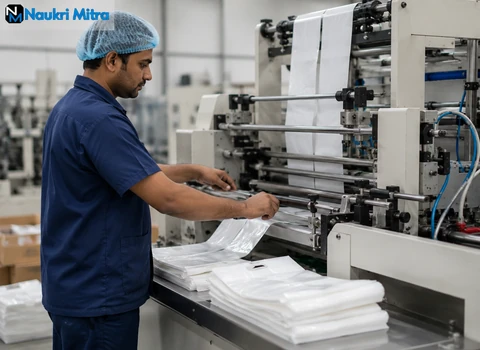
What Does a Bag Making Machine Operator Actually Do?
Walk into any packaging unit, and you'll usually find one machine running almost non-stop — feeding rolls of plastic or fabric in at one end, and pushing out neatly cut, sealed bags at the other. Someone has to run that machine. That's the Bag Making Machine Operator, a full-time role based in Vapi, Gujarat, and one of the more practical entry points into India's packaging manufacturing industry.
It's not glamorous work, but it's steady, and it rewards people who pay attention to detail rather than those looking for variety in their tasks.
Why This Role Exists in the First Place
Bags don't make themselves, obviously. But more importantly, a machine left unattended for even ten minutes can produce a stack of unusable output — wrong size, weak seals, torn edges. Factories lose money on that wastage. So they hire operators specifically to prevent it: someone who watches the process closely enough to catch a problem before it becomes fifty bad bags instead of five.
A Rough Sketch of the Daily Routine
Most shifts start the same way. Check the machine, load the raw material roll, and set the length and sealing temperature for the order running that day. Then it's a matter of watching. Bags come out fast once the machine is running, so an operator has maybe a second or two to notice if something's off before the next twenty bags carry the same defect.
In between, there's cleaning, re-threading material when a roll runs out, swapping a dull blade, and logging output numbers for the supervisor. None of it is complicated on its own. Doing it consistently across an eight- or twelve-hour shift is where the skill actually lies.
What the Job Involves, Boiled Down
Depending on the unit, an operator might handle any combination of the following:
- Running flat bag, U-cut, or side seal machines
- Adjusting temperature, tension, and cutting speed as material changes
- Checking seal strength and bag dimensions by hand, not just by eye
- Clearing jams and fixing minor faults without waiting for maintenance
- Keeping basic production logs
- Doing routine upkeep — cleaning, oiling, tightening loose parts
Where This Kind of Work Happens
Plastic bag manufacturers, woven sack units producing cement or grain packaging, paper bag plants — these are the usual employers. Vapi has a fairly dense cluster of plastic and packaging manufacturing units, which is part of why this role shows up so often in the region's job listings.
The Equipment You'll Be Standing In Front Of
The core machine varies by product — a side sealing machine behaves differently from a bottom sealing unit, and both are different again from a bag cutting and punching setup. Around the main machine, you'll typically deal with a tension gauge, a thickness gauge for checking material consistency, spare blades, heating elements, and whatever hand tools the shift toolbox has. Some lines also run a printing attachment, which means checking print alignment on top of everything else.
Skills That Actually Matter Here
Understanding heat sealing and material tension is the technical core of the job. But honestly, a lot of what separates a good operator from an average one isn't technical at all — it's attentiveness. Noticing a seal that looks slightly off before it becomes a rejected batch. Not letting your attention drift during the seventh hour of a shift. Knowing when to stop the machine and call for help instead of trying to force a fix.
Where Training Comes From
Freshers, ITI candidates, and diploma holders in mechanical or plastic technology fields are all reasonable fits for this position. Some employers lean toward candidates who've had hands-on exposure to production machinery, engineering drawings, or precision measuring instruments — that kind of practical grounding often counts for more than the specific certificate on paper. Plenty of units are also willing to train freshers directly on the machine, so a lack of prior experience isn't necessarily disqualifying.
What the Body Goes Through
This is a standing job. Rolls of raw material are heavy enough that lifting comes up regularly. The sealing process generates heat, so the area around the machine tends to stay warm even when the rest of the floor doesn't. Shift work is common — packaging plants often run rotating shifts to keep the machines producing around the clock.
Staying Safe Around the Machine
Sealing bars get hot. Cutting blades are sharp. Moving parts don't stop just because a hand gets too close. None of this is unusual for factory work, but it means operators need to actually follow the safety steps rather than treat them as optional — switching off the machine before clearing a jam, for instance, instead of reaching in while it's still running. Gloves and safety shoes are standard; some floors also require ear protection where noise levels run high.
What Tends to Go Wrong
Material changeovers are a common headache — switching from one roll thickness or bag size to another means resetting several parameters at once, and it's easy to miss one. Long runs test consistency; it's one thing to make a perfect bag, another to make the four-hundredth one just as well as the first. And machines do fail unpredictably sometimes, which means staying calm under a bit of pressure is part of the job whether it's written down or not.
A Few Things That Actually Help
New operators generally do better by shadowing an experienced operator for the first couple of weeks rather than trying to figure everything out on their own. Keeping a mental — or literal — list of common faults and their fixes speeds things up considerably over time. And cleaning the machine even when nobody's told you to tends to pay off, since a lot of breakdowns start as small buildups that go unnoticed.
Where This Can Lead
Operators who stick with it and perform reliably often move into senior operator roles or shift-in-charge positions. Some shift sideways into maintenance or quality control within the same unit. Being able to run more than one type of machine — side seal and flat bag, say, rather than just one — tends to open up more of these options over time.
Pay for This Position
The monthly salary for this Bag Making Machine Operator role in Vapi, Gujarat is ₹23,000. Pay across the wider packaging sector does shift depending on experience and the complexity of machines an operator can handle, but this is the figure attached to this specific opening.
Other Benefits That May Apply
Some employers in this line of work offer extras such as overtime pay, PF and ESI coverage, an annual bonus, uniforms, or transport and canteen facilities. These aren't guaranteed and differ from one company to the next, so it's worth confirming directly with the employer what applies.