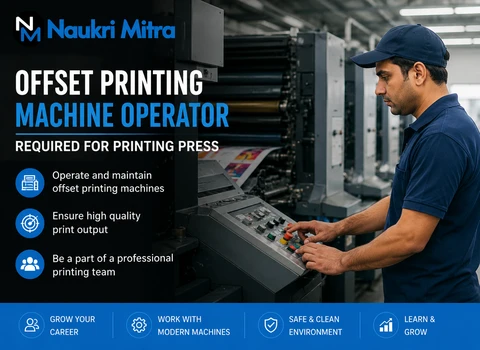
The Sound of a Press Running Right
Anyone who has stood near a running offset press knows the sound of it working well: rollers turning at a steady beat, sheets sliding through one after another, ink laying down clean and even. Getting that sound to happen, and keeping it that way for an eight-hour shift, is the job. It looks mechanical from the outside. Up close, it is mostly judgment.
What the Job Really Means Day to Day
Offset printing works on an indirect principle. Ink goes from a plate onto a rubber blanket first, and only then onto the paper. That extra step is what gives offset its sharp, consistent output, which is why the method is still the backbone of commercial printing in India despite newer digital presses entering the market.
Running that process is the machine operator's responsibility. Plates get mounted, paper gets loaded, ink gets mixed to match the design, and the whole run gets watched sheet by sheet. Nobody notices this work when it goes smoothly. Everyone notices when it doesn't, usually because a job order is sitting half-finished and a client is waiting.
Why Presses Keep Hiring for This Position
Paper is not cheap once you're printing hundreds of sheets an hour, and a mismatched ink shade or a plate that's off by a millimeter can quickly waste a stack of it. Press owners in Delhi, India need someone at the machine who can catch that before it becomes a costly reprint. This particular opening is Full-time, which fits how most presses schedule their operators around continuous production runs rather than short shifts.
Walking Through a Shift
The machine gets checked first thing. Rollers are cleaned, ink is prepared for the queued job, and once the plates are mounted, a handful of test sheets are pulled to check registration and color before the real run starts.
- Loading paper stock and setting the feed guides correctly
- Mixing and adjusting ink to match color references
- Watching print speed and sheet alignment as the run continues
- Pulling sheets periodically to check for smudging or streaking
- Cleaning rollers and blankets once the job is done
The Kinds of Places That Need This Skill
Commercial printing presses are the obvious employer, but packaging units, label makers, and small publishing houses also run offset machines regularly. In a city like Delhi, this often means working in a compact printing unit tucked into a commercial or industrial pocket of the city, where a single-color machine handles smaller jobs and a four-color press takes on the bulk commercial work.
The Machines and the Instruments Behind Them
Single-color, two-color, and four-color offset presses are all common on the floor, each suited to different volumes and budgets. Beyond the press itself, operators reach for ink density meters, color swatch books, plate mounting frames, and paper thickness gauges through the course of a job. Knowing what the impression cylinder does differently from the ink rollers is not academic trivia here; it's usually the difference between fixing a problem in thirty seconds or losing an hour to it.
Skills That Actually Get Used
Formal training helps, but a lot of what separates a good operator from an average one shows up only after months on the floor.
- Reading a print job order correctly before touching the machine
- Spotting mechanical trouble early, before it shows up in the print
- Matching color by eye, not just by the reference chart
- Knowing how different paper stocks behave under pressure and humidity
- Keeping pace with delivery deadlines without cutting corners on quality
An ITI in printing technology or a similar trade gives freshers a reasonable starting point. Diploma holders in printing or mechanical engineering tend to move into supervisory roles a bit quicker, largely because they already understand the mechanics behind the visible faults. Operators with a few years across different machine types are usually the ones trusted with the trickier, higher-value jobs.
What the Body Goes Through
This is standing work, mostly. Reams of paper need lifting, machines run close by, and shifts can stretch long during peak order periods. The floor tends to be warm and noisy, more so in units running several presses side by side. Shift schedules shift too, especially around festival seasons or academic sessions when print orders pile up.
Keeping the Floor Safe
Rollers and exposed moving parts make safety a constant, not an occasional, concern. Gloves and an apron are standard; goggles come out when handling ink or solvents. The one rule that never bends is that nobody adjusts or cleans a machine while it's still running, and loose sleeves or dangling accessories have no place near a rotating cylinder.
Where New Operators Usually Struggle
Color drifting slightly over a long run is a common early frustration, as is a sudden paper jam that seems to come out of nowhere but is usually tied to the day's humidity. Learning to catch the small signs- a faint smudge, a sheet feeding a touch unevenly- before they turn into a stopped machine is really what experience buys you here.
Moving Up Without Changing Trades
Most operators start out assisting on a machine before running one independently. From there, the path usually leads to senior operator roles, and eventually shift-in-charge positions within the same press. Operators who get genuinely good at color management and can handle multiple machine types tend to get first pick of the higher-value jobs that come in.
What This Role Pays and What Else Comes With It
The salary for this position is ₹24,500 a month. Some presses add extras on top of that: overtime pay, PF, ESI coverage, a festival bonus, uniforms, or canteen access, though none of these are standard across the industry and vary quite a bit from one employer to the next.