What Happens on a Rewinder, and Why It Matters
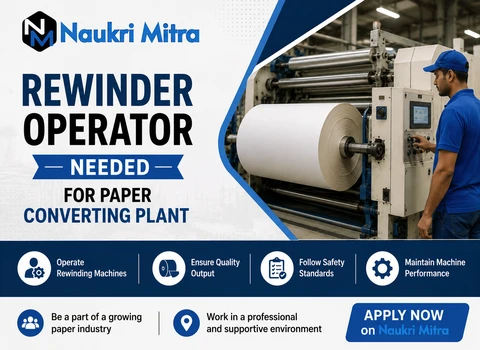
Walk into any paper converting unit, and you'll notice the jumbo rolls first — they're massive, sometimes taller than a person. Nobody ships paper in that form. It has to be slit, trimmed, and rewound into rolls that fit a printing press, a packaging line, or a retail shelf. That's the job of a Rewinder Operator: running the machine that turns a giant reel into something usable. This opening, "Rewinder Operator Needed for Paper Converting Plant," is a full-time role in Vapi, Gujarat.
The Business Reason Behind the Role
A paper mill can produce perfect paper and still lose money if the finished rolls arrive damaged. Loose winding causes wrinkles. Uneven tension causes telescoping, in which layers shift sideways during transport, rendering the whole roll unusable. So converting plants don't treat this as an entry-level formality — they need someone watching the machine closely, shift after shift, catching problems before a bad roll leaves the floor.
How the Shift Actually Unfolds
Most days start the same way: a quick machine check, then loading the parent roll onto the unwind stand. Paper gets threaded through guide rollers, past the slitter section, onto the winding shaft. After that, it's mostly watching — roll diameter, tension readings, edge alignment, all displayed on a control panel. Small adjustments here and there keep the paper winding evenly. It sounds simple written out like this. In practice, catching a tension drift before it ruins ten meters of paper takes a trained eye.
Where the Hours Actually Go
- Loading and unloading rolls with hoists or trolleys
- Setting slitter blades to the width specified for that batch
- Watching tension, speed, and roll hardness while the machine runs
- Spotting tears, dust marks or thickness inconsistencies
- Labeling finished rolls and logging what got produced
- Basic cleaning and lubrication between runs
The Equipment You'll Be Working Around
Core to the job is the rewinder line itself — unwind stands, slitter knives, tension rollers, and a winding shaft, all controlled by a PLC or touchscreen. Beyond that, operators operate core cutters, roll-wrapping units, and weighing scales. For quality checks, it's usually nothing fancier than a tape measure and a thickness gauge, but knowing exactly what to measure and when matters more than the tool itself.
What Separates a Decent Operator from a Good One
Anyone can be taught which button starts the machine. Reading a tension display and knowing whether that number means "adjust now" or "wait and watch" — that takes time on the floor. Good operators stay alert through long, repetitive cycles, keep their station clear of paper dust, and flag issues to the supervisor early rather than hoping a problem fixes itself.
Do You Need a Diploma for This?
Not strictly, but it helps. Freshers with an ITI in a relevant trade, or a Diploma in Mechanical engineering, tend to pick up machine settings and mechanics faster because they already understand the basics. That said, plenty of operators start with no formal technical background and learn entirely on the floor, working alongside a senior operator until the machine no longer feels unfamiliar.
This Job Will Keep You on Your Feet — Literally
Expect to stand for most of the shift, lift paper cores, and move rolls around a production floor that's rarely quiet. Machine motors keep the area warm, trimmed paper edges create dust, and none of that changes much across a shift. It's full-time work, and depending on how the plant schedules production, shift rotations are fairly common in converting units that run continuously.
Blades, Rollers, and Why PPE Isn't Optional
Slitter blades cut. Rollers rotate. Neither cares whether you were paying attention. Safety shoes, gloves, ear protection, and dust masks are standard here, and lockout procedures apply before clearing a jam or swapping a blade — no exceptions. Loose clothing or untied long hair near a rotating shaft is exactly the kind of thing plants train new operators to avoid on day one.
What Tends to Trip Up New Operators
Humidity changes paper behavior more than most people expect — a roll that wound perfectly yesterday might wrinkle or break mid-run today. Judging tension by feel rather than just watching the gauge is another skill that only really develops with repetition; there's no shortcut for it. And the noise — constant machine noise for a full shift takes most newcomers a few weeks to stop noticing.
Where This Can Lead
Operators who stay consistent usually get handed higher-speed rewinders first, then move toward shift-in-charge or line supervisor roles as they prove themselves. Some shift sideways into machine setting or maintenance support instead, since floor experience on the rewinder translates well into training the next batch of new operators.
Salary and What Else Might Come With It
The role pays ₹30,200 a month for this Rewinder Operator position in Vapi, Gujarat. Beyond the base pay, paper converting plants often offer overtime, PF and ESI coverage, an annual bonus, uniforms, and in some cases transport or canteen facilities — though what's actually included depends on the employer, so it's worth confirming directly during hiring.