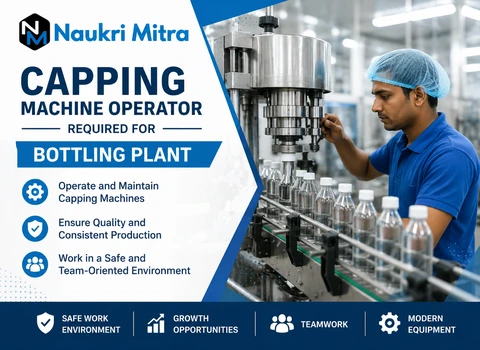
Understanding the Role of a Capping Machine Operator in a Bottling Plant
A Capping Machine Operator is a production professional responsible for securely sealing bottles with automated or semi-automated capping equipment. This role is a core part of the bottling and packaging process, ensuring that every container leaving the production line is properly sealed, leak-proof, and ready for distribution. Companies across the beverage, pharmaceutical, and packaged goods industries depend on skilled operators to keep this stage of production running smoothly and without interruption.
Why Bottling Plants Need Skilled Operators for This Work
Capping is one of the final and most critical steps before a product reaches the market. A poorly sealed bottle can lead to product spoilage, leakage during transport, or rejection during quality checks. Because of this, bottling plants prefer candidates who understand machine settings, can quickly spot defects, and know how to keep production moving at the required speed without compromising quality.
What a Typical Workday Looks Like
The daily routine of a machine operator in this field usually begins with checking the capping unit before the production line starts. This includes inspecting caps for damage, confirming the machine is aligned correctly, and running a few test bottles to check the seal quality. Once production begins, the operator continuously monitors the line, looking for loose caps, misaligned bottles, or jams that could slow the process.
Core Responsibilities on the Production Floor
- Loading caps into the machine hopper and refilling as needed
- Adjusting torque settings to ensure caps are neither too loose nor overtightened
- Monitoring bottle flow on the conveyor to prevent jams or spillage
- Removing and separating defective or improperly sealed bottles
- Performing basic troubleshooting when the machine stops or malfunctions
- Recording production counts and reporting issues to the shift supervisor
- Keeping the machine and surrounding work area clean and free of spillage
Industries and Facilities Where This Role Is Common
This position is most commonly found in bottling plants that produce water, soft drinks, juices, dairy products, or pharmaceutical liquids. Such facilities are usually organized as production units with multiple lines running in parallel, each handling filling, capping, labeling, and packing in sequence. An operator in this trade typically works close to filling machines, conveyor systems, and packing stations, making teamwork with other line workers essential.
Machines and Tools Commonly Used
Depending on the plant's scale, the equipment may range from manual capping tools to fully automatic rotary capping machines. Common tools and instruments include torque testers to verify cap tightness, cap elevators to feed caps into the machine, and sensors to detect missing or misaligned caps. Operators are also expected to use basic hand tools for minor adjustments and cleaning equipment to maintain hygiene standards, which are especially important in beverage production.
Skills That Make an Operator Successful
Technical understanding of machine operation is important, but it is equally valuable to have an eye for detail. Spotting a slightly crooked cap or an unusual sound from the machine before it becomes a bigger problem can save significant production time. Basic mechanical knowledge, quick reflexes, and the ability to stay alert during repetitive tasks are qualities that employers look for.
Employers may prefer candidates with relevant machining or tool room training. Depending on the complexity of the work, an ITI in a machining-related trade, a Diploma in Mechanical or Tool and Die Engineering, or equivalent vocational training may be considered suitable. Practical experience with EDM machines, engineering drawings, and precision measuring instruments is often valued as much as formal education, since it demonstrates familiarity with precision equipment similar to capping machinery.
Physical Demands and Working Conditions
This is a standing job that involves being on your feet for most of the shift. Operators need reasonable physical stamina, good hand-eye coordination, and the ability to work in a fast-paced environment. Bottling plants can be noisy due to running machinery, and the work area may be humid or cool depending on the product being bottled. This position is offered as Full-time employment, and shift work is common in bottling operations, as many plants operate multiple shifts to meet production targets.
Safety Practices and Protective Equipment
Safety is taken seriously in any bottling plant because of moving machine parts and slippery floors caused by liquid spillage. Operators are generally expected to use personal protective equipment such as safety shoes, hand gloves, and hairnets or caps depending on hygiene requirements. Following lockout procedures before clearing a jam and never reaching into a running machine are basic safety habits every operator must follow from day one.
Common Challenges Faced on the Job
New operators often find it challenging to keep up with high-speed lines at first. Machine jams, cap shortages, and sudden breakdowns are part of daily reality. Learning to stay calm during these situations, rather than panicking, is what separates an experienced operator from a beginner.
Building a Long-Term Career in This Field
Starting as a machine operator can lead to growth within the same production environment. With experience, operators often move into line supervisor roles, quality control positions, or specialize as maintenance technicians who handle machine repairs across the plant. Consistent performance, willingness to learn new machine models, and a strong safety record are usually the deciding factors for such promotions.
Salary and Common Benefits in This Role
For this position based in Haridwar, Uttarakhand, India, the monthly salary is ₹25,500. In addition to the base salary, bottling plants may offer additional benefits such as overtime pay, Provident Fund (PF), Employee State Insurance (ESI), yearly bonus, uniforms, and, in some cases, transport or canteen facilities. These benefits vary by employer and are not guaranteed across every plant, so candidates should confirm specific details during the hiring process.
Who Can Apply for This Role
This position suits freshers looking to enter the manufacturing sector, as well as experienced workers with line operations experience. ITI candidates and diploma holders in mechanical or related trades often find this role a practical entry point into industrial careers, as it builds hands-on familiarity with production machinery useful across many manufacturing settings in India.