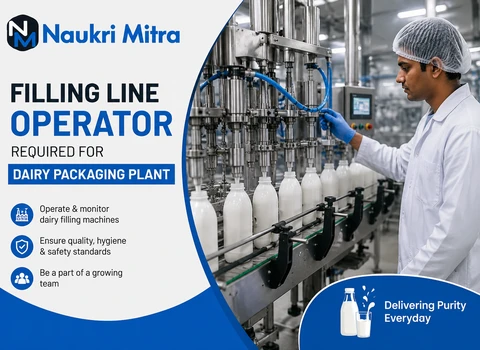
What Does a Filling Line Operator Actually Do?
Walk into any dairy packaging unit around shift-change time, and you'll see it: pouches or bottles moving down a conveyor, one after another, each one needing to be filled to the right level, sealed properly, and coded with a date before it leaves the floor. Running that process is the job of a Filling Line Operator. It's a full-time position based in Rajkot, Gujarat, India, and it's designed for people who prefer working with machines to sitting behind a desk.
The Reason Dairy Plants Hire For This Role
Milk and milk-based products don't wait around. Once processing is complete, packaging must happen quickly, cleanly, and without errors, because a small error at the filling stage can spoil an entire batch or shorten shelf life. That's really why this role exists. Someone has to watch the machine closely, catch problems early, and keep the line moving at a steady pace.
A Shift On The Floor
Most shifts start before the machine ever turns on. Pouches, caps, or cartons need to be loaded, lines need a quick clean, and settings have to be checked against the product being run that day. Once things get going, the operator isn't just standing there watching — fill levels, sealing quality, and batch codes all need constant attention. If something looks off, even slightly, it usually needs fixing before the next few hundred units come through.
Machines You'll Get Familiar With
Different plants use different setups, but a filling line operator in this line of work typically ends up handling:
- Form-fill-seal (FFS) machines, common for pouch-packed dairy items
- Bottle or carton fillers with automatic capping units
- Batch and date coding equipment
- Weighing scales or volume checkers to verify accuracy
- Conveyors that move packed product toward storage or dispatch
What Employers Actually Look For
You don't need to be an engineer, but you do need to understand how the machine you're running behaves — what a normal cycle sounds like, what a jam looks like before it fully happens, and how to make low-speed or pressure adjustments without stopping the entire line unnecessarily. Basic hygiene awareness matters a lot too, since this is food packaging, not general manufacturing.
Skills That Don't Show Up On A Certificate
- Reacting fast when a machine faults mid-run
- Noticing a slightly underfilled pouch before it's too late
- Staying consistent doing the same task, shift after shift
- Keeping basic notes on downtime or production counts
Who Tends To Get Hired
Both freshers and experienced candidates apply for roles like this, and plants generally consider candidates from both groups. An ITI in a relevant trade or a diploma in mechanical or food technology helps, but many operators learn the machine on the job after basic training. What matters more, often, is whether someone picks up machine handling quickly and takes hygiene rules seriously.
What The Body Goes Through
This isn't a sit-down job. Expect to be on your feet for most of the shift, lifting packaging rolls or cartons, and staying alert near moving parts. Because dairy plants run production almost around the clock, the role is full-time and often involves rotating shifts — morning, evening, or night, depending on how the plant schedules its lines.
Inside The Plant
The packaging area is kept cool, which protects the product but also makes it a different environment from a typical factory floor. Floors get wet often, from cleaning cycles and general wash-downs, so careful footing matters. There's also a fair amount of machine noise, and the pace rarely slows down mid-shift.
Staying Safe On The Line
Aprons, gloves, hairnets, and slip-resistant shoes are standard here. Beyond that, following lockout steps before cleaning a machine and reporting anything unusual — a strange sound, a leak, a loose part — right away, rather than waiting, keeps both the worker and the product safe.
Where Things Can Go Wrong
Machines jam. Packaging material tears mid-run. Sometimes the line has to slow down because upstream processing is delayed. None of this is unusual, and operators who stay calm, quickly flag issues to a supervisor, and know the basic troubleshooting steps tend to handle these moments with little stress.
Where This Role Can Lead
Operators who stick with it and learn more than one machine type often move up — into senior operator positions, shift-level supervision, or even basic maintenance roles within the same plant. Getting exposed to quality checks along the way tends to open more doors later, since plants value people who understand both the machine and the product.
Pay And What Else Might Come With It
The salary for this position is ₹28,800 per month. Depending on the employer, there may also be extras like overtime pay, PF, ESI coverage, bonuses, uniforms, or transport and canteen facilities — though these vary from plant to plant and aren't guaranteed. Overall, this is a full-time opportunity in Rajkot, Gujarat, suited to anyone looking for steady, hands-on work in India's dairy manufacturing sector.