
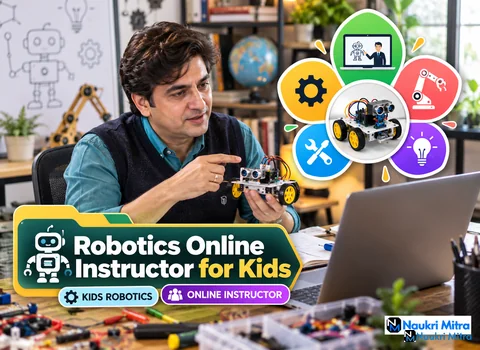
Early in the evening, a nine-year-old lifts her breadboard up to the webcam and says the LED is broken. It is not. It sits backwards, with the long leg on the wrong rail. A few minutes later the same LED blinks and she wants to know if it can blink faster. In the next slot, a small group of older children opens Tinkercad Circuits to test an ultrasonic sensor before anyone plugs in a real wire, and once classes end, short notes go out to parents describing what got built. That is an ordinary evening in robotics online instructor for kids part time jobs, and this listing is for exactly that role: live classes taught from home, open to applicants in any country, at an hourly rate of $15 (USD).
You teach live video classes, usually to one child or a small group. Every session is built around a project: an Arduino circuit, a sensor, a motor, or a LEGO Spike model. You explain one idea and show it working, then hand control to the students and help them fix whatever breaks. Between classes you test the next build in a simulator, check that the code runs, and write a short update for each family.
Put plainly, the robotics online instructor for kids job description is half teacher and half bench technician. You need patience for the teaching half and a methodical habit for the technical half, because most class time goes on small faults rather than big theory.
Nearly every student starts here. The parts list is short: an LED, a 220 ohm resistor, two jumper wires and an Arduino Uno. The code is short: set pin 13 as an output, switch it on, wait, switch it off, wait.
The teaching move is to change one thing at a time. Shorten the delay and the blink speeds up. Move the wire to pin 12 without editing the code and nothing happens, which is a good moment to ask why. Students who leave the first class understanding that the code and the wiring must agree have learned the most useful idea in hobby electronics.
The HC-SR04 sensor sends out a sound pulse and times the echo. A common build reads the distance, prints it to the serial monitor, and sounds a buzzer when something comes within ten centimetres.
This is where online robotics class projects with Arduino and sensors start to feel like real engineering. Students meet variables, if statements and a little arithmetic, since the echo time has to be converted into centimetres. A group class can build it first in Tinkercad Circuits, where you can drag a virtual object nearer to or further from the simulated sensor. Once the logic works on screen, they wire the physical version with far fewer surprises.
Younger students, roughly six to nine, often do better with LEGO Spike than with loose wires. The hub, motors and colour or distance sensors snap together, and the Spike app uses Scratch-style word blocks. A classic lesson is a small rover that drives forward until it sees a wall, then turns.
The trick is keeping the build and the code moving together. Left alone, children tend to spend most of the class on the chassis and very little on the program, so you set checkpoints: wheels on, motor test, first block, first run.
On your side, the laptop camera has to show a breadboard sharply enough to read the wiring, the connection must hold through a screen-shared Tinkercad session, and the room should be quiet. A second camera or a phone on a stand pointed at your desk helps a lot, because kids copy hands better than diagrams. Keep your own Arduino starter kit and, where you teach Spike, your own set, so you can rebuild a student's model in front of the camera.
On the student side, families usually have a physical kit, a browser for Tinkercad Circuits, or both. A sensible plan is to simulate first and wire second. Before a first class, check that the Arduino IDE or the Spike app is installed, the board is recognised over USB, and the child can position the camera to show the breadboard clearly.
Remote debugging takes the most skill. You cannot touch the circuit, so you work like a remote support engineer. Ask the child to hold the board still and close to the lens. Trace one wire at a time out loud: where does the red wire start, where does it end. Have them read the pin numbers to you instead of trusting the blurry image.
Take a typical case: an ultrasonic build that prints zero for every reading, even though the wiring looks right on camera. Careful tracing often shows the trigger and echo wires swapped. Fixing that is quick; finding it takes patience and a checklist. Teach students that same checklist (power, ground, pins, code) and they start debugging before calling you.
This role asks for a B.Tech or B.E. in electronics, mechanical or computer science, or equivalent STEM training. Experience teaching children is preferred, not mandatory, so robotics online instructor for kids jobs for freshers are a realistic target. You do need hands-on comfort with Arduino, common sensors, Tinkercad Circuits and LEGO Spike, plus clear spoken English.
The surest route for anyone working out how to become robotics online instructor for kids with no classroom time is a small portfolio. Record yourself teaching the blink project to a younger relative, document a sensor build with photos and code, and practise explaining one concept briefly. A short robotics online instructor for kids course or a recognised Arduino or LEGO education certificate can help your profile, though practical demos usually count for more than paper.
A coding teacher for kids works entirely on screen with Scratch, Python or app builders. A robotics instructor adds hardware, which means wiring faults, loose motors and sensors that read noise. If you like the physical side and can stay calm when a USB cable is the real problem, robotics is the better fit. If you prefer pure software, coding classes will feel more comfortable.
Robotics teaching here pays $15 USD an hour, the only robotics online instructor for kids salary per hour stated. This is a part-time role, and the number of classes depends on student demand and the schedule you can offer, so no fixed weekly hours are promised. Evenings and weekends are often busiest because that is when children are free.
Many people treat part time robotics online instructor for kids jobs as a second income alongside study or an engineering job. Others combine them with freelance robotics online instructor for kids jobs on other platforms. Since the work is remote, robotics online instructor for kids work from home arrangements suit people in many time zones.
Online robotics classes are commonly run by STEM edtech providers, after-school programmes and tutoring platforms. Many schools have added computational thinking to their teaching, and parents often look for hands-on STEM activities outside school. That interest supports demand for skilled STEM and robotics teachers, though it varies by region and season.
Keep your robotics online instructor for kids resume to one page. Lead with projects you have built, list the boards and tools you use, and mention any time spent tutoring, mentoring or running a club. Expect a demo class during screening, often the LED or sensor project taught to an interviewer acting as a child. When you are ready, apply through this listing with your resume and a link to any project videos.