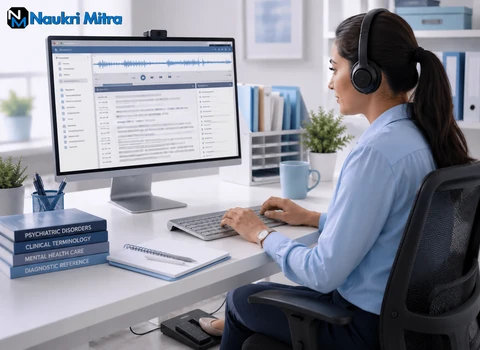
Psychiatric sessions carry weight — what's said in the room shapes diagnoses, treatment plans, and sometimes a patient's entire care path. Getting that record down accurately and keeping it private isn't a small task. We're looking for a Remote Psychiatry Transcriptionist who takes both parts of that seriously.
The Role at a Glance
This is a full-time, fully remote position paying $60,500 a year. You'll be transcribing psychiatric evaluations, therapy session notes, and related clinical documentation for mental health professionals who depend on clean, accurate records to do their own jobs well. It's detail work, and it matters more than people outside the field usually realize.
What You'll Be Doing
Most of your time goes into converting audio recordings — evaluations, session notes, diagnostic reports — into clear written documentation. That means using correct psychiatric terminology, following formatting standards, and catching your own errors before anyone else has to. When audio is unclear, or a term doesn't make sense in context, you'll reach out to the clinician directly rather than guessing.
Beyond the transcription itself, there's a fair amount of file and workflow management: keeping assignments organized, meeting deadlines without letting quality slip, and maintaining digital files that are easy to retrieve and securely stored. You'll also be expected to run your own quality checks, apply feedback when it comes in, and stay consistent in style and terminology across everything you produce.
Responsibilities
- Transcribe psychiatric evaluations, therapy notes, and diagnostic reports with precision
- Apply correct psychiatric terminology and required formatting standards consistently
- Edit and proofread completed transcriptions before submission
- Prioritize and manage transcription assignments to meet deadlines
- Communicate with clinicians to clarify unclear audio or documentation requirements
- Maintain HIPAA compliance and handle patient information with strict confidentiality
- Use transcription software and equipment (including foot pedals) to work efficiently
- Troubleshoot basic technical issues with audio files or transcription tools
What We're Looking For
- Education: High school diploma or equivalent
- Experience: At least 2 years of transcription experience, ideally in a medical or psychiatric setting
- Solid grasp of psychiatric terminology and transcription conventions
- Strong listening, typing, and attention-to-detail skills — this work doesn't forgive sloppiness
- Comfort with transcription software, audio playback tools, and Microsoft Office
- Ability to manage multiple assignments independently without close supervision
- A high bar for confidentiality and professional judgment around sensitive information
Nice to Have
- Formal training or certification in medical or psychiatric transcription
- Familiarity with HIPAA requirements beyond the basics
- Background touching several different types of psychiatric cases and diagnostic language
- Experience working fully remote and self-managing deadlines without a supervisor checking in daily
Confidentiality Isn't Optional Here
Working with psychiatric records means handling some of the most sensitive information a person has. Every file you touch must remain compliant with HIPAA and organizational policy, without exception. That's not a checkbox — it's part of doing the job well, and it's something we look for in how a candidate talks about past work, not just what's on their resume.
The Learning Curve Doesn't Stop
Psychiatric terminology and treatment approaches shift over time, and transcription tools keep evolving too. You'll be expected to stay reasonably current on both — not as an afterthought, but as part of doing accurate work. Training sessions are built into the role for exactly that reason, and team discussions are a normal part of how the group improves collectively rather than everyone figuring things out alone.
What You Get in Return
Candidates applying through Naukri Mitra should know exactly what's on the table before they commit time to the process:
- $60,500 per year, fully remote, working from wherever suits you
- Flexible scheduling that fits around a self-managed workload rather than a rigid clock-in system
- Ongoing training and skill development in psychiatric transcription and terminology
- The chance to work across many different case types over time, which sharpens your ear for the field
- A team environment that actually values precision instead of just talking about it
Who Tends to Do Well in This Role
The strongest fit here is someone who already takes transcription seriously as a craft, not just a task to get through. They manage their time well, don't need constant check-ins to stay on track, and treat confidentiality as a given rather than a rule to remember. People who genuinely find psychiatric documentation interesting — not just tolerable — tend to stick with this role longer and do better work in it.
About the Company
This role is being filled through a recruitment partner focused on matching skilled professionals with roles where their specific expertise is actually used, rather than treated as generic. The goal is a placement that works for both sides — not just filling a seat.
How to Apply
If you've got transcription experience and a genuine interest in mental health documentation, send in your application along with any relevant certifications or sample work you can share. We're especially interested in hearing about prior experience with psychiatric or medical terminology, since that's where this role operates day-to-day.