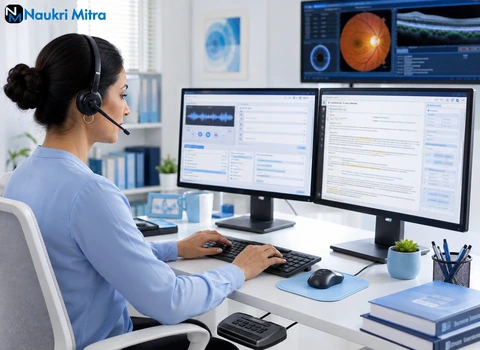
A surgical note gets dictated fast, half the terms unfamiliar even to someone who's done this for years. One wrong word — "phaco" instead of "photo," a misheard drug dosage — and the record's wrong for good unless someone catches it first. That's the job. We're hiring a
Remote Ophthalmology Transcriptionist to catch it.
This is a full-time, fully remote position with an annual salary of $50,000. You'll transcribe dictations specific to ophthalmology — exam notes, surgical procedures, diagnostic reports — for a network of healthcare providers who need those records accurate the first time, not after three rounds of corrections.
What the Work Actually Looks Like
Ophthalmology has its own language. Terms that sound similar but mean completely different things. Procedures that get referenced by shorthand doctors assume everyone already knows. Part of the job is transcribing what you hear. The other part — the harder part — is knowing when something doesn't sound right and stopping to check instead of guessing.
Responsibilities
- Transcribe ophthalmology-specific dictations, including patient histories, exam notes, diagnostic reports, and surgical documentation
- Proofread and edit transcripts for accuracy, completeness, and terminology compliance
- Follow HIPAA guidelines and confidentiality protocols on every file, without exception
- Meet delivery deadlines without letting quality slip to hit them
- Research unfamiliar terms, diagnoses, or medications rather than guessing at spelling or meaning
- Reach out to providers or team members directly when a dictation is unclear
- Stay current on transcription software and evolving ophthalmology terminology
What You'll Need
- Education: High school diploma or equivalent required
- Experience: At least 2 years of medical transcription experience, ideally including ophthalmology or a closely related specialty
- Typing speed of at least 60 words per minute, paired with strong grammar and punctuation
- Comfort with transcription software and general office technology
- A working understanding of HIPAA and confidentiality standards
- The ability to work independently, with minimal check-ins needed to stay on track
- Comfort adapting to different accents, speech patterns, and dictation habits — not everyone talks the same way
Good to Have
- Prior experience specifically transcribing ophthalmology records
- Familiarity with electronic health record (EHR) systems
- A track record of consistent accuracy on high-volume workloads
Why the Specialty Matters
Ophthalmology transcription isn't interchangeable with general medical transcription. A general transcriptionist might not know the difference between similar-sounding surgical terms, or catch that a dosage doesn't make sense for a particular procedure. That gap is exactly why this role exists — someone who already knows the field, or is genuinely willing to learn it fast, catches errors before they become permanent parts of a patient's chart.
Staying Sharp on the Terminology
Medical language shifts. New procedures get named, old terms fall out of use, and drug names change more often than people expect. Part of this role means staying current — not memorizing a list once and coasting, but actually keeping up as the field moves. When something's unfamiliar, the expectation is to research it properly rather than take a guess and hope it's close enough.
What Success Looks Like
Transcripts come back clean, with few or no corrections needed. Providers start trusting your work enough to stop double-checking it line by line. Deadlines get met consistently, not just occasionally. And when something genuinely doesn't make sense in a dictation, you're the one who flags it instead of letting an error slide through.
Working Remotely, Supported
This role runs independently day-to-day, but that doesn't mean working in a vacuum. Naukri Mitra connects transcriptionists with a broader network of medical professionals and peers who understand the specialty, so questions about an unusual term or an unclear dictation don't go unanswered for long.
Pay and Benefits
- $50,000 annual salary
- Fully remote, flexible work arrangement
- Ongoing training and certification opportunities
- A collaborative team culture that values precision and mutual support
Who Tends to Do Well in This Role
People who are genuinely meticulous, not just careful when it's convenient. People who can work for hours without someone checking in and still stay disciplined about accuracy. People who see an unfamiliar term and treat it as something to research properly, not something to skip past and hope nobody notices.
The Bigger Picture
Every accurate transcript is one less risk in a patient's medical record — a smaller chance of a misread dosage, a missed diagnosis note, a surgical detail that gets lost between dictation and documentation. It's quiet work, done well mostly unnoticed, but it matters every time a provider pulls up that chart months or years later.
How to Apply
If ophthalmology terminology doesn't intimidate you — or you're ready to learn it properly — send your resume along with your typing speed and a short note about your medical transcription background. Applications are reviewed as they come in.