
A proper bill-payment receipt shows five things: the biller name, the customer's consumer or account number, the amount paid, the date and time, and the transaction or reference ID. If any one of those is missing, the customer has nothing to show the electricity board or the mobile operator when a payment goes astray. That is why, in remote recharge and bill payment agent jobs, the receipt goes out every single time, even when the customer does not ask for it. This listing is for a full-time agent paid $300 per month (USD), working from home through retailer apps connected to Bharat BillPay.
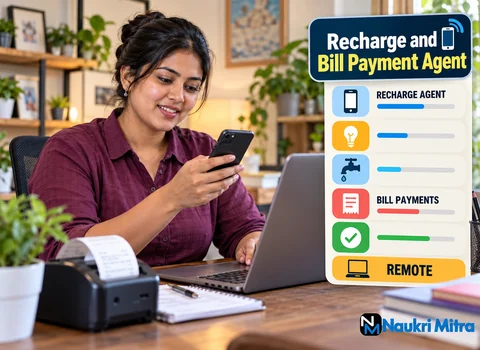
Think of it as a payment counter that lives on your phone. Customers reach you in person, by phone or through a message, and you complete their mobile and DTH recharges, electricity, gas and water bill payments using a BBPS-enabled retailer app. You then share the receipt, check the status of anything that failed, and keep a clear record of your wallet balance. That short paragraph is, in plain terms, the full recharge and bill payment agent job description.
Bharat BillPay, usually called BBPS and rebranded as Bharat Connect in 2024, is operated by NPCI Bharat BillPay Ltd (NBBL), a subsidiary of the National Payments Corporation of India. Retailer and agent platforms such as PayNearby and Spice Money give agents access to it, and Paytm also runs services for merchants. Those names are mentioned only to describe the market; none of them stands behind this particular post.
Before you can take a single payment, you complete your own KYC inside the retailer app. You will normally need:
You must be eighteen or above. No degree is needed. Because KYC rests on Indian documents, applicants from anywhere can apply to this listing, but the work itself needs a valid Aadhaar and PAN. Exact document lists differ between platforms, so follow what the app shows on screen.
Most retailer apps work on a prepaid wallet. You load money into it, and each recharge or bill payment is debited from that balance. If the wallet runs dry at eleven in the morning, the counter stops. Agents learn to top up before the rush and to note every load in a simple register or spreadsheet: date, amount, method and closing balance.
Top-ups go only through the official app or the platform's listed payment route. Never send wallet money to a personal UPI ID, however friendly the person asking sounds. As for the phone, a reasonably recent Android handset with enough storage, a working camera for KYC, stable mobile data with Wi-Fi as a backup, and a screen lock is enough. A small power bank saves the day during outages.
Here is a typical case, invented for illustration. A retired neighbour walks over with her prepaid number and wants a monthly pack. You open the recharge section, enter her number, and the app usually detects the operator and circle. You read the plan list aloud, she picks one, and you repeat the number back digit by digit before you tap pay. A wrong digit sends her money to a stranger, and a successful recharge to the wrong number is very hard to reverse.
DTH works the same way, using the subscriber or customer ID printed on the set-top box or the last bill.
For a bill, you choose the category, then the biller, then enter the consumer number. BBPS fetches the bill so you can confirm the customer's name, due date and amount before paying. Say a customer's electricity bill shows a name that does not match his: stop and ask. Often it is a landlord's connection, which is fine, but sometimes it is the wrong consumer number entirely.
Once paid, the receipt goes to the customer by SMS, WhatsApp or a printout, with the transaction ID highlighted. Gas and water bills follow the same pattern, though the list of available billers varies by city and platform.
Some transactions show "pending" or fail after the wallet is debited. Do not repeat the payment straight away. Check the status in the app's transaction history, wait for the time the platform states, and only then decide. If the money was deducted but the bill was not paid, raise a complaint using the transaction ID. BBPS has its own complaint system, and the retailer app usually has a support route too. Never promise a refund date the platform has not given you.
Many customers pay in cash, so count notes in front of them, give change on the spot, and keep the day's cash apart from personal money. At closing, match the cash in hand against the app's transaction report. If they differ, find out why that evening, not next week.
The firmest rule of the job: never ask a customer for an OTP, a UPI PIN, an ATM PIN or a password. A recharge or bill payment from your wallet does not need any of them. Keep customers' numbers and consumer IDs private, and do not save them for your own use.
Get agent IDs only from the platform's official app or website, and read its own published charges there.
An AEPS agent uses the Aadhaar Enabled Payment System to help customers withdraw cash, check balances and see mini statements with a fingerprint scan. That work needs a registered biometric device and usually stricter checks, because the agent hands out the bank's cash. This role handles recharges and bills from a wallet, with no fingerprint scanners and no cash withdrawals. Many agents add AEPS later once they are comfortable, if the platform approves them.
This role is full-time, and the recharge and bill payment agent salary per month is $300 (USD), as stated in the listing. Retailer platforms sometimes pay commissions on transactions; whether any incentives apply here depends on the employer, and none are promised. A normal week starts with checking the wallet, then handling the morning recharge queue, a midweek wave of bill payments near due dates, status checks on anything pending, and a short evening reconciliation each day.
The core recharge and bill payment agent skills are careful number entry, clear speech, honesty with cash and calm handling of failed payments. No formal recharge and bill payment agent course or certification is required, though the platform's own training videos are worth watching. Entry level remote recharge and bill payment agent jobs suit first-time workers well. Growth can mean adding services, training new agents, or setting up your own small payment counter from home once you know the rules. Listings may say recharge and bill payment agent jobs remote worldwide or recharge and bill payment agent work from home jobs; either way, the work rewards a clean record.
Keep your recharge and bill payment agent resume to one page: your age, the languages you speak, any shop, counter or cash work, and comfort with smartphone apps. Expect recharge and bill payment agent interview questions such as how you would handle a pending payment, what you would say if a customer offered their OTP, and how you would keep a daily wallet record. Applying is free. Send your details through the application button on this page.