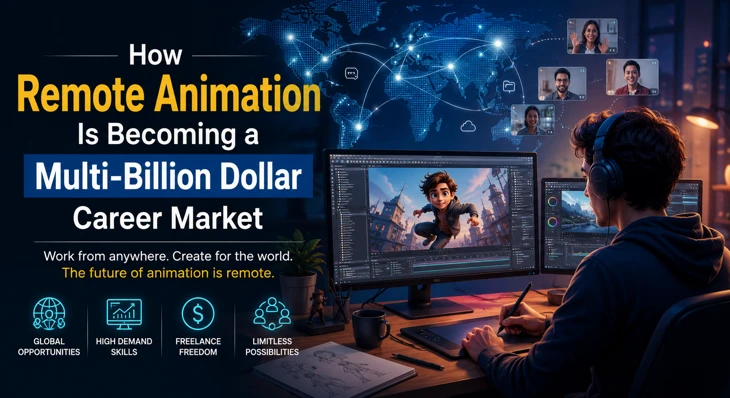
How Remote Animation Is Becoming a Multi-Billion Dollar Career Market
Introduction
You’ve probably noticed something: more studios are hiring talent without asking for a commute, and more creators are building entire careers from a spare room or a laptop-friendly café. That shift isn’t hype; it’s momentum. How Remote Animation Is Becoming a Multi-Billion-Dollar Career Market boils down to three simple forces: global demand for visual storytelling, always-on distribution channels, and accessible tools that enable skilled artists to work from anywhere. If you’ve been wondering how to ride this wave, you’re in the right place.
Let’s set the stage. Budgets that once went entirely to brick‑and‑mortar studios now split across distributed teams. Streaming platforms want more content, brands want thumb‑stopping ads, and game studios want immersive worlds—faster. If you’re exploring freelance animation jobs or dreaming about scalable 2D animation careers, the path is more apparent than ever. Stick with me, and we’ll turn ambiguity into a plan.
What you’ll learn in this guide
- Where remote opportunities actually come from (and how they pay)
- The animation software tools you’ll really use, from pre‑viz to final delivery
- How to package your skills for virtual animation studios and international clients
- Repeatable workflows for scouting projects, quoting, and scaling beyond solo work
Real Experiences & Storytelling
Picture a self‑taught animator in Jaipur. She starts with a short course on fundamentals, then builds a crisp showreel on weekends. Her first gigs come from a startup needing explainer videos for investors. Within six months, she’s delivering motion IDs for a fintech company in Berlin—no relocation required. What changed? She targeted industries hungry for visual persuasion and stitched a process that clients trust.
Another case: a former editor pivots to motion design. He takes on two CGI animation projects for indie game teams, then a product video for a SaaS company that wants animated UI walkthroughs. A few smart moves—clean contracts, consistent updates, and a transparent scope—can turn into retainer work. He leverages the pull of global animation demand and the evergreen need for online video content to keep his pipeline full.
There’s also the studio‑builder. Two classmates team up remotely: one focuses on storyboarding and character animation freelancing, while the other specializes in compositing. They present as a small shop, not a loose coalition. Their secret isn’t just talent; it’s predictability and good communication across time zones. Clients return, referrals compound, and they gradually step into the role of creative directors.
Why Sentence Variety Boosts Readability
Ever wonder why some animators struggle for years while others win steady clients in just three months? The difference is focus: pick a niche, show a reel that solves that exact problem, and run a repeatable process that delivers on time.
Ask yourself: What kind of problems do you solve best? Micro‑ads. Stylized product demos. Title sequences. Educational shorts. Game cinematics. Your answer determines the platforms you pitch, the reels you build, and the rates you quote.
And here’s the twist. Many newcomers chase everything at once. Don’t. Specialization accelerates credibility. For instance, say you lean into motion graphics, remote work, and performance‑marketing ads. Suddenly, your reel speaks to a specific buyer. Your proposals feel familiar to media agencies. When the fit is correct, the close is easy.
Communicate Like a Pro in Remote Animation
On a kickoff with a growth team, skip jargon and get specific: “What KPI matters most—view‑through rate or click‑through?” Then send a 5‑bullet recap within an hour. That one habit prevents scope slip and keeps approvals fast. Follow up with bullets. When you describe a shot, keep it simple: “Three‑second push‑in, logo reveal, particle trail, track‑matched to the beat.” That line saves three emails.
Here’s the thing: the fastest animators aren’t always the most technical. They’re the best at reducing ambiguity—storyboards that read like comics, quick animatics for timing, and clean file structures so anyone can pick up where you left off. Those habits make you referable.
Handling Client Stress in Remote Animation
It’s normal to feel overloaded the first time a big client pings you. New pipeline. New terms. New expectations. Take a breath. You’re not alone.
Maybe you’re juggling animation contract work with a day job. Perhaps your files are breaking because you have mixed versions. Or maybe you have three rounds of feedback due tomorrow and a blank timeline staring back at you. Happens to everyone.
What works? A gentle cadence. Break tasks into smaller clips. Share animatics earlier. Use checklists. If you’re coming from remote media production, you already know that asynchronous collaboration is a skill. Keep a calm tone in messages. Confirm changes in writing. When the scope shifts, re-quote with options rather than reacting emotionally. You’ll be seen as a partner, not a vendor.
Relatable Examples
Think of your pipeline like a school project with rolling deadlines. You wouldn’t start writing the final essay without an outline. In animation, that outline is your storyboard and animatic. Treat the animatic like a “mock exam”—it reveals timing issues before the real test.
Or picture a workplace stand‑up: quick status, blockers, next steps. Run your animation sprint the same way. Short, focused updates keep clients aligned and informed. This habit matters even more when working with international animation clients in different time zones.
Key Skills / Tools / Insights
The skills that unlock the remote animation market aren’t mysterious; they’re layered. Master the core, then add specialized edges that suit your niche. This is where the multi‑billion‑dollar engine runs—and where you’ll find compounding leverage.
Core creative foundations
- Timing, spacing, and easing (the classic 12 principles)
- Visual hierarchy and typography for motion design
- Composition and camera moves that guide attention.
- Story structure for short‑form narratives
The tool stack that actually ships
You don’t need everything, but you need enough to deliver at professional speed.
- After Effects, Premiere Pro (or Resolve): bread‑and‑butter for animation for advertising and social ads
- Blender, Cinema 4D, Maya: 3D workflows for 3D animator opportunities and product visualization
- Toon Boom Harmony, TVPaint: 2D pipelines for TV and 2D animation careers
- Houdini, Nuke: advanced setups for visual effects careers and compositing
- Spine, DragonBones: game‑ready rigs
- Figma, Illustrator, Photoshop: style frames and assets
- Frame.io, ShotGrid, Notion: animation project management
- Zoom, Slack, Miro: virtual collaboration tools that keep distributed teams sane
Production pipelines that scale remotely
- Pre‑production: brief, goals, KPIs, mood boards
- Story & design: script, storyboard, style frames
- Animation: blocking, passes, polish
- Review: time‑coded notes, change logs, approvals
- Delivery: versioning, codecs, backups, handoff docs
Building a Remote Creative Production Pipeline
Remote work raises the coordination bar. Treat your setup like a tiny studio: a single source of truth for briefs, shot lists, and notes; agreed review windows across distributed animation teams; and clear ownership for each scene. This keeps remote creative production predictable when time zones stack.
A quick note: platforms like Naukri Mitra regularly surface hiring patterns across markets, highlighting where the demand clusters and which skills translate across niches. Use that intel to sharpen your roadmap.
Strategic edges clients pay for
- Marketing literacy: tie shots to outcomes (click‑throughs, sign‑ups, watch time)
- Technical fluency: explain codecs, bitrates, and delivery specs in plain language
- Systems thinking: templatize your scenes, presets, and rigs.
- Communication: calm, written updates that reduce meetings
Where the opportunities hide
- Performance-marketing agencies are hungry for scalable, creative content.
- Indie game teams that need trailers and in‑engine cinematics
- Ed‑tech firms producing modular course content
- SaaS brands explaining invisible features with motion
- E‑commerce brands are testing variations weekly.
Across these, animation software tools aren’t the differentiator—your taste, a documented animation pipeline workflow, and a consistent review rhythm are. Remote or not, clients buy certainty.
Career Growth / Future Scope
Let’s talk about where this goes. The remote animation universe is widening, not flattening. As pipelines virtualize and budgets are distributed across countries, talent has leverage.
Macro forces are pushing demand.
- Always‑on content ecosystems (social, streaming, micro‑learning) with sustained double‑digit growth in short‑form consumption
- Game engines expanding into automotive, product visualization, and architecture
- Short‑cycle ads that demand faster iteration and data‑driven creative
- Advances in procedural and real‑time rendering are accelerating turnaround times.
In this climate, the arc of remote animation careers points up. You’ll see more virtual animation studios that spin up squads for campaigns, more hybrid teams that blend on‑site capture with distributed compositing, and more crossovers between cinematics and interactive media. If you’re tracking industry signals through platforms like Naukri Mitra, you’ll notice category spikes—product explainers this quarter, tutorial series the next—as buyers respond to trends.
For you, that means optionality. You can stay specialized or widen into creative direction, pipeline engineering, or producer roles. The growing animation industry also rewards those who can bridge art and analytics—tying creative decisions to performance metrics and measurable online growth in animation careers.
Niches with compounding upside
- Remote creative industries serving B2B explainers and webinars
- Branded entertainment and mini‑docs for tech
- In‑app motion systems (micro‑interactions, onboarding flows)
- AR try‑ons and real‑time 3D showcases for commerce
- Localization‑first content for international animation clients
The future isn’t only more content; it’s smarter content. Teams that measure outcomes will outpace teams that only ship pretty frames. Teams that measure outcomes will outpace teams that only ship pretty frames.
Start Your Remote Animation Career in 10 Steps
You don’t need a perfect reel to get your first paying project. You need a targeted reel that solves a repeatable problem.
Step 1: Pick a lane
Choose a paid problem where buyers already spend: short ads, product reveals, game teasers, and course intros. Align your lane with a delivery format—square, vertical, or 16:9—and a platform. This clarity trims your learning curve and keeps your reel cohesive. (Great lanes for motion graphics remote work include performance‑marketing hooks and product UI stings.)
Step 2: Learn fast with focused practice
Follow a mini‑curriculum of online animation courses that ladder into your lane. For motion design, study kinetic type and logo stings. For characters, practice walk cycles and acting beats to enhance your performance for 3D, master lighting and materials. Keep sessions short, daily, and specific.
Step 3: Build a tight, outcome‑oriented reel
- 30–60 seconds, max
- Start with your strongest shot.
- Use brand‑like frames (fictional is fine if polished)
- Add captions: “Lifted onboarding completion by 24%” (spec is okay; label it)
- End with a clear CTA and contact
Motion Graphics Freelance Work: How to Start
- Pick one ad format (7s hook, 15s story, or 6s bumper) and master it
- Rebuild three top‑performing ads you admire; note pacing and type.
- Offer a test asset to a niche brand and charge a small, flat fee to mitigate risk.
Step 4: Package your services
Create three offer tiers that buyers understand:
- Starter – one 10–15s asset, one round of edits
- Growth – three variants for A/B testing, two rounds
- Scale – monthly batch, analytics handoff, back‑catalog refresh
Tie deliverables to animation production pipelines so clients know what’s next.
Step 5: Price with confidence
Anchor to outcomes and complexity. For animation in advertising, pricing by asset, along with performance bonuses, can be effective. For CGI animation projects, price by sequence, not by hour. Keep a buffer for revisions. Use a clean SOW: scope, timeline, approvals, and file ownership.
Step 6: Set up your remote studio
- Hardware: fast CPU/GPU, color‑accurate monitor, ample RAM
- Storage: RAID or fast SSD + offsite backup
- Sync: cloud drive with versioned folders
- Communications: a single source of truth for briefs and notes
- Reviews: timecode‑based comments via Frame.io or similar
This is the backbone of professional remote work when you’re collaborating across borders as a work-from-home animator setup.
Step 7: Find and qualify projects
Create a short script for cold outreach. Keep it value‑first: a 15‑second teardown of a prospect’s ad, a storyboard idea, or a visual hook tailored to their product. Ask one straightforward question: “Want me to turn this into a test asset?”
Then diversify: marketplaces, referrals, small agencies, direct brand pitch. Track your funnel. Follow up every 7–10 days with something practical—an insight, a quick mock, or a case study.
You can explore more opportunities with trusted platforms, such as Naukri Mitra, to spot emerging roles and steady motion graphics freelance work that aligns with your niche.
Step 8: Run projects like a pro
- Kickoff call → brief, audience, KPIs
- Storyboard/animatic → approval gate 1
- First animation pass → approval gate 2
- Polish + sound → delivery
- Post‑mortem → lessons, templates, and a testimonial ask
Step 9: Keep clients for life
Offer a light retainer: monthly variations, seasonal refreshes, or platform‑specific crops. Create reusable libraries—creative animation portfolios that act as internal kits for your best clients. Loyalty outperforms cold outreach over time.
Step 10: Scale beyond yourself
Bring in collaborators for overflow. Start with a strong compositor, then a designer for style frames. Build simple SOPs. This is how virtual animation studios form—slowly, then all at once.
Opportunities Map: Where the Work Comes From
Advertising and performance marketing
- Short, punchy assets that drive clicks
- Endless iteration cycles, data‑driven decisions
- Clear metrics for success
Product and SaaS
- Feature explainers, onboarding, UI tours
- In‑app motion systems and micro‑interactions
- Tutorials that reduce support tickets
Games and entertainment
- Teasers, trailers, title sequences
- Cutscenes and in‑engine cinematics
- Key art and motion posters
Education and e‑learning
- Modular course content
- Visual mnemonics and concept explainers
- Platform‑ready packaging for global rollouts
Corporate communications
- Culture videos, town hall intros, event stings
- Investor decks with motion
- CSR and employer brand storytelling
Across all these, animation outsourcing trends continue as teams seek specialized talent for specific phases—such as storyboards, rigging, and compositing—without expanding their payrolls. Distributed animation production pipelines make this even easier.
Workflow Templates You Can Steal
The 48‑Hour Explainer Sprint
- Day 1 AM: script, scratch VO, storyboard
- Day 1 PM: animatic, style frames, quick client review
- Day 2 AM: animation pass, sound bed
- Day 2 PM: polish, export, handoff
The Game Trailer Loop
- Capture in‑engine shots, plan beats
- Motion titles synced to hits.
- Particle + logo resolve
- End card options for platforms
The Social Variations Engine
- Base 15s master
- 7s hooks for TikTok/Shorts
- 4:5 and 1:1 crops
- CTA tests, supers for silent playback
Communication Habits That Win Deals (for Distributed Animation Teams)
- Confirm every decision in a single, updated doc
- Turn ambiguous feedback into specific options.
- Share before‑and‑after clips to anchor progress.
- Use video notes for complex changes.
- Maintain consistent response times, even if brief.
These habits align seamlessly with animation project management tools, keeping you in sync with distributed producers.
Money: Rates, Rights, and Retainers
Rate models you can justify
- Per asset (flat): best for short ads and social content
- Per sequence: ideal for narrative or CGI animation projects
- Hybrid: base fee + performance incentive for animation for advertising
Rights and licensing
Specify usage: platforms, geographies, and time periods. Charge for exclusivity. Price cut‑downs and language versions up front, especially for international animation clients.
Retainers that make sense
Bundle monthly deliverables with clear value: refresh existing assets, create new hooks, and performance report. Set a minimum term. Review quarterly.
Learning Loops: Always Be Leveling Up
- Analyze top ads and game trailers weekly.
- Recreate a complex shot each month.
- Publish breakdowns: storyboard → animatic → final.
- Teach what you learn; it builds authority.
Here’s a pattern you’ll notice: the more you systematize, the more you can take on without burning out. Systems let you say yes to bigger scopes while staying sane.
Collaboration Across Borders
Working with teams across different time zones requires a consistent rhythm. Utilize overlapping hours for decision-making and asynchronous blocks for focused work. Keep handoffs predictable by labeling scene numbers, shot lists, and render folders by date.
If you’ve done remote media production, you already understand the cadence. The same principles apply here—just with more layers of files.
Quality Control Without Drama
- Create a checklist: resolution, frame rate, alpha channels, and color space.
- Watch your exports on a phone and a laptop.
- Keep a versioned folder of delivery presets
- Log feedback themes to prevent repetition.
Consistency is quiet excellence. It’s the difference between one‑off gigs and multi‑year relationships.
Red Flags to Watch For
- Vague briefs with moving deadlines and fixed budgets
- “Exposure” offers with all rights assigned.
- Unlimited revisions with no approval gates
- Late payments and opaque sign‑off processes
Your contract is your safety net. It’s not about distrust; it’s about clarity.
Career Ladders: From Solo to Studio
- Solo specialist → razor‑sharp reel and high margins
- Lead animator → directs sequences, mentors juniors.
- Pipeline lead → builds templates, rigs, and SOPs.
- Creative director → pitches, sculpts ideas, ensures consistency.
- Producer/owner → runs operations for a small, distributed team.
Every step adds leverage. Choose the ladder that fits your temperament.
Conclusion + Call-to-Action
Let’s bring this home. The path is absolute, the demand is global, and distributed teams are the new normal. If you’ve been on the fence, start small: one reel, one offer, one campaign. Then iterate. Don’t wait for perfect. Momentum beats hesitation every time.
Remember what’s driving this shift: content‑hungry platforms, more innovative tools, and buyers who care more about outcomes than office addresses. That’s why How Remote Animation Is Becoming a Multi-Billion Dollar Career Market isn’t a slogan—it’s a snapshot of where the work already lives. If you want in, build a simple pipeline, package clear offers, and focus on problems you can solve repeatedly. The rest follows.
Ready to move? Explore roles, scout teams, and track market signals with Naukri Mitra. It’s a practical way to see the demand up close and line up your next step. Whether you’re aiming for motion graphics freelance work or a spot in a distributed team, start today. If you’re serious about this career, start exploring opportunities today with Naukri Mitra.