
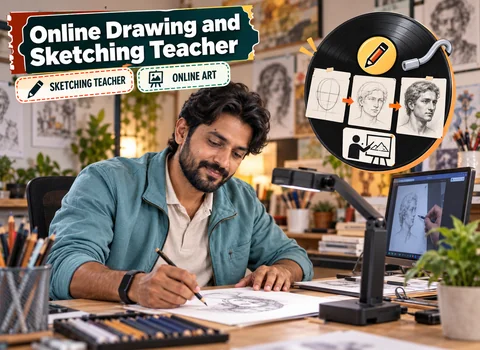
Why does a student's sketch of a cup look flat even when the outline is right? Because an outline only records where the edges are. The eye reads roundness from light: the pale side facing the window, the gradual turn into shadow, the dark crescent under the rim, the cast shadow on the table and the thin band of reflected light along the base. Teaching people to see those changes, then to put them on paper, is the work behind these online drawing and sketching teacher jobs. The position is Part-time, carried out remotely, open to people in any country and paid at $15 per hour (USD). You run live classes in shading, perspective, proportion and figure sketching, demonstrate on paper under a document camera or in Procreate, set exercises, and review student work in detail.
A typical session follows a studio rhythm. You show the subject (a still life, a room corner, a seated figure) and ask what students notice before anyone picks up a pencil. Then you demonstrate slowly, narrating each decision: where the light comes from and which shape goes down first. Students draw while you watch and correct. The class closes with a review of what they made and a clear exercise for the days before the next meeting.
Outside class, the drawing and sketching teacher job description adds reviewing submitted sketches and tracking each learner against a level plan.
Most beginners shade by darkening everything near an edge. The fix starts with a value scale: a strip of boxes running from bare paper to the darkest mark a soft graphite pencil can make. Students make one, then hold it against a real object and match each area of the subject to a box. Squinting helps, because it removes detail and leaves only light and dark.
From there you teach the families of light on a simple form: highlight, light side, core shadow, reflected light and cast shadow. A sphere and a cylinder come first, then the cup from the opening question. Hatching, cross-hatching and blending all get covered, but the value must be right before texture matters. A smooth tone in the wrong place still flattens the form.
Perspective is where careful seeing meets a few rules. With one-point perspective, students set a horizon line at eye level, place a single vanishing point, and draw a road, a hallway or a row of boxes facing them square-on. The lesson to press home is that the horizon is the viewer's eye height, not the place where land meets sky in the picture.
Two-point perspective follows, with a box turned at an angle and two vanishing points on the horizon. Students learn why verticals stay vertical, how to find a centre with crossed diagonals, and how ellipses sit on a cylinder. Then the ruler goes away and they sketch a real room freehand, checking angles against a pencil at arm's length.
Figure work depends on measurement. You teach comparative measuring: hold the pencil at a fixed arm length, use the head as a unit, and compare every other length to it. Students learn to block in the big shapes first (head, ribcage, pelvis) before limbs, and to find the gesture line that gives a pose its movement.
Quick gesture drawings train the hand to follow the whole body. Longer studies of hands and faces correct the beginner habit of drawing what a nose is supposed to look like instead of the shapes in front of them. Reference photos or a family member can stand in for a life model.
Students learn by watching your hand, so the camera has to show the paper clearly and steadily. A workable live sketching setup includes:
Many webcams wash out pale graphite, so press a little harder during demos than you would in your own sketchbook.
A good review changes what the student does tomorrow. Start by naming what works, specifically: the cast shadow is the right shape, the angle of the shoulder is accurate. Then pick one or two problems, not ten. Point to the spot, say what the subject shows that the drawing misses, and give a concrete correction, such as darkening the core shadow one step on the value scale.
Drawing over a copy of the sketch often teaches faster than words. Strong drawing and sketching teacher skills show up here: patience, a precise vocabulary, and the habit of describing what you observe rather than what you prefer.
Level planning keeps a course from drifting. A beginner track might cover line control, simple shapes, the value scale and basic still life. An intermediate track adds perspective, textures, and portraits from reference. Advanced learners work on full figures, composition and longer finished pieces in graphite or digital media. For each level, write down the skills a student must show before moving up, and set exercises that test exactly those skills.
A BFA or fine arts diploma helps, but a strong portfolio in pencil drawing and sketching is acceptable instead. What has to show in that portfolio is real command of shading, perspective and figure drawing. You also need teaching patience, clear English or Hindi, graphite pencils or Procreate, a document camera and a working internet connection.
No particular drawing and sketching teacher certification or course is listed as a requirement. If you are new to teaching, show observational work (not only copies) and one or two step-by-step sequences of a drawing in progress. That makes a resume far more convincing for drawing and sketching teacher jobs for freshers, since it proves you can explain a process, not just finish an image.
Traditional classes teach pressure control, erasing as a drawing tool and the patience of building tone slowly, and suit students sketching from life or preparing for art school. Digital classes in Procreate add layers, undo and adjustable brushes, which suit learners heading towards illustration.
The underlying skills are the same. Value, perspective and proportion do not change because the surface is glass. Starting digital students on the same value scale, with one hard brush, stops them hiding weak observation behind effects.
Start with work people can see. Post short process clips of a shading demo or a two-point perspective box, and explain one idea in each. Offer trial lessons to friends or a local art club and ask for frank feedback on pace. Course marketplaces such as Outschool and Skillshare are examples of platforms where art teachers publish classes; read each platform's own terms and teacher requirements yourself before applying.
For this post the figure is $15 per hour (USD), Part-time and remote, whichever country you live in. Drawing and sketching teacher salary levels elsewhere swing widely by platform, region and class format, and a number in another listing belongs to that offer alone. Can a drawing teacher earn well online? It depends on returning students, a clear set of courses and steady bookings, and nothing guarantees a particular income or number of classes. What this drawing and sketching teacher work from home offers is the stated hourly rate and regular practice explaining the craft, which tends to sharpen your own drawing too.