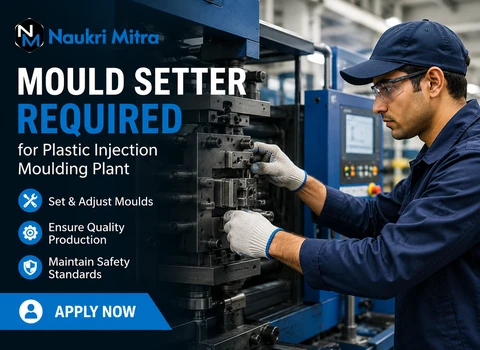
Build a Career as a Mould Setter in a Plastic Injection Molding Plant
A
Mould Setter is an important part of modern production work because this role helps prepare injection molding machines for steady, accurate output. The job involves fitting molds, fine-tuning machine settings, checking product quality, and keeping the production line running with as little interruption as possible.
This is a
Full-time position based in
Daman, Dadra and Nagar Haveli, and Daman and Diu, India. It suits people who like hands-on mechanical work, careful machine setup, and solving practical issues on the shop floor. Freshers with technical training, as well as experienced workers in manufacturing, can both build strong careers in this field.
Why Skilled Mould Setters Matter on the Shop Floor
Plastic injection molding is among the most common methods used in manufacturing to produce plastic parts in large numbers. Companies rely on correctly fitted and adjusted molds to make products that meet quality standards and production targets.
A mould setter helps production begin the right way by:
- Fitting molds safely and accurately
- Adjusting machine settings as per production needs
- Checking whether the first parts meet quality expectations
- Cutting down delays and machine stoppages
- Supporting smooth production throughout the shift
If the machine is not properly set up, factories may face defective parts, material waste, longer downtime, and higher production costs.
How the Injection Molding Process Works
Injection molding is a process that turns plastic raw material into finished items.
The basic working cycle is usually like this:
- Plastic granules are fed into the machine's hopper.
- The material is heated until it becomes molten.
- The molten plastic is pushed into a closed mould under high pressure.
- The mould cools the plastic into the required shape.
- The mould opens automatically.
- The finished part is removed for inspection or the next stage of work.
The mould decides the final shape, size, and finish of the product. That is why proper mould fitting and machine setup are so important for reliable production.
What the Workday Usually Looks Like
Daily duties can vary depending on the production plan, machine type, and shift schedule, but this role typically involves setup work, inspection, and production support.
Common tasks may include:
- Installing and removing injection molds
- Positioning molds correctly before production starts
- Connecting cooling water lines
- Linking hydraulic or pneumatic systems when needed
- Checking mould locking arrangements
- Setting machine parameters such as:
- Injection pressure
- Injection speed
- Holding pressure
- Cooling time
- Cycle time
- Temperature settings
- Making trial samples
- Inspecting molded parts for defects
- Solving basic production problems
- Supporting machine operators during production
- Cleaning mould surfaces before storage
- Writing down setup details for future use
During busy production periods, fast and accurate mould changes help reduce downtime and improve overall plant efficiency.
Industries That Commonly Hire for This Work
Plastic injection molding supports many sectors across India. Skilled production workers with mold-setting experience are needed wherever plastic parts are produced in high volumes.
Typical industries include:
- Automotive component manufacturing
- Electrical product manufacturing
- Consumer goods production
- Packaging units
- Medical plastic product manufacturing
- Household plastic item production
- Industrial engineering products
- Agricultural equipment manufacturing
- Electronics manufacturing
- Furniture component production
These workplaces are usually manufacturing plants with several injection molding machines of different sizes and capacities.
Tools, Machines, and Measuring Instruments Used
A mould setter works with a mix of mechanical tools, lifting devices, and inspection instruments every day.
Common equipment includes:
- Plastic injection molding machines
- Injection moulds
- Overhead cranes
- Chain pulley blocks
- Hoists
- Hand tools
- Allen keys
- Ring spanners
- Torque wrenches
- Hydraulic clamps
- Air blow guns
- Water hose connections
- Temperature controllers
- Hot runner controllers
- Material dryers
- Hopper loaders
For quality checking, precision measuring instruments are often used, such as:
- Vernier calipers
- Digital calipers
- Micrometers
- Height gauges
- Thread gauges
- Go/No-Go gauges
- Steel rulers
Using these instruments correctly helps keep product dimensions within the required tolerance range.
Technical Knowledge That Helps You Perform Better
Good performance in this profession depends on understanding both the machine and the mould structure.
Helpful technical skills include:
- Reading engineering drawings
- Understanding mould assembly
- Basic hydraulic systems
- Pneumatic connections
- Plastic material behavior
- Cooling system management
- Cycle time improvement
- Machine parameter adjustment
- Defect identification
- Preventive maintenance awareness
- Safe mould handling methods
Employers may prefer candidates with relevant machining or tool room training. Depending on the complexity of the work, an ITI in a machining-related trade, a Diploma in Mechanical or Tool and Die Engineering, or equivalent vocational training may be considered suitable. Practical experience with EDM machines, engineering drawings, and precision measuring instruments is often valued as much as formal education.
Hands-on shop-floor experience often becomes one of the biggest strengths for long-term growth in this line of work.
Workplace Skills That Make a Real Difference
Technical knowledge is important, but it is not enough on its own in a busy production environment.
Strong workers in this field usually show:
- Good observation skills
- Patience during machine setup
- Careful attention to small dimensional changes
- Clear communication with production teams
- Time management
- Problem-solving ability
- Safe lifting habits
- Teamwork with maintenance and quality departments
- Ability to work under production targets
- Willingness to learn new molding methods
These qualities help reduce interruptions while maintaining product quality.
Work Environment, Shifts, and Physical Demands
Plastic manufacturing plants often run for long hours to meet production demand. Because of this, shift work is common.
Depending on the factory, employees may work:
- Day shifts
- Evening shifts
- Night shifts
- Rotational shifts
The workplace may involve:
- Machine noise
- Warm conditions near processing equipment
- Standing for long periods
- Frequent movement across the production floor
- Handling heavy mould parts with lifting equipment
- Working closely with maintenance and quality teams
The job also requires physical fitness for bending, lifting small tools, climbing machine platforms where allowed, and performing repeated setup tasks safely.
Safety Rules Every Mould Setter Should Follow
Working around hot machinery and heavy molds means safety must always come first.
Important safety practices include:
- Lock out machines before changing molds
- Follow approved setup procedures
- Check lifting equipment before use
- Never stand under a suspended mould
- Confirm mould clamping before starting production
- Keep the work area clean and free from obstacles
- Report damaged tools right away
- Follow emergency shutdown procedures
- Never bypass machine safety interlocks
Common personal protective equipment (PPE) includes:
- Safety shoes
- Industrial gloves
- Safety glasses
- Ear protection
- Protective uniforms
- Helmets where required
- Heat-resistant gloves for specific tasks
Safe habits help prevent injuries and also protect costly molds and production machines.
Common Challenges on the Production Floor
Like many manufacturing jobs, this role requires flexibility and quick thinking.
Some common challenges include:
- Tight production deadlines
- Sudden mould breakdowns
- Machine setting changes after material changes
- Maintaining dimensional accuracy
- Reducing product defects
- Managing production during shift handovers
- Handling urgent mould changeovers
- Coordinating with several departments at once
Learning from experienced technicians and keeping records of successful machine settings can make future production runs easier and more efficient.
Growing Further in This Profession
People who keep improving their technical knowledge often take on more responsibility over time.
Career growth within the same manufacturing field may include roles such as:
- Senior mould setter
- Injection molding setup specialist
- Shift production technician
- Process technician
- Production supervisor
- Mould maintenance specialist
- Production planning support roles focused on injection molding operations
Staying up to date with new mould technologies, automation systems, robotics for part removal, and improved process control methods can support long-term development in plastic manufacturing.
Salary Expectations and Employment Considerations
For this position, the
monthly salary is ₹ 26000.
Across India’s manufacturing sector, pay for similar roles can vary based on experience, technical skills, production complexity, machine size, shift patterns, overtime, and company policies.
In many manufacturing workplaces, employees may also receive benefits such as:
- Overtime pay
- Provident Fund (PF)
- Employee State Insurance (ESI)
- Performance bonus
- Attendance incentives
- Uniforms
- Safety equipment
- Canteen facilities
- Transport assistance
These benefits depend on the employer’s policy and should be treated as possible offerings rather than guaranteed ones.