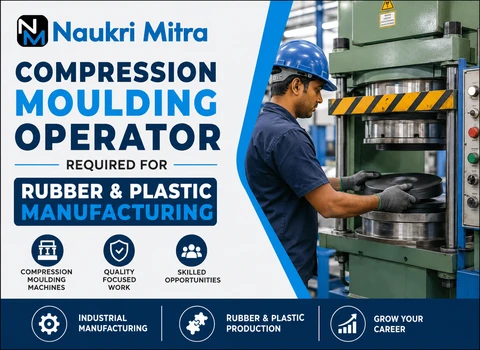
What a Compression Molding Operator Actually Does
Press. Heat. Hold. That's the basic rhythm of compression molding, and it's how a huge share of rubber and plastic parts get made in India. The raw compound enters a heated mould cavity; the press descends, and under sustained pressure, the material spreads out and takes the shape of the mould. It sounds simple written out like that. Doing it right, shift after shift, is where the skill actually lies.
This particular opening is a Full-time role based in Ahmedabad, Gujarat — a city with no shortage of rubber and plastic component manufacturers feeding into automotive, industrial, and consumer goods supply chains.
Why This Job Exists on Factory Floors
You'd think molding is just "load material, press button, wait." It isn't. Cure time, temperature, and pressure all interact, and getting even one of them slightly wrong shows up as a rejected part — flash that won't trim clean, an air pocket, a part that's under-cured and soft where it shouldn't be. Factories hire dedicated operators because rejection eats into margins quickly, and a careless press run wastes both material and machine time.
A Shift, Start to Finish
Most days start before the press even turns on — checking the mould for leftover residue from the last batch, confirming the compound is ready, making sure nothing's cracked or misaligned. Once the line is running, the actual job becomes a loop:
- Weigh and load the compound into the cavity
- Set or confirm the press cycle — temperature, pressure, dwell time
- Watch the cure closely; this isn't a walk-away step
- Open the mould, pull the part, trim the flash
- Check for defects before it moves to packing or the next process
It's repetitive, yes. But the repetition is exactly where an experienced operator starts to notice things a newer worker might miss — a slightly longer cycle time than usual, a mould running hotter than it should.
The Machines and Instruments Involved
The compression press itself is either hydraulic or pneumatic, and which one a factory uses usually depends on part size and required tonnage. Around that main machine sit the smaller tools that matter just as much day-to-day — trimming knives and deflashing tools for cleanup, a weighing scale to get compound quantities right, and calipers or similar gauges to check finished dimensions. Some units also run a pre-heater before the material even reaches the mould, softening it and shortening the cure cycle.
Skills That Actually Get Used
A working sense of how heat and pressure change rubber or plastic compound matters more here than most people expect. So does the ability to read a defect and trace it back to a cause — is it the compound batch, the mould temperature, or the cycle time? That kind of troubleshooting is usually picked up on the job rather than taught in a classroom.
On paper, employers commonly look for candidates with an ITI in a relevant trade, though a Diploma in Mechanical or Plastic Technology is also accepted depending on how complex the machines are. Familiarity with engineering drawings and precision measuring instruments tends to count for just as much as the certificate itself, since it's what lets an operator confirm a part actually meets spec rather than just "looks right."
The Physical Side of the Job
Expect to be on your feet for most of the shift. Loading and unloading the press involves repeated hand and arm movements, and the molds themselves stay warm even between cycles, so there's a physical toughness this work demands that doesn't show up in a job listing. Shift rotations are standard in this line of manufacturing, so flexibility around timing helps.
What the Work Environment Feels Like
Warm air, the smell of rubber compound, and the steady noise of presses cycling — that's a fairly accurate picture of the shop floor. None of it is unusual for the industry, but it's worth knowing going in, especially for someone who hasn't worked in a plant setting before.
Staying Safe Around the Press
Heat and pressure are the two things that can genuinely hurt someone here, so the basics aren't optional: heat-resistant gloves, safety goggles, a proper apron, and closed shoes rated for the floor. Lock-out procedures before any maintenance work, and never reaching past a safety guard to "just quickly" clear something — these habits matter more than they sound like they should, right up until the day they prevent an injury.
What Tends to Go Wrong
Compound batches aren't perfectly identical, so quality can drift slightly even when the process hasn't changed. Downtime happens when a mould needs cleaning or a heater needs attention, and switching between different products often means re-adjusting cycle settings from scratch. None of this is dramatic — it's just the ordinary friction of running a press day after day, and handling it calmly is part of the job.
What Separates a Good Operator From an Average One
Cleaning the mould properly between cycles instead of rushing it. Noticing when calibration has drifted before it becomes a batch of rejects. Flagging an odd sound or vibration the moment it starts rather than waiting to see if it goes away. Operators who keep a simple record of their cycle times and rejection reasons tend to spot patterns faster than those who don't — it's a small habit that pays off over months, not days.
Where This Can Lead
Operators who stick with the trade and build up experience across different mould types often move into senior operator roles, shift-in-charge positions, or quality-checking within the same department. It's a fairly natural progression — the same core skill set, applied with more responsibility as trust builds.
Pay for This Role
This Full-time position in Ahmedabad, Gujarat offers a monthly salary of ₹25,500. As with most factory roles, actual take-home can shift a little depending on experience and how a particular employer structures pay.
Other Benefits Worth Asking About
Some employers in this space also offer overtime pay, PF and ESI coverage, an annual bonus, uniforms, and occasionally transport or canteen facilities. None of these are guaranteed in every role, so it's worth confirming directly with the employer which apply.