Home
›
Plastic & Packaging
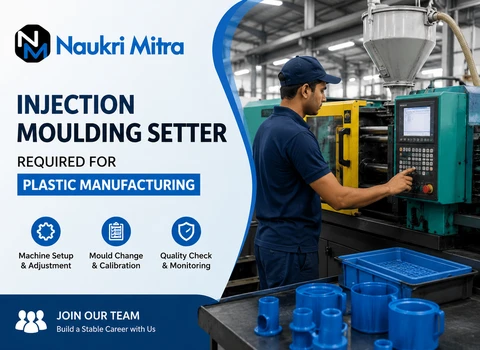
Injection Moulding Setter Required for Plastic Manufacturing
Working on the Shop Floor in Plastic Manufacturing
The Injection Moulding Setter Required for Plastic Manufacturing role is a hands-on job for people who want to work close to machines, production targets, and product quality. This is a Full-time position in Silvassa, Dadra and Nagar Haveli and Daman and Diu, India, where plastic manufacturing supports many industrial units and supply chains. The work is not only about running a machine. It is about setting it correctly, keeping production steady, and making sure each plastic part comes out as expected.
For someone who likes practical work, this job can be a strong entry into the manufacturing field. It suits freshers who are ready to learn, as well as experienced workers who already understand factory routines.
Why Injection Moulding Matters in Factories
Injection moulding is a common process used to make plastic parts in large numbers. The machine heats plastic granules until they melt, then pushes the molten material into a mould under pressure. After cooling, the mould opens and the finished part comes out. The same cycle repeats many times during a shift.
Factories use this process because it helps them produce parts quickly and with good repeatability. A skilled setter is important because even a small mistake in temperature, pressure, or timing can affect the final product.
Industries that often depend on injection moulded parts include:
- Automotive
- Packaging
- Consumer goods
- Electronics
- Household products
- Industrial components
- Medical and utility items
That is why companies look for people who can manage machine setup with care and consistency.
What a Setter Does During a Normal Shift
A setter’s day usually begins before production starts. The machine must be prepared properly so that the line can run without avoidable stoppages. In many plants, the setter works closely with machine operators, quality staff, and maintenance teams.
Typical work may include:
- Fitting and changing moulds as per the production plan
- Setting temperature, pressure, speed, and cycle time
- Starting the machine after checking all settings
- Watching the first few pieces carefully
- Checking whether the parts match the required size and shape
- Making small adjustments when defects appear
- Supporting operators during regular production
- Recording machine settings and output details
- Informing the team if the machine shows unusual behavior
- Helping during cleaning or scheduled maintenance
This is a practical role where attention to detail matters every hour, not just at the start of the shift.
Machines, Tools, and Measuring Instruments Used
A machine setter in plastic manufacturing works with equipment that needs both technical understanding and safe handling. The exact setup may vary from plant to plant, but the basic tools are usually similar.
Common equipment includes:
- Injection moulding machines
- Moulds and dies
- Hopper loaders
- Material dryers
- Temperature controllers
- Hydraulic and pneumatic systems
- Cooling units
- Conveyors
- Hand tools for mould fitting
- Calipers
- Vernier calipers
- Micrometers
- Gauges for checking dimensions
Knowing how to read engineering drawings is very useful because it helps the setter understand the required size, shape, and tolerance of the part. In many factories, this is just as important as knowing how the machine works.
Skills That Help You Do Well
This job needs a mix of technical knowledge and practical sense. A good setter does not only press buttons. The person must understand how the machine behaves and how small changes affect the product.
Useful technical skills include:
- Understanding the injection moulding process
- Setting machine parameters correctly
- Spotting common moulding defects
- Reading engineering drawings
- Using precision measuring instruments
- Handling moulds safely
- Basic preventive care of machines
- Understanding plastic material behaviour
Practical workplace skills also matter a lot:
- Careful observation
- Quick problem-solving
- Clear communication with the production team
- Time management during shift work
- Clean and disciplined work habits
- Ability to follow instructions properly
Employers may prefer candidates with relevant machining or tool room training. Depending on the complexity of the work, an ITI in a machining-related trade, a Diploma in Mechanical or Tool and Die Engineering, or equivalent vocational training may be considered suitable. Practical experience with EDM machines, engineering drawings, and precision measuring instruments is often valued as much as formal education.
Work Environment, Shifts, and Physical Demands
This is a factory-based job, so the environment is usually busy and machine-driven. In many plants, production runs for long hours to meet demand. Because of that, shift work may be part of the routine. A setter may work day, evening, or night shifts depending on the factory schedule.
The work environment can involve:
- Standing for long periods
- Walking across the production floor
- Working near hot machines
- Exposure to industrial noise
- Handling moulds and production materials
- Staying alert during continuous machine cycles
The role can be physically demanding, but it is manageable for people who are fit, focused, and comfortable with industrial work. Good concentration is important because one missed setting can affect many pieces in a short time.
Safety Habits That Matter Every Day
Injection moulding machines work with heat and pressure, so safety cannot be ignored. A careful setter protects both the machine and the people around it.
Important safety practices include:
- Wearing the correct personal protective equipment (PPE)
- Keeping hands away from moving mould parts
- Using lockout procedures before maintenance
- Handling hot plastic parts with care
- Checking guards and safety devices before starting work
- Keeping the floor clean and free from obstacles
- Using lifting support when changing heavy moulds
Common PPE may include:
- Safety shoes
- Gloves
- Safety glasses
- Ear protection
- Protective uniforms
- Heat-resistant gloves where needed
These habits reduce accidents and also help production run more smoothly.
Problems You May Face on the Line
Even in a well-run plant, production issues can happen. A setter must be ready to notice the problem early and respond in a practical way.
Some common issues are:
- Flash on the moulded part
- Short moulding
- Sink marks
- Warpage
- Poor material flow
- Mould alignment problems
- Unexpected machine stoppage
- Variation in part size
When these problems appear, the setter usually checks machine settings, mould condition, cooling time, and raw material quality before making changes. Experience helps a lot here, because many defects have more than one possible cause.
Growth Opportunities in the Same Field
The Injection Moulding Setter Required for Plastic Manufacturing role can lead to steady growth for people who keep learning on the job. A person who starts as a setter can build strong technical knowledge over time by working with different moulds, materials, and machine types.
Ways to grow in this field include:
- Learning more machine models
- Improving mould change speed
- Understanding different engineering plastics
- Studying preventive maintenance
- Strengthening quality inspection skills
- Learning basic automation systems
- Keeping production records accurately
- Taking part in safety and technical training
With experience, a worker may move into senior setter duties, production supervision, process support, or technical leadership within the same manufacturing environment.
Salary and Common Workplace Facilities
For this position, the offered monthly salary is ₹ 26500.
In the Indian plastic manufacturing sector, actual earnings can vary based on experience, shift pattern, technical skill, and the employer’s policy. Some companies may also provide facilities such as:
- Overtime pay
- Provident Fund (PF)
- Employee State Insurance (ESI)
- Bonus
- Uniforms
- Transport support
- Canteen facilities
These are possible workplace benefits, not guaranteed ones.
Who Should Consider This Job
This Full-time role in Silvassa, Dadra and Nagar Haveli and Daman and Diu, India can suit freshers who want to enter manufacturing, as well as experienced production workers, ITI candidates, diploma holders, and technical job seekers who want practical shop-floor work.
It is a good fit for people who are comfortable with machines, quality checks, and disciplined factory routines. If you are looking for a career where skill improves with experience, this injection moulding setter role can offer a solid path in plastic manufacturing.
Apply Now