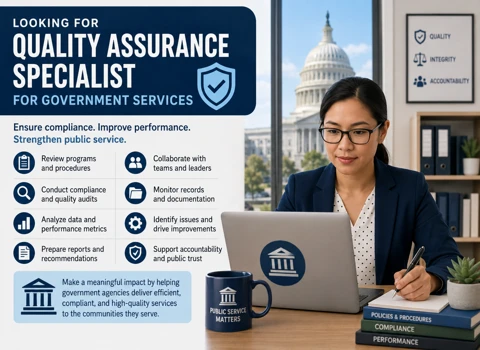
Inside the Quality Assurance Specialist for Government Services Profession
Government agencies manage programs that affect daily life, including licensing, healthcare administration, transportation services, public assistance, and regulatory enforcement. To keep these operations running smoothly, agencies rely on professionals who can evaluate performance, verify compliance, and identify opportunities for improvement. That is where a Quality Assurance Specialist for Government Services becomes essential.
This role focuses on examining how programs and services are delivered. Specialists review procedures, assess outcomes, and help ensure departments follow established standards. Their findings often lead to better efficiency, fewer errors, and stronger accountability across government operations.
For people who enjoy analyzing information, solving process-related problems, and contributing to public service, this career can provide both purpose and professional growth.
The Importance of Quality Oversight in Public Programs
Government organizations operate under strict regulations and public scrutiny. Citizens expect services to be accurate, timely, and fair. When procedures are not followed correctly, the consequences can affect budgets, compliance requirements, and public confidence.
A Quality Assurance Specialist for Government Services helps reduce those risks by:
- Reviewing compliance with laws, policies, and procedures
- Detecting operational weaknesses
- Supporting service improvement initiatives
- Monitoring quality standards
- Evaluating contractor performance
- Improving recordkeeping practices
- Identifying recurring errors
- Assisting with audit readiness
Their work helps agencies maintain consistency while adapting to changing regulations and operational demands.
How Quality Assurance Supports Government Operations
Unlike quality assurance roles in manufacturing or software development, government-focused quality assurance often centers on services, documentation, workflows, and regulatory obligations.
A specialist may examine whether employees are following required procedures, whether records are complete, or whether a program is meeting established performance goals.
Areas commonly reviewed include:
- Public assistance programs
- Licensing and permit services
- Healthcare administration
- Transportation operations
- Public safety programs
- Regulatory compliance activities
- Community development initiatives
- Citizen support services
The objective is to ensure that services are delivered accurately and consistently while meeting legal and organizational requirements.
What You Can Expect During a Typical Workday
The daily routine varies depending on the agency and program being reviewed. Some days involve detailed audits and documentation reviews, while others focus on meetings, investigations, or performance analysis.
Common responsibilities include:
- Examining operational reports
- Conducting compliance reviews
- Auditing records and case files
- Tracking corrective actions
- Investigating quality concerns
- Meeting with managers and stakeholders
- Writing reports and recommendations
- Updating quality procedures
- Monitoring performance indicators
Much of the role involves gathering evidence, evaluating findings, and presenting practical recommendations that support better outcomes.
Evaluating Program Results
One of the core responsibilities is determining whether programs are performing as intended.
This often involves reviewing metrics such as:
- Accuracy rates
- Processing timelines
- Compliance percentages
- Customer satisfaction scores
- Error frequencies
- Documentation quality
By analyzing these indicators, specialists can identify trends and recommend improvements before issues become more significant.
Monitoring Compliance and Procedures
Quality reviews frequently focus on whether departments and employees are following established requirements.
Activities may include:
- Reviewing records and files
- Observing operational processes
- Testing compliance controls
- Verifying documentation accuracy
- Assessing adherence to standards
The results often guide training efforts, policy revisions, and workflow improvements.
Skills That Help Professionals Excel
Employers look for candidates who can do more than identify mistakes. Successful specialists understand how to interpret information, communicate findings, and recommend realistic solutions.
Analytical and Investigative Thinking
A large portion of the job involves examining data and identifying patterns that may not be immediately obvious.
Valuable abilities include:
- Data interpretation
- Root cause analysis
- Critical thinking
- Risk evaluation
- Process assessment
Strong analytical skills help professionals move beyond identifying problems and toward solving them.
Precision and Attention to Detail
Government programs often involve detailed regulations and procedural requirements. Small oversights can create larger compliance concerns.
Specialists routinely review:
- Case documentation
- Operational reports
- Policies and procedures
- Regulatory guidance
- Audit records
Careful attention to detail helps ensure findings are accurate and reliable.
Communication and Collaboration
Quality assurance findings must be communicated clearly to be effective.
Professionals regularly:
- Prepare written reports
- Present recommendations
- Discuss findings with leadership
- Coordinate with multiple departments
- Explain compliance concerns
Clear communication helps organizations understand issues and implement corrective actions.
Educational Paths and Professional Qualifications
Most employers prefer candidates with a bachelor's degree, although relevant experience in compliance, auditing, or government operations may also be considered.
Common fields of study include:
- Public Administration
- Business Administration
- Political Science
- Public Policy
- Organizational Leadership
- Government Studies
- Information Systems
- Management
A strong understanding of organizational processes and regulatory environments is often more important than a specific major.
Certifications That May Strengthen Your Resume
Professional certifications can demonstrate expertise and commitment to quality standards.
Examples include:
- Certified Quality Auditor (CQA)
- Certified Quality Improvement Associate (CQIA)
- Certified Manager of Quality/Organizational Excellence (CMQ/OE)
- Lean Six Sigma Green Belt
- Lean Six Sigma Black Belt
- Project Management Professional (PMP)
These credentials may be especially valuable for professionals pursuing supervisory or management roles.
Technology Commonly Used in Government Quality Assurance
Modern quality assurance work relies heavily on digital systems and reporting tools. Specialists often spend much of their day reviewing electronic records and analyzing operational data.
Frequently used systems include:
- Quality management platforms
- Audit tracking software
- Case management systems
- Compliance monitoring tools
- Workflow applications
- Document management systems
- Reporting dashboards
- Business intelligence platforms
Microsoft Excel remains a widely used tool for organizing information, tracking trends, and performing data analysis.
Understanding Performance Metrics
Government agencies often use measurable indicators to evaluate service quality and operational effectiveness.
Examples include:
- Processing turnaround times
- Accuracy percentages
- Compliance rates
- Resolution timelines
- Audit scores
- Service quality benchmarks
Understanding these metrics allows specialists to identify strengths, weaknesses, and opportunities for improvement.
Challenges Often Associated With the Role
Quality assurance professionals frequently work in environments where regulations, priorities, and operational demands are constantly evolving.
Common challenges include:
- Managing large volumes of documentation
- Keeping current with regulatory updates
- Investigating recurring issues
- Coordinating across departments
- Meeting reporting deadlines
- Addressing resistance to change
- Balancing multiple priorities
Professionals who remain organized, objective, and solution-focused are often the most effective in these situations.
Is This Career a Good Match for You?
People who succeed in this profession often share certain traits and interests.
You may enjoy this career if you:
- Like solving operational problems
- Prefer structured environments
- Pay attention to details
- Enjoy working with data
- Value consistency and accountability
- Communicate well with different audiences
- Have an interest in public service
Those who naturally look for ways to improve systems and processes often find quality assurance work rewarding.
Remote Work Possibilities in Government Quality Assurance
Many agencies and government contractors now offer remote or hybrid arrangements for quality assurance positions. Since much of the work involves reviewing digital records and analyzing electronic information, many responsibilities can be completed from a home office.
Remote tasks may include:
- Reviewing electronic documentation
- Conducting virtual compliance assessments
- Preparing reports and recommendations
- Monitoring performance indicators
- Participating in online meetings
- Collaborating through digital platforms
A remote Quality Assurance Specialist for Government Services typically benefits from strong time-management skills, dependable technology, and the ability to work independently.
Compensation for This Opportunity
The listed compensation for this
remote position is:
$50 per hour
Actual earnings may vary depending on experience, agency requirements, contract terms, certifications, and other job-specific factors.
Employers That Frequently Seek Quality Assurance Specialists
Opportunities exist throughout the public sector as well as within organizations that support government operations.
Examples of employers include:
- Federal agencies
- State departments
- Local government offices
- Public health organizations
- Transportation authorities
- Government contractors
- Educational institutions
- Regulatory bodies
- Social service agencies
- Defense support organizations
As accountability and performance measurement remain priorities, quality assurance expertise continues to be valuable across many government-related sectors.
Building a Long-Term Career in the Field
Many professionals begin by reviewing compliance and operational processes before advancing into broader leadership responsibilities.
Career development often involves strengthening skills in:
- Regulatory compliance
- Process improvement
- Data analysis
- Audit management
- Risk assessment
- Project leadership
- Organizational performance
Ongoing learning is important because regulations, technologies, and government priorities continue to evolve.
Advancement Opportunities for Experienced Professionals
Experience as a Quality Assurance Specialist for Government Services can open doors to a variety of leadership and specialized positions.
Potential career paths include:
- Senior Quality Assurance Specialist
- Compliance Manager
- Quality Assurance Manager
- Program Evaluation Analyst
- Performance Improvement Manager
- Risk Management Specialist
- Operations Manager
- Government Program Manager
- Director of Quality
Professionals who combine technical expertise with leadership abilities often move into roles that influence agency-wide policies and improvement initiatives.
The Lasting Impact of This Profession
Government agencies depend on reliable systems, accurate processes, and consistent service delivery. Quality assurance professionals help maintain those standards by evaluating performance, identifying weaknesses, and supporting continuous improvement efforts.
A Quality Assurance Specialist for Government Services serves as an important link between compliance requirements and operational excellence. The role combines analysis, oversight, collaboration, and problem-solving to help agencies deliver effective services to the communities they serve.
For individuals who enjoy improving processes, promoting accountability, and contributing to meaningful public outcomes, this profession offers a practical and rewarding career path with opportunities for continued advancement.