
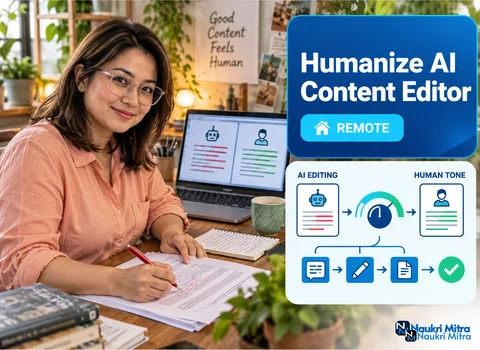
Most online humanize AI content editor jobs come down to one habit, so here it is on a single paragraph. Everything in the sample below is made up, including the gardening blog, the gardener and the figure in the draft:
Before: "In the modern era, composting has become more important than ever. Studies show that 70% of household waste can be composted, making it a powerful tool for sustainability. By composting, homeowners can make a real difference for the planet and their gardens alike."
After: "Priya fills a kitchen caddy with carrot peel, coffee grounds and crushed eggshells, tips it into a plastic bin behind her flat every Sunday, and by late spring has a dark, crumbly layer she digs into her tomato beds. [QUERY: the draft says 70% of household waste is compostable. No source given. Please send one or I cut the line.]"
Three changes did most of the work:
This listing is part-time, remote from anywhere in the world, and pays USD 22 per hour.
Here is the plain humanize AI content editor job description. Clients hand over drafts produced by a language model: blog posts, guides, product explainers, newsletters. You return articles that read as if a person who knows the subject wrote them. That means adding a genuine voice, real examples and some personal insight from the client, removing generic phrasing, checking statistics and claims against sources, running the draft through GPTZero, and making sure the finished piece matches the client's style guide.
In practice it is line editing combined with research, and much of it depends on judgement.
Before touching a sentence, read the brand guide and two or three pieces the client has published and liked. Note the boring specifics: "e-mail" or "email", contractions or not, British or American spelling. A fitness brand that writes "you'll" and "let's" will sound wrong if you hand back stiff, formal prose, however clean it is.
Then read the AI draft once, start to finish, without editing. Mark where it drifts out of that voice. Drafts usually drift in the introduction and the last paragraph, where models love a moral.
Some phrases show up in machine drafts so often that readers skim past them. "Plays a crucial role." "A wide range of." "Not only X, but also Y." Closers that begin "Ultimately".
Cutting them is the easy half. The harder half is noticing what was hiding behind them. Often a stock phrase is covering for a missing fact. "Plays a crucial role in customer retention" usually means the draft does not know how. Your job is to find out, ask the client, or cut the claim.
Treat every statistic, date, quote and named study as unconfirmed until you have seen the source. Language models produce figures that look tidy and are sometimes made up. If you can find a reliable primary source, link or cite it the way the style guide asks. If you cannot, flag it with a clear query, as in the compost example above, rather than rounding it into something vaguer that is still unsupported.
Some clients also require a plagiarism check on the finished piece. Read the brief for which tool and what threshold. Note what you checked in your hand-back comments so the client does not have to guess.
Generic drafts lean on hypothetical people and imaginary companies. Replace those with examples the client actually supplies: a customer story, a mistake from their own business, a screenshot they describe, a number from their own records. If the brief arrives without any, ask. A single true anecdote from the client usually helps an article more than extra polish.
Then look at structure. AI drafts often put the useful part in section four, behind three sections of background. Move it up.
Grammarly catches typos, agreement slips and doubled words you stopped seeing on the third read. Hemingway highlights long sentences and passive voice. Neither knows the client's audience. Hemingway will flag a sentence that is long for a good reason, and Grammarly may suggest rewording that breaks the brand voice you just restored. Accept the corrections that are right.
The listing asks you to check drafts with GPTZero, so be clear about what that tool is. It gives an estimate of how likely a text is to be machine-written, based on patterns in the wording. Scores vary between tools and between runs, so read the result as a rough estimate, and judge your edit on the writing itself rather than on the number.
It is not proof of anything. Detectors of this kind can flag text written entirely by people, especially plain or formulaic writing, and can miss text that was generated. Treat the result as one signal, report it honestly if the client asks for it, and never present a score as a verdict on who wrote a piece.
Be wary of anyone who describes this work as "making AI text undetectable". Rewording text purely to push a detector score down does not make an article better, and passing machine text off as something it is not misleads readers. If a client asks for that, raise it with them or decline the work. The editing described in this listing is about accuracy, a voice that fits, examples that happened and claims that hold up. If the article gets that right, the detector score is a side note.
No degree is on the list. Editing experience is preferred rather than required, so humanize AI content editor jobs for freshers are realistic, and newcomers without paid editing work can still compete on the strength of their samples. What the listing does expect is excellent written English, a sharp eye for clichés, the ability to fact-check, comfort with the three tools above and editing samples.
As for how to get hired as an AI content editor: build the samples yourself. Generate a draft on a topic you know, save the original, edit it, and show both side by side with short notes explaining each change. On a humanize AI content editor resume, lead with links to those before-and-after pieces, then any editing, writing or research work you have done.
USD 22 is the humanize AI content editor salary per hour this opening states, and the role is part-time and remote. Weekly hours and article volume are left open, so ask about expected workload, turnaround times and how time is tracked before you start. Freelance humanize AI content editor jobs also show up on Upwork and on content platforms such as Contently. Each sets its own terms; neither has any connection to this opening.
Expect a paid or unpaid test edit, or a few practical humanize AI content editor interview questions. Typical ones: walk us through how you would edit this paragraph; what do you do when a statistic has no source; how do you keep a voice consistent across a long article; what does a GPTZero score actually tell you. Answer with specifics from your samples.
To apply, send two or three before-and-after edits, a line on which style guides you have worked with, and your availability for part-time work. Nothing is charged for applying, and a client who asks for an editing starter fee is not a real client.