
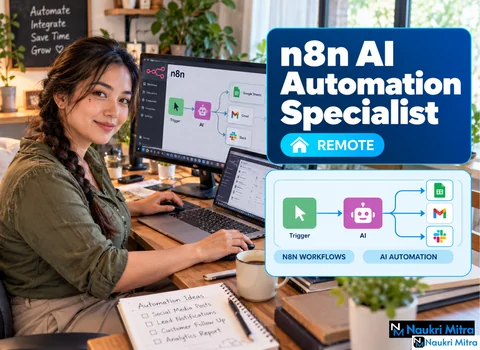
The execution log said it plainly. Run 4,812 started at 2:03 a.m., passed the webhook, the AI Agent and a small Code node, then stopped at an HTTP Request node with "429 Too Many Requests". Sorting out that kind of night is the heart of these online n8n AI automation specialist jobs: you open the failed run, see which node broke on which item, and change the workflow so it can't break that way again.
The fix was small. On the HTTP Request node you switch on Retry On Fail and set how many attempts to make and how long to wait between them; four tries with a 5000 ms gap is one reasonable starting point, not a rule, and the right values depend on the API's limits. If the API sends a Retry-After header, a Code node can read it and feed a Wait node instead of guessing. Then you rerun the failed execution and watch every item go green.
The position is remote, part-time and open worldwide, with USD 30 per hour as the rate. No employer is named, but the n8n AI automation specialist job description is specific. You build AI agent workflows in n8n that connect LLMs with tools, memory and company data through agent nodes and webhooks, write JavaScript in Code nodes for custom logic, add error handling, and host or maintain the finished workflows for clients. It is n8n AI automation specialist work from home in the literal sense: a laptop, a running instance and a client on a video call. The build below is illustrative, not any real client's.
Most agent builds start with a Webhook node. A website form or help desk posts JSON to a production URL, and n8n starts a run. Do you reply straight away with a 200 and process in the background, or hold the connection and return the agent's answer through a Respond to Webhook node? A chat widget needs the second; ticket triage is happier with the first. You also lock the door: header auth, a check that the payload carries the expected fields, and an early IF node that drops junk before it costs a model call.
Next comes the AI Agent node. Into it you plug a chat model sub-node for whichever LLM API the client pays for, a system message that sets the agent's job and limits, and its tools: a sub-workflow, an HTTP Request tool that looks up an order, a calculator. The agent picks tools from the descriptions you write, so "gets data" produces vague behaviour, while "Looks up an order by its 8-digit number and returns status and ship date" works far better. The agent's intermediate steps in the execution log show why it chose a tool, what it sent and what came back. Read those steps after every test message and you will catch most bad tool choices before a client does.
Agents become useful when they can answer from the client's material: policies, product sheets, old tickets. In n8n that means a vector store node with an embeddings model attached. A separate ingestion workflow loads documents, splits them into chunks, embeds them and writes them to the store, and the agent gets a retrieval tool that searches it. No deep maths needed, but you should understand chunk size, why the same embeddings model must be used for writing and searching, and how to re-index when a document changes.
Between the interesting nodes sits a lot of reshaping. An API returns nested arrays when the next node wants one item per line. A model returns text that should have been JSON. That is Code node territory in JavaScript: mapping over $input.all(), returning objects in the { json: { ... } } shape n8n expects. A few clean lines there can replace a chain of Set and IF nodes.
HTTP Request nodes cover every outside API without a native node, so headers, bearer tokens, pagination and reading API docs should feel routine. Rate limits like the 429 from the opening are common with real APIs, so retries and Wait nodes soon become habits. Among n8n AI automation specialist skills, agent nodes, JavaScript and webhooks carry the most weight, with HTTP and credential handling close behind.
A chat agent with no memory forgets the customer's name between messages. You attach a memory sub-node keyed to a session ID from the webhook and choose how many past exchanges to keep, since more context means more tokens. Guardrails follow: a system message listing what the agent must refuse, a Code node that masks anything resembling a card number, an IF node that routes low-confidence answers to a person.
Every production workflow should also point to an error workflow built on an Error Trigger node, posting the workflow name, failed node, error message and execution link to the client's team chat or inbox. The client hears about a problem from your alert first, not from an unhappy customer.
Self-hosting or Docker experience helps, and clients often ask which route to take. n8n Cloud means no server to patch, with plan limits and less control as the trade-off. Self-hosting usually means the n8n Docker image on a small VPS or the client's own infrastructure, often with Postgres instead of SQLite, a reverse proxy for HTTPS, and environment variables for the webhook URL, timezone and encryption key. Data stays on the client's machine and you see every log, but someone must back up the database, guard that key and upgrade carefully. Explaining that plainly is part of the job.
Handover means sticky notes on the canvas, nodes renamed from "HTTP Request3" to "Get order from shop API", credentials moved into accounts the client owns, the workflow exported as JSON, and a short runbook: what triggers it, what the error alert looks like and what to check first. If you're staying on to maintain it, agree how failures reach you and how quickly you respond.
No formal degree is needed; working n8n builds are the key proof. So a strong n8n AI automation specialist resume leans on two or three short screen recordings of real executions, canvas visible and log open, plus exported JSON for one build with credentials stripped and a few lines on a failure you fixed. Good portfolio pieces: a document Q&A agent over public PDFs, a webhook triage agent that calls an HTTP tool, and a Docker setup with an error workflow you can trigger live. If the question is how to become an n8n AI automation specialist, building those three teaches more than any reading plan.
Clear English for client calls is in the qualifications for good reason. You scope a workflow by asking what triggers it, which systems it touches, what a wrong answer would cost and who hears about failures. You demo by running a test execution live and talking through the log.
The rate: USD 30 per hour, part-time. Like most part time n8n AI automation specialist jobs, this one names no fixed weekly hours or minimum workload, so treat the rate as just the rate. Track time per workflow, debugging and calls included, because that is what you bill.
Before applying, rebuild the 429 scenario on your own instance: point an HTTP Request node at a rate-limited test endpoint, watch it fail, then add retries, batching and a Wait node until it passes. Trigger an error workflow on purpose. Write one Code node that tidies a messy API response. For learning, the official n8n docs, template library, community forum and free n8n courses are the best starting points, alongside your LLM provider's docs. When you apply, link your recordings and JSON, say whether you've run n8n in Docker, and give your time zone. There's no fee to apply through Naukri Mitra, and a client who wants money before seeing your work isn't worth it.