
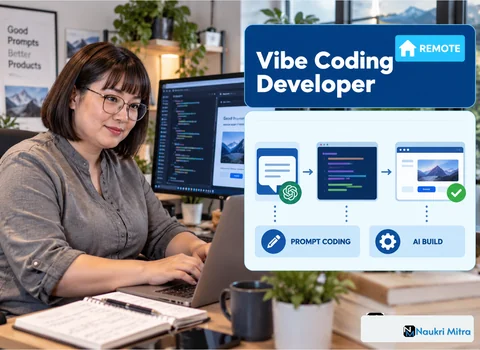
A booking app gets thrown together over a weekend with AI prompts. It works, the client loves it, and it goes live on Monday. On Thursday a curious visitor opens the browser's developer tools, scrolls through the bundled JavaScript and finds a payment provider's secret key sitting in plain text, because the AI wired the API call straight from the front end and nobody checked. That kind of slip is exactly what this role exists to prevent. These are online vibe coding developer jobs: you build client apps at AI speed and still ship code you would sign your name to. It is part-time vibe coding developer work from home, open worldwide, at a rate of $45 per hour in USD.
What follows is the vibe coding developer job description in working order, from picking a tool to the final check before handover.
No single AI tool suits every request. When a client already has a codebase, or the app will grow past a prototype, editor and terminal tools such as Cursor and Claude Code make more sense: they work inside real files, show you what they change, and sit happily next to Git. When a founder wants a clickable full-stack prototype by Friday, browser builders such as Lovable and Bolt get a front end, a database connection and a hosted preview up very quickly.
The trade-off is control. Browser builders hide more of the plumbing, which is fine for a test version and awkward once real users arrive. A sensible pattern is to prototype fast in one, export or sync the code to a repository, and continue in an editor tool where every change is visible.
A prompt like "build the whole dashboard" produces hundreds of lines nobody will read properly. Ask instead for one slice: "Add a server route that returns the signed-in user's bookings, reading the database URL from an environment variable. Do not touch the front end yet." Name the files involved, state what must stay unchanged, and ask the tool to explain its plan before it writes anything.
Small requests give you changes you can read in a couple of minutes. They also expose the moments when the AI edits files you never mentioned.
You do not need to write a framework from memory, but you must read JavaScript and TypeScript comfortably. That means following a function, spotting where data comes from, and noticing when a type has been loosened to "any" just to silence an error. When something breaks, open the browser console and the server logs first, reproduce the bug, then paste the exact error and the relevant file into the prompt. Guessing at fixes through vague prompts tends to stack new bugs on old ones.
Among vibe coding developer skills, this reading habit matters most. Clients pay for apps that keep working after the demo, and that depends on someone who understands why the code works.
Commit after every working step, with a message that says what changed in plain words. Put each feature on its own branch so an AI experiment that goes sideways can be thrown away without harming the main version. Before you merge, look at the diff as a whole and ask whether anything in it surprises you.
Git also protects you commercially: the history shows where the billed hours went.
This is where the opening scenario happens, so slow down here. Keys for payment, email or AI services belong in environment variables on the server or the hosting platform, never in code the browser downloads. Many front-end frameworks expose any variable carrying a public prefix, so learn which prefix your stack uses and keep secret values out of it. Add the environment file to your ignore list before the first commit, not after.
For databases, switch on access rules so each user can read only their own rows, and test that by logging in as two different accounts. For authentication, prefer the provider's built-in login over anything the AI invents from scratch. Ask the tool to route third-party API calls through a server function rather than straight from the page.
Deploy to a preview link early, ideally from a branch, so the client can try it on their own phone and laptop. Keep test and production data apart, and set environment variables separately for each. Send a short note with every preview: what to try, what is unfinished, and where to report problems.
Before you call anything finished, run through a short list:
On a small app this does not take long, and it catches many common AI-introduced problems.
A reasonably recent laptop that runs a modern browser, a code editor and Node.js without strain is enough. You will also want paid plans on the AI tools you use most, a GitHub account, and accounts on whichever hosting and database services your clients prefer. Tool subscriptions are normally the freelancer's expense; some clients supply their own accounts, especially for hosting and databases, so that the project stays theirs after you leave. Settle ownership of every account in writing at the start, and check each tool's current plan terms for commercial use and client work.
Each billed hour earns $45 (USD), and the work stays part-time and remote. Hours depend on the client's project and its pace, so some weeks are full and others quiet, and nothing guarantees a set number. Track time per task so your invoices line up with your commit history. If you take extra freelance vibe coding developer jobs elsewhere, Upwork, Contra and Fiverr all carry this kind of work; each has its own fees, rules and policies on AI-assisted work, so check them before you bid.
No computer science degree is needed here. A portfolio of shipped apps is. Build three small, real projects with live links: a booking form with login, a dashboard that pulls from a public API, and something with payments in test mode. For each, write a few lines on the tool you used, one bug you fixed, and how you handled secrets. That last line separates you from applicants who only show screenshots.
Vibe coding developer jobs for freshers start the same way. Offer a narrow, fixed-scope job first, such as fixing a broken prototype, then grow from there. A vibe coding developer resume works best when it leads with live links and a short security note rather than a long list of tools.
Be honest with yourself about the gap. A software engineer designs systems, writes tests, plans for scale and maintains code for years. A vibe coding developer builds smaller apps fast and relies on AI for most of the typing. The two overlap more each year, and the best vibe coders steadily pick up engineering habits. Large, regulated or high-traffic systems still need engineers.
Is it a real job? Yes, clients pay for this work today. It is also true that AI-generated code can contain vulnerabilities, from exposed keys to missing access checks, which is why review is mandatory here and why careful builders tend to keep their clients.