
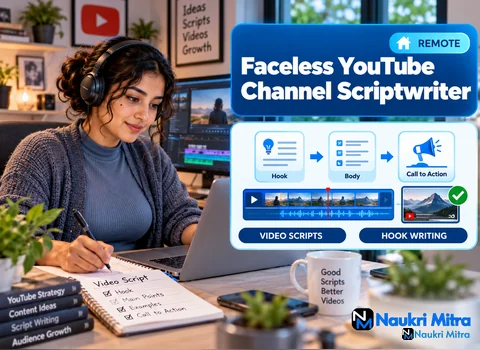
Read these two lines out loud. Same video, same facts, but listeners are far more likely to drift away during the first. Writing the second kind of line, again and again, is most of the work in online faceless YouTube channel scriptwriter jobs, and this part-time listing pays for exactly that.
Flat: "In this video, we are going to look at 1816, which is known as the Year Without a Summer."
Rewrite: "In June 1816, snow fell on Vermont. Farmers watched their corn freeze standing up. And the reason was a volcano half a world away."
Why does the second one hold attention? It opens on a picture instead of a label. Snow in June sounds wrong, so the listener wants it explained, and the last line raises a question the video has not answered yet. With no presenter on screen, the words carry the video.
A faceless channel never shows its host. Think history explainers or true crime. The narration carries the video, which makes the script the core product.
Here is the faceless youtube channel scriptwriter job description, stripped down. You research a topic. You check your sources. You write a narration script with a strong hook, open loops and clear pacing. You format it in Google Docs with scene notes, hit the target length, and revise when retention feedback comes back.
Your part is the words. Recording, editing and uploading are handled by other people, so your notes to them stay as suggestions.
It is part-time, remote, and open to writers in any country. Pay is USD 18 per hour.
Take the 1816 topic. "The Year Without a Summer" is a subject. It is not an angle.
An angle is the one question the whole video answers. Try a few:
Pick the one you can explain in a single breath. If it takes two, you probably have material for two separate videos.
History audiences check details, and a wrong date hurts the channel.
So every claim gets a source, and every source gets a second look. Prefer university pages, museum archives, published books and primary documents over listicles. Keep a source list at the bottom of the doc so the channel owner can see your trail.
ChatGPT is a research helper here and no more than that. Use it to map a topic, suggest search terms, or summarize a long paper you then read yourself. Never paste a date, a quote or a number from it into the script without confirming it somewhere solid. It can produce a made-up quote and present it confidently, and an error like that can cost you a client.
An open loop is a question you raise now and answer later. Used well, it gives people a reason to keep watching.
For a 10-minute piece, a rough outline might look like this:
Close every loop you open. Viewers notice a loose one and often point it out in the comments.
Only the narrator reads this script; everyone else hears it once.
So short sentences. One idea each. Numbers said the way people say them: "about ten thousand," not "10,412." Avoid words that trip the tongue. If two lines in a row start the same way, the voice goes flat.
Read every paragraph aloud and trim wherever you run out of breath.
Ten minutes of the same rhythm puts people to sleep. Every minute or so, change something. A one-word line. A direct question to the viewer. A sudden jump in time. A quiet fact after a loud one. These are pattern breaks, and they work best when they are planned in the script.
The editor turns your words into pictures. Help them. Next to each block, add a short B-roll note in brackets:
Keep notes short and treat them as suggestions, since the final cut is the editor's call.
Tie the call to action to the story. A line such as "If one volcano could do this, the next video looks at the one that nearly did it again" gives the viewer a reason to click.
Then cut, because first drafts usually run long and the target length is part of the brief.
A common rule of thumb is around 140 to 160 spoken words a minute, so a 10-minute script often lands somewhere near 1,400 to 1,600 words. Narrators vary, so ask the channel owner about their narrator's actual pace.
In Google Docs, use suggestion mode for your own second pass, so the owner can see what changed. Leave comments where a fact needs their call.
Before you start the next idea, check it in vidIQ. Look at what similar videos are getting searched for and which titles already crowd the topic. That way you can suggest angles of your own as well as taking assigned ones.
Strong English writing is the key skill in the listing, and it asks for no degree.
That makes faceless youtube channel scriptwriter jobs for freshers realistic, provided you can show the work. Write two or three spec scripts in a niche you like. Include the hook, the outline, B-roll notes and a source list. A busy channel owner may only read the first few lines, so put your strongest material at the top.
If you have no paid experience, your samples stand in for it. It also answers how to become a faceless YouTube scriptwriter: keep writing scripts until one reads well aloud, then lead with that one.
The faceless youtube channel scriptwriter skills that matter most: accurate research, spoken-style writing, hooks, open loops, pacing, scene notes, and taking feedback without arguing.
Pay sits at USD 18 per hour, which makes it the faceless youtube channel scriptwriter salary per hour for this opening and the only figure the listing gives.
Among part time faceless youtube channel scriptwriter jobs, this one is fully remote, so it works as a faceless youtube channel scriptwriter work from home role open worldwide. Hours and volume are not promised in the listing, so ask before you start.
Some writers also take freelance faceless youtube channel scriptwriter jobs alongside part-time work like this.
The listing says a YouTube scriptwriting course helps. It does not say one is required.
A good faceless youtube channel scriptwriter course teaches hooks, retention writing and structure. Free videos from working scriptwriters cover a lot of the same ground. There is no single faceless youtube channel scriptwriter certification that clients look for. In practice, a finished script tells a client more about you than a certificate does.
Update your faceless youtube channel scriptwriter resume so it leads with links to scripts, not job titles. One line per sample: the topic, the length, the niche.
Expect faceless youtube channel scriptwriter interview questions like these:
Practice rewriting hooks against a timer before any interview.
Putting in an application costs you nothing. Send your best sample first, the one you would read out loud to a stranger.