
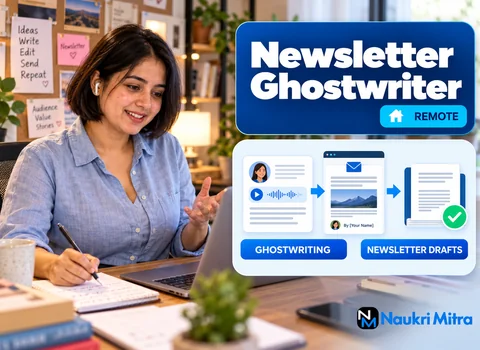
Every issue you write goes out under someone else's name. Readers reply to that person, forward that person's opinions to their teams, and sometimes tell them it is the one newsletter they still finish. None of them should be able to tell that somebody else drafted it. That invisibility is the work. In the family of online newsletter ghostwriter jobs, this post pays $30 per hour (USD) for part-time writing that you can do from any country. You turn a client's notes and voice memos into a weekly issue that reads as if they wrote it themselves.
The newsletter ghostwriter job description starts with listening. Before the first issue, you hold a voice interview, which is usually a recorded video call. You ask about their work, but you are listening for how they say things: the phrase they always start with, the word they use for customers, the way they hedge.
From that call you build a voice guide, a short living document in Google Docs. It holds two lists that matter more than anything else in the file. One is phrases they actually use. The other is phrases they would never use, which is often more revealing. A blunt operator might never write "I'm thrilled to share." A careful academic might never say "hack." Both lists grow every time feedback comes back.
Most weeks the raw material arrives messy: a voice memo recorded on a walk, three links and the line "something about why pricing pages lie," a forwarded thread. Your job is to find the one idea worth an issue.
Transcribe the memo, then read it for the sentence where the client's energy picks up. That is usually the thesis. Keep their examples, their numbers and their stories; cut your own cleverness where it competes. If the notes are too thin, ask a short, specific question rather than filling the gap with guesses.
A good newsletter has a shape readers learn to expect: one essay, or a short note followed by a few links with commentary. Agree the format early and keep it stable.
The opening carries most of the weight. Preview text in many inboxes shows only the first line or two, so that line has to sound like the client and give a reason to keep going. Write three openings and keep the one that sounds most like them talking.
Subject lines are their own small craft. You will often draft four or five per issue and let the client choose. They should match the client's register: a dry consultant does not suddenly start using emoji and capital letters.
Each issue usually ends with a call to action: reply with a question, book a call, share with a colleague. Keep it to one ask. Two competing requests tend to get neither, and the last line should sound like the client asking, not a sales page bolted on.
Drafting happens in Google Docs, where comments and suggestions are easy to trade. Once approved, you move the issue into the client's platform. On beehiiv or Substack that means headings, pull quotes, images with alt text, button links for the call to action, and a clean preview on mobile and desktop.
Send a test email to yourself before you schedule anything. Broken links and a stray heading size make a polished writer look careless. Some clients want you to schedule the send; others press the button themselves.
Feedback arrives as tracked changes, a voice note saying "too formal," or a single line reading "I'd never say this." Treat every note as voice data. When a client rewrites a paragraph, study what changed and update the voice guide.
Weekly deadlines hold the role together. A newsletter that ships on Tuesday one week and Friday the next loses readers. Agree a timeline with each client, for example notes by Monday, draft by Wednesday, final by Friday, and keep to it. If a client goes quiet, a polite nudge with a ready draft is better than a missed issue.
Many clients ask you to sign a non-disclosure agreement before the first call. Expect it and read it properly. Some forbid you from naming them at all, which affects how you build a portfolio. Ask in advance whether you may show an anonymised sample or describe the work in general terms.
Ghostwriting is a common, accepted practice for newsletters, and readers generally understand that a named author may work with help. The line you never cross is invention. Do not make up facts, statistics, testimonials, client wins or personal experiences the client did not have. If a story would make the issue better but it did not happen, it does not go in. The voice can be borrowed; the life behind it cannot be faked.
No degree is needed here. What counts is a portfolio of newsletters or other published writing. The newsletter ghostwriter skills that matter are excellent English, the ability to mimic how different people sound, solid copywriting and headline skills, and comfort with beehiiv, Substack and Google Docs.
Copywriting courses help, and a newsletter ghostwriter course that covers email and editing is a reasonable investment, but neither is required, and no single newsletter ghostwriter certification is recognised across the industry. If you are new, write sample issues for imaginary clients in two very different voices. A spec issue written as a gruff engineer, next to one written as a warm wellness coach, tells a client more than a certificate would. That is how to become a newsletter ghostwriter without a long track record: newsletter ghostwriter jobs for freshers are won on samples and reliability.
A copywriter writes for a brand, usually to sell something, and the voice belongs to the company. A ghostwriter writes as a person. The newsletter has to carry that person's opinions, doubts and quirks, and the goal is trust built week after week rather than a single conversion.
The skills overlap: tight sentences, strong subject lines, clear calls to action. The difference is who takes credit and how much listening comes before writing.
Freelance newsletter ghostwriter jobs turn up on Contra and Upwork, among other sites. Search for terms like "newsletter writer" or "LinkedIn and newsletter ghostwriter," and pitch with a short note that references the client's existing content and offers a sample opening in their voice. Fees and rules on these sites are rewritten now and then, so never build the whole practice on one of them.
Your first client often comes through people you already know, such as a consultant who keeps meaning to start a newsletter. One paid trial issue at your normal rate is a clean way to start.
It can be, for writers who are reliable and patient. Newsletters recur, so one good fit can mean regular weekly work and referrals. At $30 per hour, part-time, your earnings track the hours clients actually need each week, which vary. Nothing here guarantees hours or income, and clients pause or bring writing in-house.
Transcription apps or a premium writing assistant are costs you would normally carry yourself. If you use AI tools to help transcribe or tidy notes, check each client's policy and the tool's current terms first; some clients forbid it entirely. What lasts is the skill: hearing a person clearly enough to write as them, every week, from home or anywhere else.