
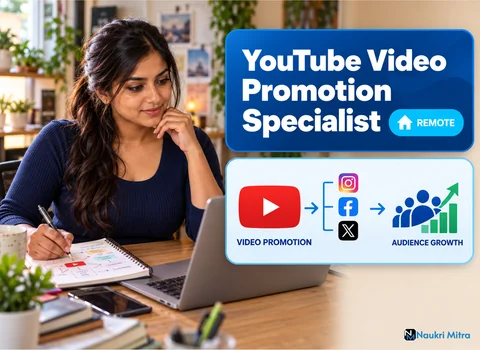
Two campaigns can spend the same budget on the same upload and tell opposite stories. One buys a pile of cheap views from people who skip at second five. The other buys fewer, from viewers who stay for half the video and come back for the next one. The gap rarely comes down to luck; it comes from the goal agreed with the client, the audience chosen and someone watching the numbers once ads go live. This listing is for online youtube video promotion specialist jobs: part-time, open to any country, with an hourly rate of $18 in USD, setting up and running Google Ads video campaigns for creators' uploads and reporting what the spend actually bought.
A campaign starts with a question to the client, not a click: what should this money do? More views on one upload, more subscribers or traffic to a product page are different goals, and the goal shapes which formats and bid strategies Google Ads offers. Settle it in writing first.
Formats come next. Described broadly, there are three you will use most:
Google renames and reshuffles campaign subtypes periodically, so trust what the account shows today over an old tutorial.
Targeting is where most wasted budget comes from. You can aim ads by topics (the subject of the content being watched), interests and life events, keywords related to what people search and watch, and demographics such as age range and household details where available.
The careful habit: stack fewer layers at first, note why each one is there, and exclude what obviously does not fit. A cooking channel advertising a budget recipe series has no reason to show up beside children's cartoons, and content exclusions exist for exactly that.
The client sets the total; you translate it into a daily budget plus a bid strategy. Depending on the goal, you may see cost-per-view bidding, impression-based bidding or conversion-focused options. Start conservative. A small daily cap for the first few days shows what views cost in that niche.
Always set the end date when the client has a fixed budget. Then confirm daily cap, end date and expected total back to the client in one message. That prevents most billing arguments.
The client owns the Google Ads account and the payment method. You never run their spend on your own card or accept a password. The client invites your email to their Google Ads account through its access settings, at a level that lets you build and edit campaigns. The YouTube channel is then linked to that ad account, which the channel owner approves. Linking matters because it lets you pick the client's uploads as ads and feeds paid viewer data into their channel reporting.
When the contract ends and access is removed, everything stays with them, which is how it should be.
Once ads are live, the first few days are for watching, not tweaking. The numbers you track are views, cost per view, view rate (how many impressions became views), and how much of the video paid viewers actually watched.
Cheap views with almost no watch time are a warning sign, not a win. They usually mean the targeting is too loose or the placement put the ad in front of people with no interest. A higher cost per view from viewers who stay through half the video is often the better buy.
After enough data comes in, you adjust. Pause audience segments that spend without watching. Shift budget towards the ones holding attention. Raise a bid slightly if the campaign is not spending at all; lower it if views cost more than the client agreed to pay. Adjust a single setting per round and note the date, otherwise nobody can tell which change did what.
Sometimes the problem is the video itself. If every audience skips at the same moment, tell the creator the opening needs work. No bid fixes a slow hook.
A promotion report that shows only ad numbers is half a report. Pull the ads data, then open YouTube Studio and show what happened organically in the same period: traffic sources, where paid views appear as advertising traffic, plus subscribers gained and changes in browse and suggested traffic. vidIQ can help you compare the promoted upload against the channel's usual performance.
Be blunt in the write-up. If organic traffic did not move, say so. If the paid viewers watched for a few seconds and left, say that too. Creators can tell when a report is dressing up spend.
This youtube video promotion specialist job description is short on paperwork: basic Google Ads experience is required, while a degree is not. Expect to show familiarity with video campaign formats, audience targeting and budgets, and comfort reading analytics in YouTube Studio and vidIQ. The Google Ads Video certification helps and is free through Skillshop, Google's training site. It shows clients you know the platform's vocabulary, though it cannot replace hands-on work. Good English for client updates and a steady internet connection round it out.
The core youtube video promotion specialist skills show best in practice, so on a resume a short case write-up beats a list of tools: the goal, the format and targeting you chose, what you changed after the first week and what happened. Interviewers tend to probe judgement, such as what you would do with views that cost almost nothing but get no watch time.
A YouTube SEO specialist works on titles, descriptions, tags and topic choice so videos get found without paying for it. A promotion specialist pays for attention through Google Ads and is judged on what each dollar bought. The skills overlap, since both read the same analytics, but the risk differs: SEO mistakes cost reach, while promotion mistakes cost the client money directly. Many creators hire both, and an SEO person who learns ad buying can offer clients both services.
Your time is billed at $18 per hour (USD). As youtube video promotion specialist work from home, it is part-time with no fixed weekly hours; volume rises and falls with clients and campaigns. Fiverr and Upwork both list freelance youtube video promotion specialist jobs. Some sellers there promise view counts, so stand out by promising a process instead: setup, a test phase, adjustments and an honest report.
For a first client, offer a small, capped test campaign on a channel you already know, perhaps a friend's or your own, using real money at a level you can explain. Document every setting. That record becomes your first case study, and it is how to become a youtube video promotion specialist when nobody has hired you yet. It is also why youtube video promotion specialist jobs for freshers exist at all.
Plenty of services sell "promotion" that is really views from bots, click farms or pop-under traffic. That violates YouTube's fake engagement policy, and the consequences can include removed views, removed videos or penalties against the channel. It also wrecks the channel's retention data, because fake viewers do not watch.
The test is simple. Real promotion runs through the ad platform, the client pays Google directly, and every view appears in the Google Ads report and as advertising traffic in YouTube Studio. Anyone offering a guaranteed view count for a flat fee, with no ad account involved, is not selling promotion. Neither is this role.