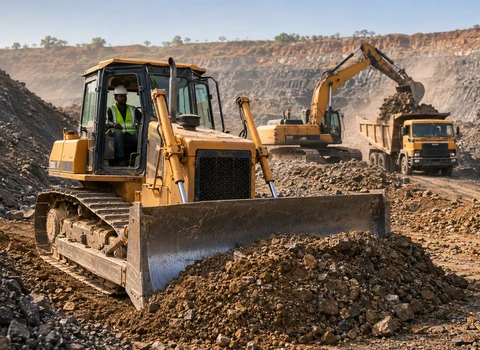
What Does a Dozer Operator Actually Do at a Mining Site?
A Dozer Operator is a heavy equipment professional who handles bulldozers to move earth, rock, and overburden at open-cast mining locations. This
Dozer Operator Required for Surface Mining Site position is a Full-time opportunity based in Korba, Chhattisgarh, India, and it plays a direct role in keeping extraction operations running smoothly. Unlike office-based roles, this job demands physical presence at the mining face, working closely with excavators, dumpers, and drilling teams to prepare the ground for coal or mineral extraction.
Why Mining Companies Depend on Skilled Dozer Operators
Surface mining, also known as open-cast mining, involves removing large volumes of soil and rock to reach mineral deposits underneath. Without a dozer clearing paths, leveling haul roads, and pushing loose material, other machinery cannot function efficiently. This is why operators with steady hands and sound judgment are always in demand across coal belts like Korba, one of Chhattisgarh's major coal-producing regions.
Typical Daily Work on the Job
A regular shift usually starts with a walk-around inspection of the machine before ignition. Operators then move to assigned work zones where tasks may include:
- Clearing topsoil and vegetation before excavation begins
- Pushing and leveling overburden material
- Building and maintaining temporary haul roads inside the pit
- Ripping hard or compacted ground using the dozer's rear attachment
- Assisting excavator and dumper crews by keeping work areas accessible
Work is guided by site supervisors and mining engineers who mark grading levels, so operators need to read simple site instructions and follow directional signals accurately.
Machines and Instruments Used in This Trade
The core equipment is a crawler-type bulldozer fitted with a front blade and, in many cases, a rear ripper attachment. Operators also get familiar with:
- Track undercarriage systems suited for uneven mining terrain
- Hydraulic blade controls for angling and tilting
- Basic gauges for engine temperature, fuel, and hydraulic pressure
- Two-way radios for coordination with the pit supervisor
Some larger mining sites are gradually introducing GPS-assisted grading systems, so exposure to digital display panels is becoming a useful additional skill, even though manual operation remains the industry standard in most regions.
Skills That Make an Operator Reliable
Technical ability alone is not enough on a mining site. Employers usually look for a mix of machine-handling skills and workplace discipline. An ITI qualification in a trade such as Heavy Earth Moving Machinery, Mechanical, or Diesel Mechanic is commonly preferred, though a Diploma in Mining or Mechanical Engineering can also be suitable depending on site requirements. Hands-on familiarity with track machines, basic understanding of grading levels, and comfort working around moving equipment often matter as much as formal certificates.
Practical Workplace Skills
- Judging slope and depth visually without constant supervision
- Basic troubleshooting of minor engine or hydraulic issues
- Communicating clearly with ground staff and other operators
- Staying alert during dust, low visibility, or night operations
Physical Demands and Shift Patterns
This is a physically engaging role that requires sitting for long hours while managing constant vibration and machine movement. Full-time shifts are standard, and mining operations often run on rotational schedules, so operators should be prepared for early-morning, evening, or occasional night duty depending on production targets.
Working Environment and Safety Culture
Surface mining sites involve dust, noise, uneven ground, and proximity to other heavy vehicles. Because of this, safety is treated seriously. Operators are generally expected to use PPE such as safety helmets, high-visibility vests, safety shoes, and hearing protection. Following speed limits inside the pit, using seatbelts, and respecting exclusion zones around blasting areas are standard safety practices at most mining operations.
Common Challenges Operators Face
New operators sometimes struggle to judge depth on sloped terrain or to work during monsoon months when ground conditions become soft. Dust in summer and reduced visibility during early-morning shifts are other realistic challenges that come with the job in this region.
Tips for Building a Strong Reputation on Site
Operators who consistently inspect their machine before starting work, report unusual sounds or vibrations early, and maintain smooth, controlled blade movements tend to be trusted with more responsibility over time. Patience during difficult ground conditions is often what separates an average operator from an experienced one.
Growing Within the Same Profession
With consistent performance, operators can progress toward handling larger dozer models, take on ripping and grading tasks that require more precision, or move into a senior operator role that involves guiding newer team members on site procedures.
Salary Expectations for This Role
This Dozer Operator position in Korba, Chhattisgarh offers a monthly salary of ₹40,200 for a Full-time role, which is a reasonable starting point for operators with relevant machine-handling experience in the surface mining sector.
Possible Employee Benefits
Depending on the employer, workers in similar mining roles may also receive additional benefits such as overtime pay, Provident Fund (PF), ESI coverage, annual bonus, uniforms, and transport or canteen facilities. These vary by organization and are not guaranteed as part of every position.