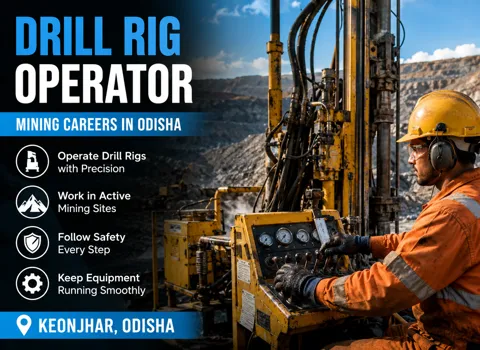
What It Actually Takes to Run a Drill Rig on a Mine Site
Walk onto almost any active mine in Odisha, and you'll hear it before you see it — the steady grind of a drill rig chewing through rock. That machine and the person controlling it set the pace for everything that happens afterward on site. This particular opening is for a Drill Rig Operator, full-time, based in Keonjhar, Odisha, paying ₹42,800 a month. It's physical work, it's outdoors, and it rewards people who can stay sharp through a long shift.
The job itself comes down to this: boring holes into rock or ore-bearing ground so that blasting crews, geologists, or ground-support teams can do their part next. Get the depth or angle wrong and the whole chain slows down, sometimes dangerously. That's really why this role carries weight on a site — not because the title sounds important, but because everyone downstream is waiting on accurate holes.
Where the Demand Comes From
Keonjhar sits in one of Odisha's more active mineral belts, and open-cast iron ore and chromite operations here don't run themselves. Somebody has to be at the controls, reading the rock, adjusting for hard patches, keeping the pattern tight. Mines can bring in geologists and blasting engineers, but none of that matters if the holes underneath their plans aren't drilled properly. That's the gap this role fills, and it's why sites keep hiring for it season after season.
Walking Through a Shift
Most days start with a toolbox talk and a walk-around inspection before the rig even moves. Once cleared, the operator lines up the machine against the drilling pattern marked out by the survey team, then starts boring. It's not a set-and-forget job — pressure, rotation speed, and bit wear all shift as the rock changes underneath, so there's constant small adjustment happening. Finish one hole, reposition, start the next. Repeat across the pattern until the shift's target is met.
What the Work Actually Involves
- Running percussion or rotary drill rigs to spec, hole after hole
- Following the drilling pattern handed down by supervisors or survey staff
- Watching depth, hydraulic pressure, and bit condition through the shift
- Flagging anything unusual — a fault, a soft patch, a hard seam — right away
- Handling routine upkeep like lubrication and bit swaps
- Staying in sync with the blasting and geology teams so drilling lines up with the mine plan
The Kind of Sites This Role Shows Up On
Iron ore mines, chromite operations, and manganese pits across Odisha's belt all need operators like this. It's not limited to mining either — quarries and large construction sites use the same core skill set before laying foundations. Wherever the work happens, expect dust, heat, noise, and on some rigs, time spent on an elevated platform.
Equipment You'll Be Handling
Depending on rock type, the machine could be a rotary rig, a percussion drill, or a down-the-hole (DTH) hammer. Alongside it, operators rely on depth gauges and pressure meters, as well as hand tools for bit changes and light servicing. Most rigs today run on hydraulics, so smooth, controlled handling matters — jerky inputs are one of the fastest ways to knock a hole off line.
Skills That Separate a Good Operator from an Average One
Knowing the machine is only half of it. The better operators can read what the rock is doing in real time and adjust before a problem shows up, rather than after. Patience counts for more than people expect — rushing a hole to save five minutes tends to cost far more later. A bit of mechanical sense helps too, since catching a small issue early usually prevents a bigger breakdown down the line.
Training and Background That Helps
An ITI in a mechanical or fitter trade is a common starting point for this line of work, and a diploma in mining or mechanical engineering opens doors toward supervisory roles later on. That said, hands-on exposure to drilling equipment, safety routines, and basic engineering drawings often counts for just as much as the certificate itself. A lot of what makes someone good at this job is learned standing next to the rig, not in a classroom.
The Physical Side of the Job
Expect to be on your feet, climbing onto rig platforms, and handling equipment for stretches at a time — this isn't a desk job by any stretch. Shift work is standard across most mining operations, with day and night rotations to keep output steady. Odisha's open-cast sites also mean working through heat, dust, and the occasional monsoon disruption, so some tolerance for rough conditions goes a long way.
Staying Safe on Site
Mining doesn't leave much room for shortcuts on safety. Helmets, goggles, ear protection, gloves, and steel-toe boots are standard PPE, worn without exception. Lock-out steps before any maintenance, staying clear of blast exclusion zones, and reporting hazards the moment they're spotted are just part of how the day runs. Toolbox talks and safety drills tend to be routine rather than occasional.
The Rough Patches Nobody Mentions Upfront
Rock doesn't always behave the way the geology report says it should, and that alone can throw off a schedule. Equipment breaks down, sometimes far from a workshop. Monsoon season brings its own delays. None of this is unusual — it's just part of the job — but it helps to go in expecting it rather than being caught off guard.
Where This Role Can Lead
Operators who stick with it and build a track record often move into senior operator positions, shift-in-charge roles, or drilling supervisor responsibilities — usually with better pay and more say in how the site runs. Staying current with newer rig technology and updated safety practices tends to be what pushes someone toward that next step.
On Pay and What Else Might Come With It
The role pays ₹42,800 a month, full-time, based in Keonjhar, Odisha. Beyond the base salary, some employers add overtime pay, PF, ESI coverage, bonuses, uniforms, or transport and canteen facilities — none of this is guaranteed across the board, so it's worth confirming directly with the employer during hiring.
If heavy machinery and outdoor technical work appeal to you, this is a role with steady demand and a real path forward inside India's mining sector — not just a job to get through, but one that can turn into a long-term trade.