What Happens Inside a Mineral Processing Plant
Before ore or raw mineral can be sent for smelting or refining, it has to be broken down into a manageable size. That job falls to the crushing section of a mineral processing plant, and the person running it is the Crusher Plant Operator. There is a Full-time opening for this role in Jajpur, Odisha, India, paying ₹36,200 a month. If you've never worked around heavy crushing machinery before, here's a realistic look at what the job actually involves.
Why This Position Exists
Jajpur has a long history tied to mining and mineral-based industry, and plants in this belt depend on a steady, well-managed crushing process. If the crusher runs too fast, jams, or produces uneven output, everything downstream slows down or suffers. So plants need someone on the floor who actually understands how the machine behaves, not just someone pressing buttons. That's the gap this role fills.
A Shift on the Crushing Floor
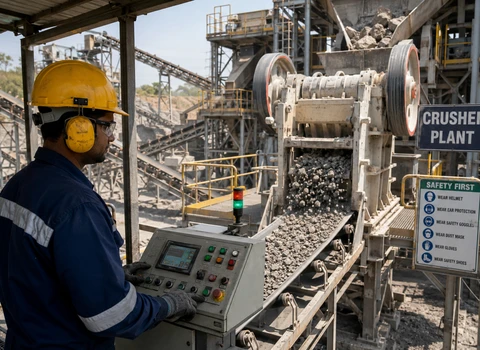
Most days start the same way: a walk around the crusher and the feed system, checking that nothing looks off before startup. Once the unit is running, the work becomes a mix of watching and adjusting. An operator keeps an eye on how fast material is being fed in, checks that the crushed output is the right size, and listens for sounds that don't belong. When a blockage happens — and it will, sooner or later — clearing it safely without damaging the crusher becomes the priority. By the end of the shift, there's usually a log to fill out and any issues to hand over to the next operator or the maintenance team.
The Machines You'll Actually Work With
The exact machine you end up on depends on the plant — some run jaw crushers, others use cone or impact crushers instead. Around the main unit sit vibrating screens, feeders, and conveyor belts that move material through the process, along with dust suppression systems that keep airborne particles down. For monitoring, operators use tools like pressure gauges, tachometers, and belt scales, and increasingly, plants are shifting to PLC-based control panels instead of purely manual controls. Knowing how to read these instruments matters just as much as knowing how to operate the crusher itself.
What Separates a Good Operator from an Average One
Anyone can start a machine. Running it well is different. A few things tend to separate operators who last in this field from those who don't:
- A working understanding of how feed rate affects crush size and output quality
- The instinct to catch small mechanical problems before they turn into shutdowns
- Comfort reading control panel data and reacting to it quickly
- Physical stamina, since the job involves standing, climbing, and staying alert for long stretches
Training and Background That Helps
Employers hiring for this kind of role often look favorably on candidates with an ITI qualification in a mechanical or fitter trade, or a Diploma in Mechanical Engineering. That said, formal education isn't the whole story. Hands-on time around industrial machinery, some familiarity with engineering drawings, and basic comfort using precision measuring instruments can carry as much weight as a certificate, particularly for someone coming from a workshop or tool room background rather than a classroom.
Where You'll Be Standing Most of the Day
This work happens inside mineral processing plants and ore beneficiation units, usually as part of a larger mining or metal-processing operation. It's not an office job or even fully indoor work in most cases — expect a plant-floor environment with a fair amount of dust, vibration, and machine noise as background conditions rather than exceptions.
What the Job Asks of Your Body
There's no getting around it — this is physically demanding work. You'll be on your feet for most of the shift, climbing platforms to check equipment at height, and staying alert even during repetitive stretches of monitoring. Some plants run rotating shifts, including night shifts, since crushing circuits often need to keep operating around the clock.
Staying Safe Around Heavy Equipment
Crushers don't forgive carelessness, so safety habits matter more here than in most industrial jobs. Lockout-tagout procedures should be followed every time before maintenance checks; moving conveyor belts need to be given a wide berth; and safety guards are never to be bypassed for convenience, even when it seems faster. On the PPE side, expect to wear a safety helmet, ear protection, a dust mask or respirator, safety goggles, gloves, and steel-toe shoes as standard.
What Trips Up New Operators
The noise and dust catch most newcomers off guard in the first few weeks. Beyond that, the real learning curve is in handling material blockages calmly and keeping output size consistent when the feed isn't uniform — raw ore rarely behaves predictably. Operators who stick with it usually say the difference between year one and year three is being able to spot a problem from a sound or a vibration before the control panel even flags it.
Growing Within the Same Line of Work
Most people don't walk in as a senior operator. You typically start in a junior or assistant capacity, learn the equipment properly, and build up from there. Over time, that experience can lead to a senior operator position, a shift supervisor role, or a move toward plant maintenance coordination — all within the same mineral processing environment. What moves that progression along faster than anything else is a clean safety record and a reputation for catching problems early.
What the Salary Looks Like
This Full-time role in Jajpur, Odisha, India comes with a monthly salary of ₹36,200. On top of that, some employers in this sector offer additional benefits such as overtime pay, PF, ESI, bonuses, uniforms, or transport and canteen facilities — though these vary from company to company and shouldn't be assumed as guaranteed.
If You're Just Starting Out
Freshers, ITI candidates, and diploma holders looking to break into this field will benefit from any workshop exposure or internship time spent around industrial machinery, even if it wasn't specifically crushing equipment. For those already experienced in other machine-operating roles, it's worth highlighting any background with heavy equipment, control panels, or production monitoring when applying. Beyond qualifications, what tends to matter most on the floor is a steady temperament, genuine interest in how the machinery works, and a habit of taking safety seriously from day one.