What Does a Rock Breaker Operator Actually Do?
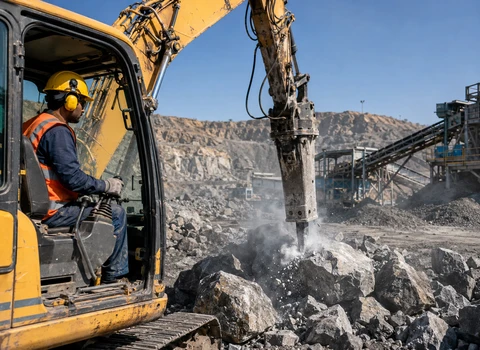
Walk into any active quarry or mining crusher yard, and you'll notice something quickly: not every boulder that comes out of a blast fits through the crusher intake. Someone has to break those oversized rocks down first. That's the job of a Rock Breaker Operator - running a hydraulic breaker attachment, usually mounted on an excavator boom, to smash large stones into pieces small enough for the primary crusher to handle.
It sounds simple on paper. In practice, it takes a fair amount of judgment, mechanical awareness, and patience to do it well, shift after shift.
The Reason This Role Exists on a Mining Site
Crushers are expensive, and they're not built to accept boulders of every size. If an oversized rock jams the hopper or gets fed into the crusher anyway, it can crack liners, damage jaw plates, or stall the whole line for hours. So instead of risking that, mining and crushing operations keep a dedicated breaker running near the feed point, clearing the bottleneck before it becomes one. Without this position, production simply slows down or grinds to a halt every time a big rock shows up.
A Shift on the Job
An operator generally starts by checking the machine over - hoses for leaks, the chisel tip for wear, oil levels, mounting bolts. Skipping this step and finding out mid-shift that a hydraulic line is weeping is a mistake nobody wants to make twice.
Once cleared, the operator moves the unit toward the stockpile or hopper area where oversized material has been set aside, and gets to work. It's not just mindless hammering - reading how a rock is likely to split, angling the chisel along a natural fracture line, and knowing when to reposition rather than force a strike are things that separate someone efficient from someone who burns through tips and hours getting the same result.
What fills most of the day:
- Breaking oversized boulders down to crusher-feed size
- Pre-shift inspection of hydraulic lines, chisel condition, and bolts
- Clearing blockages at the grizzly screen or crusher inlet
- Flagging odd noises, vibration, or pressure drops to maintenance before they turn into breakdowns
- Keeping a basic record of running hours and tonnage handled
Where You'll Find This Kind of Work
This role turns up wherever rock is being extracted and processed at scale - open-cast mines, stone quarries, and aggregate crushing units. Karnataka's Bellary belt, long known for its iron ore and stone mining activity, is one such region where crushing operations regularly run and need operators for this exact function.
The Equipment You're Working With
The core piece of equipment is the hydraulic rock breaker itself - a boom-mounted attachment that delivers rapid, forceful blows through a tungsten-carbide chisel tip. Since most breakers are mounted on excavator bases, a working knowledge of excavator controls matters just as much as understanding the breaker mechanism. Day to day, operators also handle grease guns for lubrication points and keep an eye on hydraulic pressure gauges, since a sudden pressure drop is often the first sign something's wrong before it becomes visible on the outside.
Skills That Actually Matter Here
Formal training helps, but it's the combination of mechanical understanding and field experience that makes someone good at this. ITI graduates from mechanical or heavy equipment trades tend to pick things up faster because they already understand hydraulic principles, but plenty of capable operators have built their skill purely through time spent on-site.
What tends to matter most:
- Judging a rock's grain and fracture pattern before striking
- Basic diagnosis of hydraulic leaks or pressure loss
- Timing movement around loaders, dumpers, and other equipment working the same area
- Staying focused and steady through dust, heat, and constant noise
The Physical Side of the Job
This isn't desk work. Long hours in an operator cabin, repeated hand and foot movement on controls, and constant exposure to vibration take a toll over time. Weather doesn't pause for production targets either - operators work through heat, dust storms, and occasionally rain, depending on the season. Shift rotations are common at sites running extended production hours, so flexibility around timing is worth expecting going in.
Staying Safe Around Heavy Rock and Machinery
Flying rock chips, swinging booms, and heavy vehicle movement mean safety can't be an afterthought here. Operators are expected to keep clear distances from ground crew, follow signal protocols during coordinated lifts or clearing operations, and stick to lockout procedures whenever maintenance work is underway nearby.
Standard protective gear on site usually includes:
- Safety helmet
- Ear protection
- Safety goggles
- High-visibility vest
- Steel-toe boots
- Dust mask
What Makes the Job Hard on a Bad Day
Dust is probably the most constant irritant - it gets into everything, and visibility can drop fast during peak crushing hours. Heat during summer months adds to the fatigue, and the continuous vibration from breaker operation isn't something you fully get used to, even after years on the job. There's also a quieter pressure most operators feel: balancing output speed against wear on the chisel tip and hydraulic system, since pushing too hard just means more downtime later.
Where Experience Can Take You
Operators who stick with it and build a solid track record often move into senior equipment operator roles or shift supervisor positions within the same crushing or mining unit. Some cross-train onto excavators or other heavy machinery altogether, which opens up more flexibility across the site. Mechanical aptitude and a record of reliable, low-downtime operation tend to be what gets noticed when these openings come up.
Pay and What's Realistic to Expect
This is a full-time position based in Bellary, Karnataka, and it pays ₹38,400 a month. Beyond the base salary, some employers offer overtime pay, PF and ESI coverage, bonus payouts, uniforms, or transport and canteen facilities - though these vary from company to company and shouldn't be assumed as fixed benefits.
Getting Ready to Apply
If you're just starting out, completing an ITI course in a mechanical or heavy equipment trade will put you ahead of other freshers applying for similar roles. If you already have hands-on hours on a hydraulic breaker or similar boom-mounted attachment, make sure that shows clearly when you apply - in this line of work, practical time on the machine often counts for more than the certificate on paper.